
Reviewed · ANGKOR TEMPLE TOURS
Phnom Bakheng Sunset Tour, Pre Rup, Neak Pean, Preah Khan
Phnom Bakheng is the grand finale here, but the best part of this six-hour outing is the mix of temple styles and eras before sunset. You move from Pre Rup’s brick temple mountain to Neak Pean’s island shrine, then on to the tree-root drama of Preah Khan. I like that variety, and I like the human touch from guide Son, whose clear English and explanations of Hinduism and Buddhism add useful meaning to the stones.
The tour also keeps things easy with hotel pickup, cold water, local snacks, and a driver. The main caution is the 200-step climb at Phnom Bakheng, which can feel demanding after several temple stops and is not suitable for pregnant women.
Key points at a glance
- Pre Rup sets the historical tone: See a 10th-century Hindu temple mountain built for King Rajendravarman.
- Neak Pean changes the scenery: Reach an artificial island in the Jayatataka Baray for one of Angkor’s most unusual settings.
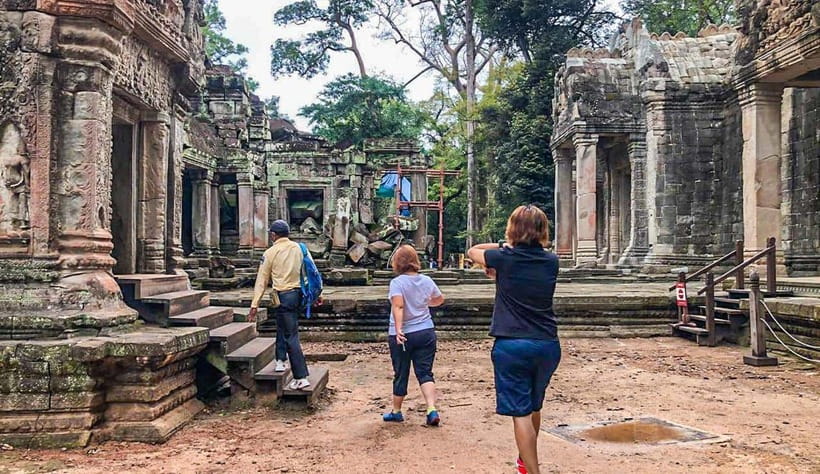
- Preah Khan brings the drama: Walk among crumbling stone and tree roots at the largest temple on this route.
- Son adds useful context: Expect English explanations that connect Hindu and Buddhist ideas to what you see.
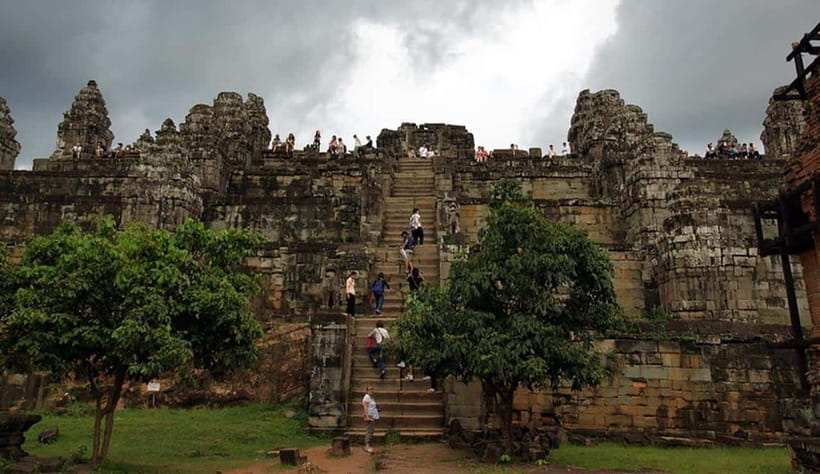
- Phnom Bakheng requires effort: You climb 200 steps to reach the sunset viewpoint.
- The $55 price is not the full cost: Add the $37 temple ticket, while lunch remains separate.
Why this temple route works so well
Many Angkor outings focus on the familiar central temples. This one takes a different path, linking four sites that give you a broader sense of Khmer religious architecture. You see an early Hindu temple, a later Buddhist-era water complex, a large royal temple with trees growing through its masonry, and an older hilltop shrine saved for sunset.
That sequence matters. Instead of seeing four similar ruins, you get clear changes in shape, setting, and mood. Pre Rup is built upward in strong tiers. Neak Pean is reached across water. Preah Khan spreads through a large maze of galleries. Phnom Bakheng asks you to climb for the view.
I also like the afternoon start. Meeting your guide and driver at your hotel at 12:30 pm gives you a manageable half-day rather than a dawn-to-dusk temple marathon. You should return to Siem Reap around 7:30 pm, so this tour occupies most of the afternoon and early evening without taking your entire day.
The tradeoff is that the schedule is built around sunset. Your time at each earlier temple may feel purposeful rather than leisurely, especially if you like to linger over every carved doorway. This is a good choice for variety and a planned finish, not for an unhurried archaeological study.
More Angkor Temple Tours in Siem Reap:
- Siem Reap Tour: Angkor Wat Sunrise, Bayon, Ta Prohm, Banteay Srei
★ 5.0 · 931 reviews - Siem Reap: Bike the Angkor Temples – Full-Day 30km Tour
★ 5.0 · 463 reviews - Angkor Wat one Day Private Tour for All Highlight Angkor Temples
★ 5.0 · 199 reviews
Pre Rup and the power of a temple mountain
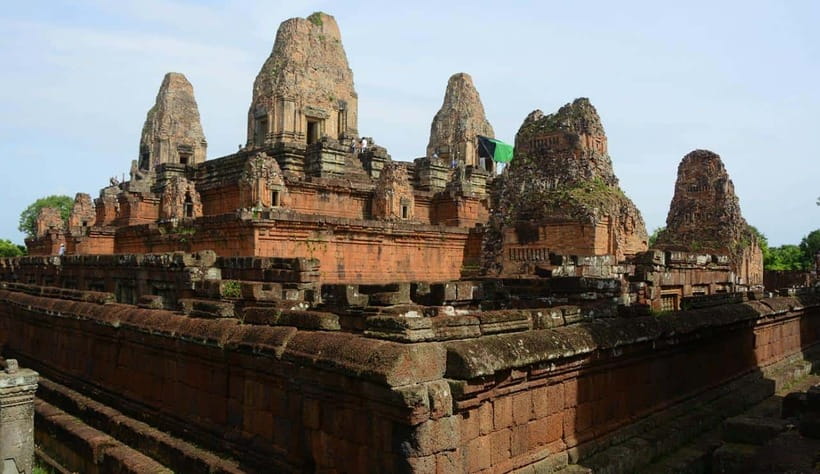
Your first stop is Pre Rup, a Hindu temple built by Khmer King Rajendravarman and dedicated in 961 or early 962. It served as the king’s state temple, and its design reflects the Khmer idea of a sacred mountain made in stone.
Pre Rup combines brick, laterite, and sandstone. That mixture gives the temple a warmer, earthier look than the all-stone buildings many people associate with Angkor. The upper levels rise above the surrounding ground, so even the approach helps you understand the basic idea: royal power and religious order expressed through height.
I would pay attention to the building materials here. The brick sections and laterite structure are not minor details. They show how Khmer builders used different materials for different parts of a temple, while sandstone supplied harder, more decorative surfaces.
Pre Rup is also a useful opening stop because it introduces Shiva worship and Hindu temple planning before you reach the later sites. A good English-speaking guide can point out how the temple’s layout and vertical form connect to Hindu beliefs. Son has been praised for explaining both Hinduism and Buddhism in a way that works for adults and children, so this is a place where his guidance can make the architecture easier to read.
You will want sensible footwear. The climb is not described as a major stair challenge, but the temple mountain form means uneven ground and elevated levels. Take your time, especially if you are saving energy for Phnom Bakheng.
Neak Pean, a shrine surrounded by water
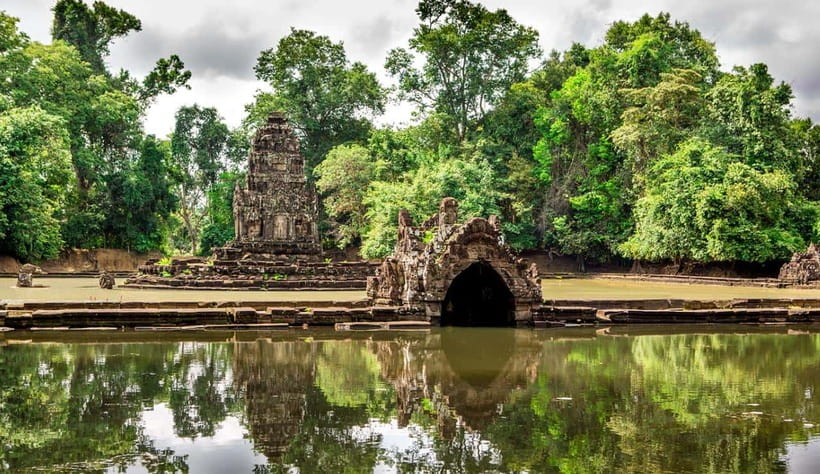
Next comes Neak Pean, an artificial island with a Hindu temple on a circular island in the Jayatataka Baray. It was built in the 12th century, and its setting gives you a sharp change from Pre Rup’s dry, rising brick structure.
The approach across the water is part of the appeal. Neak Pean does not announce itself as a huge pile of stone. Instead, the temple sits within a carefully planned water setting, making the relationship between shrine and reservoir central to what you see.
The site is valuable because it shows that Angkor was not only about towers and carved walls. Water management and sacred design were closely connected. Jayatataka Baray is an artificial reservoir, and the island temple gives the visit a more composed, almost symbolic quality.
I would not expect Neak Pean to take as long as Preah Khan. Its importance comes from the unusual arrangement rather than sheer size. This makes it a smart middle stop in the tour. You get a quieter visual pause before entering the much larger temple complex that follows.
Stay close to your guide here. An island shrine can be harder to understand at a glance than a tall temple mountain. Son’s explanations about Hindu and Buddhist traditions can help you see why water, islands, and sacred structures were placed together.
Preah Khan and the beauty of controlled ruin
Preah Khan is the largest temple on this route. King Jayavarman VII built it to honor his father, and it lies northeast of Angkor Thom. After the compact form of Neak Pean, Preah Khan gives you room to explore.
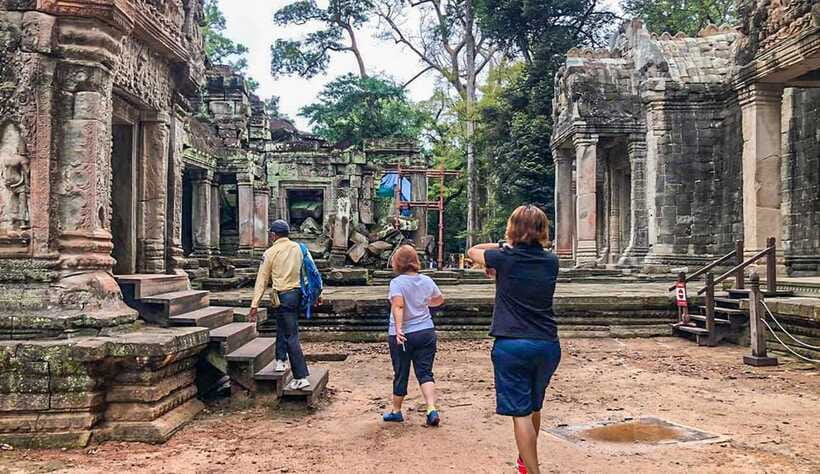
This is the stop where the atmosphere changes most. Tree roots and crumbling stone create the familiar Angkor look, but Preah Khan is not simply a photogenic ruin. Its scale and layered corridors show how much activity once took place within the complex.
The mix of surviving walls, open sections, and roots makes every turn different. You might find one passage framed by stonework, then another where nature has become part of the structure. I like this contrast because it lets you see both the skill of the original builders and the long effects of time.
Preah Khan also gives your guide more to explain. Jayavarman VII is associated with a later period of Khmer building, and the temple’s Buddhist connections make a useful comparison with the Hindu focus of Pre Rup. The tour description specifically includes both religious traditions, and Son has been noted for making those connections clear.
Families may appreciate this stop most. The scale, corridors, and changing views can give children more to notice than a single compact shrine. One family booking specifically found that the children had fun, while the guide offered useful explanations without making the visit feel like a classroom.
Do not rush through the roots for a photograph and move on. Look at how the trees interact with the masonry, but also pause to notice the temple’s repeated spaces and long internal movement. Preah Khan rewards a little patience, even on a schedule.
More Sunset Tours in Siem Reap:
- Angkor Wat Sunrise or Sunset Tour with Guide from Siem Reap
★ 5.0 · 12,109 reviews - Siem Reap: Angkor Wat: Small-Group Sunrise or Sunset Tour
★ 5.0 · 9,444 reviews - Sunset tour of Kampong Phluk stilts home village on the Tonle Sap
★ 5.0 · 4,865 reviews - Siem Reap: Angkor Wat 2-Day Tour with Sunrise and Sunset
★ 4.9 · 4,429 reviews
Phnom Bakheng and the sunset finish
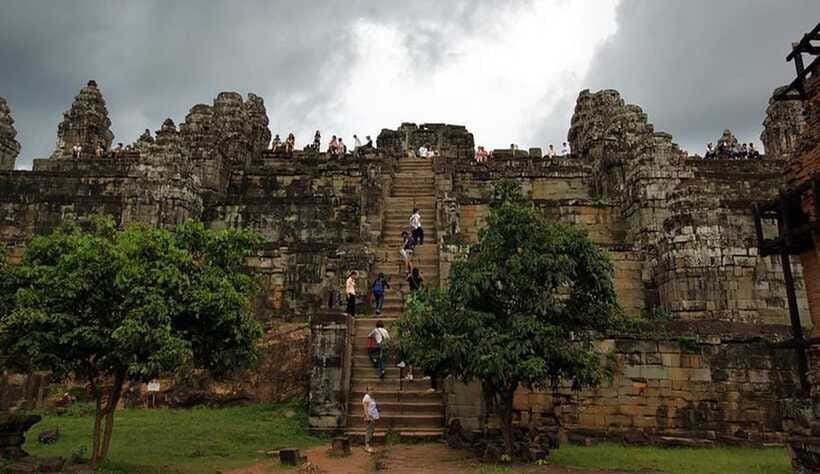
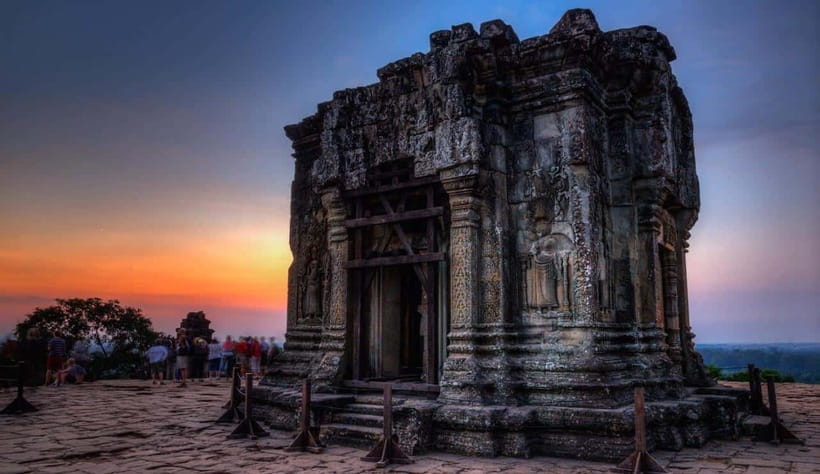
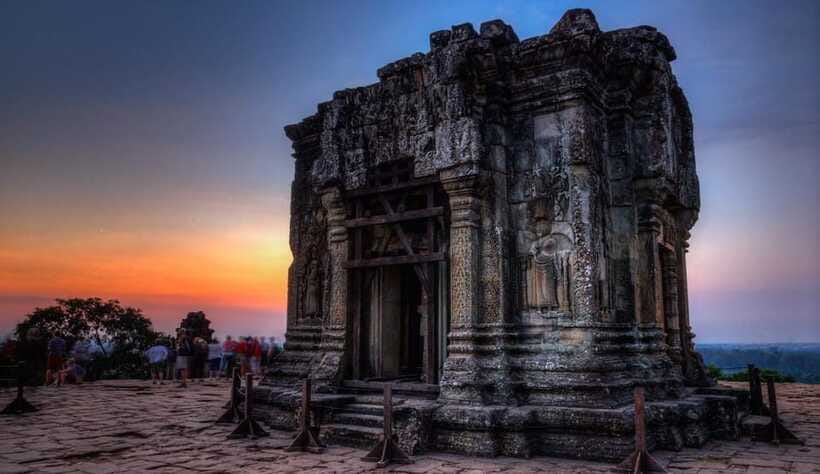
The final stop is Phnom Bakheng, a Hindu temple in the form of a temple mountain dedicated to Shiva. It was built at the end of the 9th century during the reign of King Yasovarman.
The sunset viewpoint is the emotional finish of the tour, but it comes with a clear physical requirement: you climb 200 steps to reach the top of the hill. That detail should shape your decision. If stairs are difficult for you, the final stop may be uncomfortable. Pregnant women should not book this activity according to the stated safety guidance.
For those able to make the climb, the reward is a high viewpoint at the close of a temple-filled afternoon. After examining individual buildings at ground level, you get a broader view from above. The shift helps you think about Angkor as a connected royal and religious zone rather than a series of isolated monuments.
The timing is practical. You leave Siem Reap at 12:30 pm, visit three major sites, and then arrive for the sunset portion before returning around 7:30 pm. Exact sunset conditions are not guaranteed, of course, but the tour is designed to place this final view at the end of the day.
Bring water even though cold water is supplied. The climb, warm weather, and earlier walking can add up. Wear shoes that feel secure on steps and uneven temple ground. Local snacks are included, but they do not replace lunch, so eat before pickup or arrange lunch separately.
Guide Son and the value of a good explanation
The strongest praise attached to this tour centers on guide Son. He is described as professional, kind, polite, and fluent in English, with experience that helps him choose good places and offer useful tips. Those are practical qualities, not just pleasant extras.
At Angkor, a guide can change the entire visit. Without context, Pre Rup may look like an attractive old brick ruin. With an explanation of its state-temple role and Shiva dedication, its height and layout become easier to understand.
The same applies at Neak Pean. The artificial island and circular temple are unusual, but the setting can seem puzzling without an explanation of its religious purpose. At Preah Khan, a guide can help you connect the physical remains with Jayavarman VII and his decision to honor his father.
Son has also shared insights into both Hinduism and Buddhism. That is especially useful on a route that moves across different religious periods and traditions. You are not simply collecting temple names. You are learning why these places were built and how their ideas differ.
The feedback also points to the driver as safe, helpful, and pleasant. That matters on a six-hour outing. You spend time moving between sites, and a careful driver makes those transitions less tiring. The exact vehicle depends on group size: one to three people use a shared tuk tuk, while groups of four or more use an air-conditioned vehicle.
Transport, timing, and what the $55 covers
The listed price is $55 per person. That includes hotel pickup and drop-off, an English-speaking guide, local snacks, cold water, and transportation. For a private or small-group style outing with four major temple stops and a sunset finish, that can be a fair package.
The temple ticket is extra at $37 per day. Add that to the tour price and your basic cost becomes $92 per person before lunch. That is the number I would use when comparing this activity with other Angkor options.
The ticket fee is not a small detail, but it covers access to the temple sites rather than a single stop. If you already plan to visit Angkor for the day, the pass may fit naturally into your wider plans. If this is your only temple outing, remember to budget for it before booking.
Lunch is not included. Since pickup is at 12:30 pm, have lunch before the guide arrives. Snacks and water help during the afternoon, but they are meant as refreshments, not a meal.
Free cancellation is available up to 24 hours before the start for a full refund, and you can reserve now and pay later. For pickup, wait in your hotel lobby 15 minutes before the scheduled time. These details are simple, but they remove some avoidable stress on a tour with a fixed sunset finish.
Who should book this afternoon tour?
I would recommend it to you if you want several different Angkor sites in one afternoon and prefer a guide who explains the religious and royal background. It is also a good fit if you have already seen the most famous central temples and want a route with a more varied feel.
Families can benefit from the mix of open spaces, unusual water design, large temple corridors, and a clear sunset goal. Son’s friendly approach and ability to speak with children are useful advantages, based on the information provided about his tours.
This is less suitable for anyone who wants a slow visit at each site. Four temples in six hours, including driving and a sunset climb, require a steady pace. It is also not the right choice if you have difficulty with 200 steps or if you are pregnant.
The transport setup is worth checking against your group. One to three people travel by shared tuk tuk, while groups of four or more use an air-conditioned vehicle. If you have a strong preference, confirm the arrangement before you pay.
Should you book the Phnom Bakheng sunset tour?
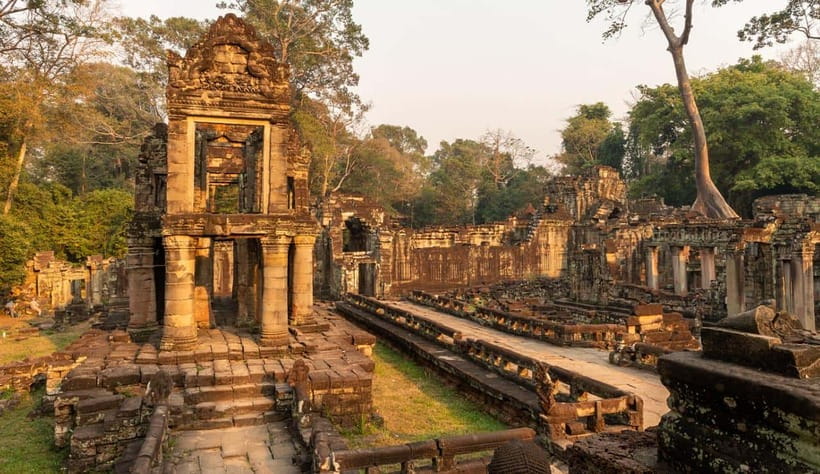
Book this tour if you value variety, clear guiding, and a planned sunset finish more than unlimited time at one temple. Pre Rup, Neak Pean, and Preah Khan each offer something different, and Phnom Bakheng gives the day a memorable final climb.
The $55 price is reasonable only after you add the $37 temple ticket and allow for lunch. Even so, the package includes transport, guide service, snacks, and water, which can make it good value for a first or second Angkor visit.
I would skip it if stairs are a serious concern or if you want a slow, deeply detailed day at fewer sites. For everyone else, the route offers a smart balance of architecture, religion, nature, and scenery, with guide Son adding the kind of explanation that helps the temples stay in your mind after the sunset fades.
FAQ
What time does the tour begin?
Hotel pickup is scheduled for 12:30 pm. You should wait in the hotel lobby 15 minutes before pickup.
How long does the tour last?
The tour lasts six hours. You can expect to return to Siem Reap city around 7:30 pm.
Is the temple ticket included in the price?
No. The temple ticket costs $37 per day and is not included in the $55 tour price.
Is lunch included?
No. Lunch is not included. Local snacks and cold water are provided.
How difficult is the Phnom Bakheng climb?
You will climb 200 steps to reach the top of Phnom Bakheng. The activity is not suitable for pregnant women.
What type of transportation is provided?
One to three people travel by shared tuk tuk. Groups of four or more use an air-conditioned vehicle. Hotel pickup and drop-off are included.
More things to do after dark in Siem Reap
- Siem Reap: Full-Day Angkor Wat Guided Tour with Sunset
★ 4.9 · 3,803 reviews - Angkor Wat Sunset Small Group Tour with Lunch Included
★ 5.0 · 3,059 reviews - Angkor 2-Day Sunset & Sunrise Small-Group Tour
★ 5.0 · 2,567 reviews - Siem Reap: Angkor Wat Sunrise or Sunset Guided Tour
★ 4.9 · 2,123 reviews
New around Siem Reap
- Siem Reap Temple and Waterfall 3-Day Tour★ 4.5 · 3 reviews
- Siem Reap: Guided Day Trip to Local Village & Cooking Class★ 5.0 · 3 reviews
- Savor the Countryside: Tours with Authentic Cooking Classes”★ 5.0 · 3 reviews
- Siem Reap Private Tour: Angkor Wat Sunrise And Banteay Srei★ 5.0 · 3 reviews
- Angkor Wat Sunrise TukTuk Tour★ 5.0 · 3 reviews
- Angkor Wat Sunset In Private and Small-In-Group★ 4.3 · 3 reviews
- Angkor Wat: Highlights and Sunrise with Spanish Guide★ 4.8 · 3 reviews
- Full Day to Banteay Srei, Kulen National Park and Beng Mealea★ 5.0 · 3 reviews
Angkor Temple Tours, compared.
1-Day private Angkor Temple Tour from Siem Reap
Read our review →
Private Full-Day Angkor Temple and Sunset Viewing with Lunch
Read our review →
Private one-day tuktuk ‘small tour’ of the oldest Angkor temples
Read our review →
Explore Angkor Temple & Other – Private Vehicle with Tour Guided
Read our review →
Angkor Wat Private Driver Tours to Angkor Wat Sunrise, Angkor Thom & Ta Prohm
Read our review →Browse the lists this tour appears in