Reviewed · ANGKOR WAT TOURS
Angkor Wat: Highlights and Sunrise with Spanish Guide
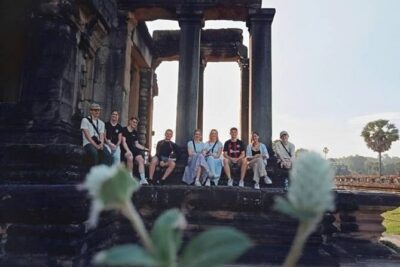
Angkor Wat before breakfast is the main event here. You enter the temple in darkness from its less-used eastern side, follow old cloistered corridors, and reach the pools as the sky begins to brighten. That early start gives you a cooler, quieter look at the world’s most famous Khmer temple.
I like the Spanish-speaking guide service, especially for visitors who want more than a photo stop. I also like the practical touches: hotel pickup, an air-conditioned vehicle, cold water, and damp towels. The main drawback is the early departure, plus the separate $37 temple pass, which makes the real cost $66 per person before breakfast.
Key points to know before booking
- Sunrise begins before dawn at Angkor Wat, with entry from the eastern side and a flashlight needed for the dark corridors.
- Two full hours are devoted to Angkor Wat, enough time for corridors, bas-reliefs, central chambers, and upper terraces.
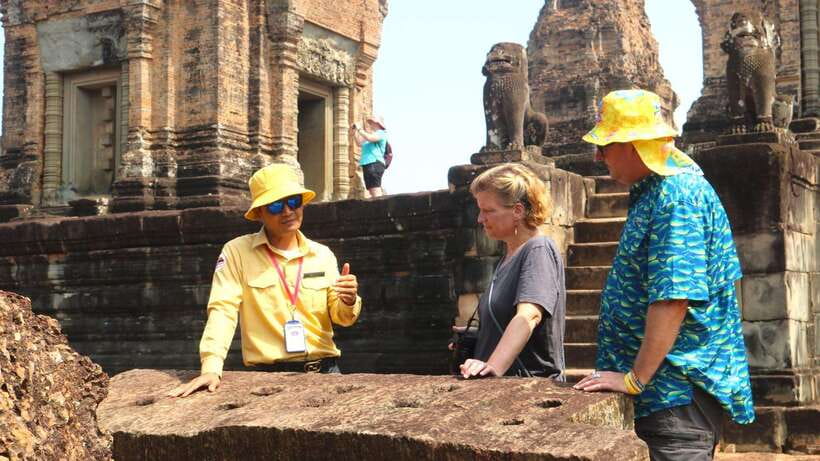
- The Spanish-speaking guides Chhut and Sokha are named in the service feedback, with Sokha especially praised for temple explanations, viewpoints, and photographs.
- The route adds Ta Prohm, Bayon, Angkor Thom, and the South Gate, giving you a strong first look at the main Angkor sights.
- The advertised price is $29, but the required temple entrance pass costs another $37, and breakfast is not included.
- Hotel pickup and drop-off, air-conditioning, water, and cooling towels make the long, hot morning easier.
Why this sunrise tour works so well
Angkor Wat is often treated as a quick picture stop. That is a mistake. The temple is huge, and its best details are easy to miss if you simply walk across the causeway, take a photograph, and move on.
This tour gives the main temple a serious block of time. You arrive before sunrise, enter in the dark, and spend about two hours examining the interior. That timing matters because the stone holds the cool of the night, while the first light makes the carvings easier to appreciate without the harsh midday sun.
I especially like the eastern entrance plan. Most first-time visitors focus on the famous western approach and the reflection pools. Entering from the eastern side gives you a different sense of the building, with corridors and bas-reliefs appearing gradually as your eyes adjust.
Bring a flashlight. This is not a decorative suggestion. The tour enters the temple while it is still dark, and your phone light may work, but a small torch is more practical.
The tour is designed for people who want a broad introduction to Angkor in one morning. You see the central attractions without having to arrange several separate rides or work out the road connections yourself. The tradeoff is that the day moves at a steady pace. You will not have unlimited time at each site.
More Angkor Wat Tours in Siem Reap:
- Angkor Wat Sunrise or Sunset Tour with Guide from Siem Reap
★ 5.0 · 12,109 reviews - Siem Reap: Angkor Wat: Small-Group Sunrise or Sunset Tour
★ 5.0 · 9,444 reviews - Siem Reap: Angkor Wat 2-Day Tour with Sunrise and Sunset
★ 4.9 · 4,429 reviews
Angkor Wat before sunrise
Pickup begins in Krong Siem Reap before dawn. The exact starting time depends on the date, so you need to check availability when booking. The advertised duration is eight hours, although the described visit ends around 12:30 to 1:30 p.m. Plan on giving the whole morning to the experience.
The first stop is Angkor Wat. In darkness, you make your way through the temple from the eastern side and descend through old cloistered passages. This approach puts the building’s scale into perspective before you see the familiar towers from the front.
The bas-reliefs are a major reason to have a guide here. Angkor Wat contains one of the longest continuous stretches of carved reliefs in the world, and the scenes are not just decoration. They tell stories connected to Khmer religion, royal power, warfare, and daily life during the Khmer Empire.
A Spanish-speaking guide can explain what you are looking at as you walk, rather than leaving you with a wall of stone and a few disconnected facts. Chhut was praised for being attentive and open to questions. That is useful at a site where you can easily spend ten minutes staring at a scene without knowing what it represents.
As dawn approaches, you pause near one of the ancient library pools. This is where you can watch the light develop around the temple. The famous sunrise photographs are taken from the western side, but this tour also gives you time to appreciate the temple from within its own courtyards and water features.
Sunrise conditions are never guaranteed. Clouds can soften the view or hide the strongest colors. Even so, the early entry has value because it gives you cooler temperatures and a more atmospheric start.
After sunrise, the guide leads you through the corridors, central chambers, and upper terraces. The upper areas involve walking and may require climbing. The tour is not suitable for wheelchair users, and you should be comfortable on your feet for several hours.
Two hours inside the main temple
The two-hour Angkor Wat visit is the strongest part of the schedule. It gives you enough time to look up, slow down, and notice how the temple is arranged.
Your guide can connect the carvings to the larger story of the Khmer Empire, including what life may have been like when Angkor was at its height. That human context helps. You begin to see Angkor Wat not only as a religious monument, but also as a place shaped by rulers, builders, worshippers, artists, and workers.
The upper terraces provide broader views over the temple grounds. The tour description also promises excellent elevated views, but keep your expectations sensible: the experience is about seeing the temple and its grounds from higher points, not taking an aerial flight.
The pace should suit you if this is your first Angkor visit. If you already know the site well, you may wish for more time with individual relief panels. This is a highlights tour, not a specialist study of every carving.
Dress and sun protection matter. The provided list recommends sunglasses, a sun hat, and sunscreen. Wear practical clothing that lets you walk comfortably and follow temple access rules. The morning starts cool, but Cambodia’s heat builds quickly.
Breakfast near Srah Srang, at your own cost
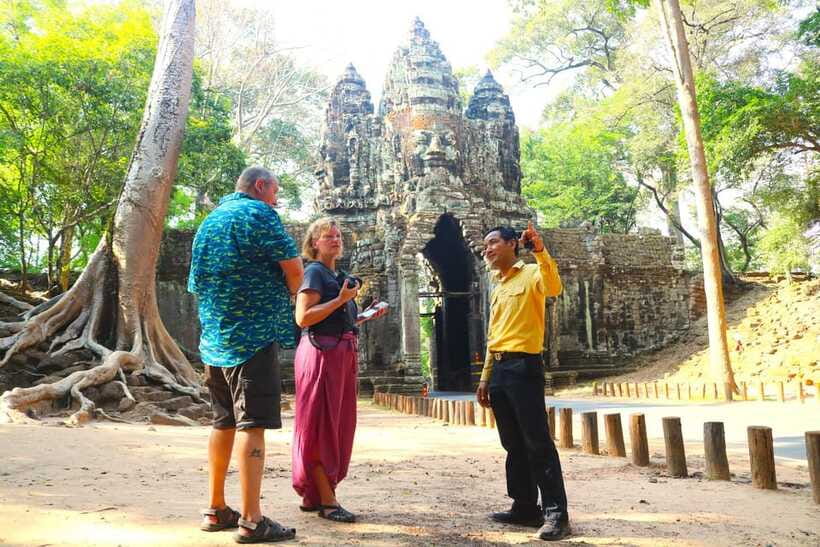
After Angkor Wat, the group stops for breakfast outside the temple area, around Srah Srang. The schedule allows about an hour for a break, coffee, tea, and food.
Breakfast is not included, so bring money for this stop. That is a small but important cost to add to the advertised price. The pause is still useful. You have been awake since before dawn, and a proper rest makes the next temples more enjoyable.
Srah Srang is an ancient reservoir and a pleasant place to slow down. The schedule describes it as a break rather than a full guided temple visit, so do not expect another long historical explanation here. Use the time to eat, drink, and cool off.
The vehicle supplies bottled water and damp towels. Those details may sound minor when you book, but they matter after walking through exposed temple grounds. Sokha was particularly praised for providing cold water and refreshing towels during the morning.
More early starts in Siem Reap:
- Angkor Wat Sunrise tour with Small – Group and Guide tours
★ 5.0 · 3,655 reviews - Angkor Wat Highlights and Sunrise Guided Tour from Siem Reap
★ 5.0 · 3,213 reviews - Full-Day Angkor Wat Sunrise Private Tour with Guide from Siem Reap
★ 5.0 · 2,920 reviews - Angkor Wat Sunrise & 3 Main Temples with Breakfast – Small Group
★ 5.0 · 2,857 reviews
Ta Prohm and the power of the jungle
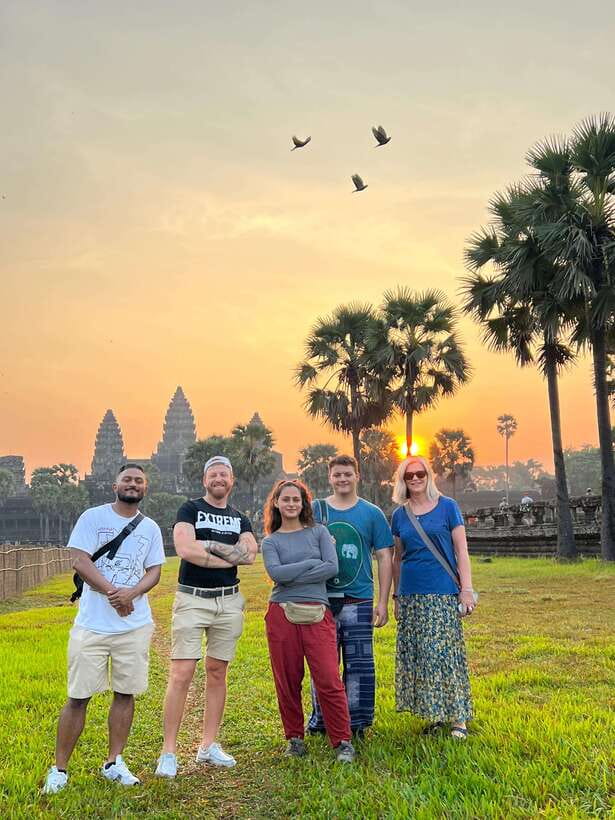
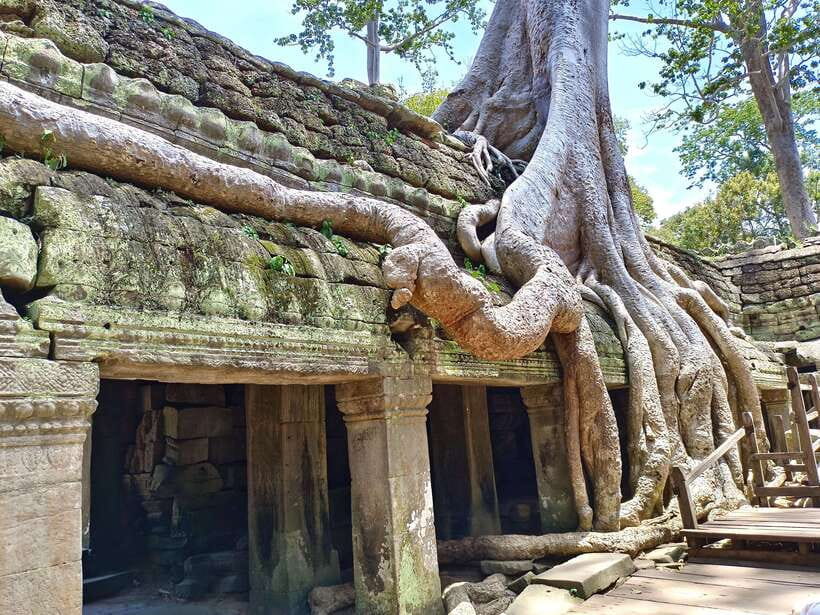
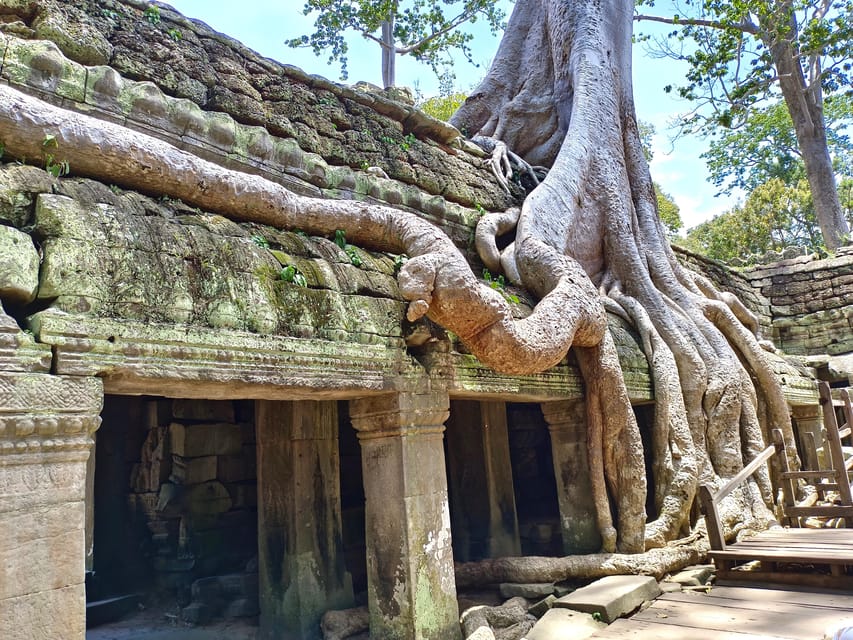
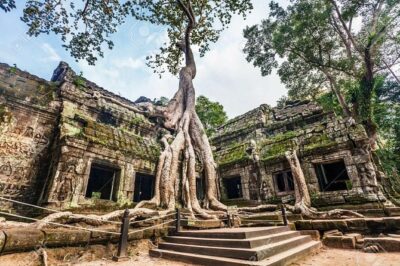
The next major stop is Ta Prohm, one of Angkor’s most recognizable temples. Its fame comes from the way trees and jungle growth have become part of the ruins.
Ta Prohm once housed 2,740 monks. Today, its broken galleries and stone walls offer a sharp contrast to Angkor Wat’s more formal layout. You can see why the temple has become a symbol of Angkor: it gives you a sense of a site shaped by time, vegetation, and abandonment.
The tour allows about an hour here. That is enough to walk through the main areas, see the best-known tree-covered sections, and hear how the temple functioned. It is not enough for a slow exploration of every corner, especially if the walk is crowded.
Your guide is valuable because Ta Prohm can otherwise become a hunt for the most recognizable tree roots. Chhut or Sokha can help you look beyond the picture spots and understand the temple as a working religious complex.
The route includes a photo stop, guided sightseeing, and walking. Expect uneven ground and a warm, exposed setting. Good shoes and water are more important than dressing for a perfect photograph.
Bayon’s enormous stone faces
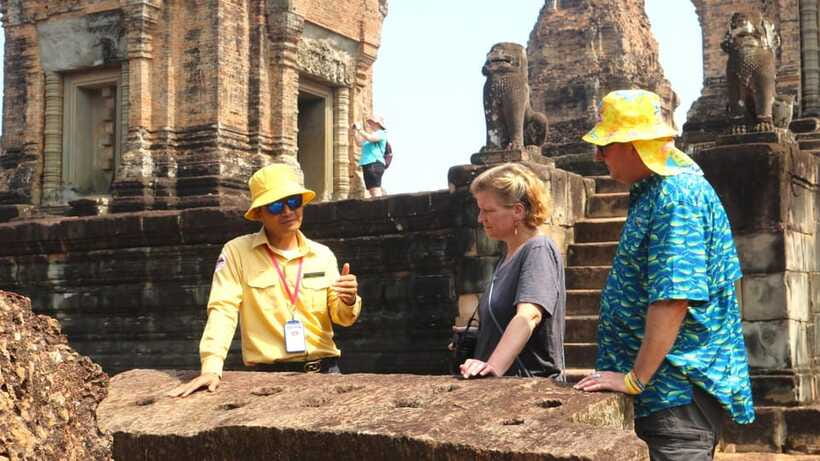
From Ta Prohm, the tour continues to Bayon Temple in Angkor Thom. Bayon is known for its carved central towers, covered with more than 200 enormous faces.
This is one of the most memorable stops because the faces appear from different angles as you move through the temple. Some look directly across the towers, while others seem to watch from above the narrow passageways.
Bayon is also a good place to ask questions. The carvings and layout can be confusing, and the guide’s interpretation helps you understand how this temple fits into the wider city of Angkor Thom.
The visit lasts about an hour, including walking and photographs. Again, the schedule favors an overview. You will see the major features, but you will not have the time of a private, slow-moving archaeology visit.
The Spanish-language service is the key reason to choose this tour over a general group outing. Sokha received strong praise for clear explanations, friendly help, and finding good viewpoints for photographs. If you want someone to help frame a picture as well as explain the site, that personal attention is a useful bonus.
Angkor Thom and the South Gate
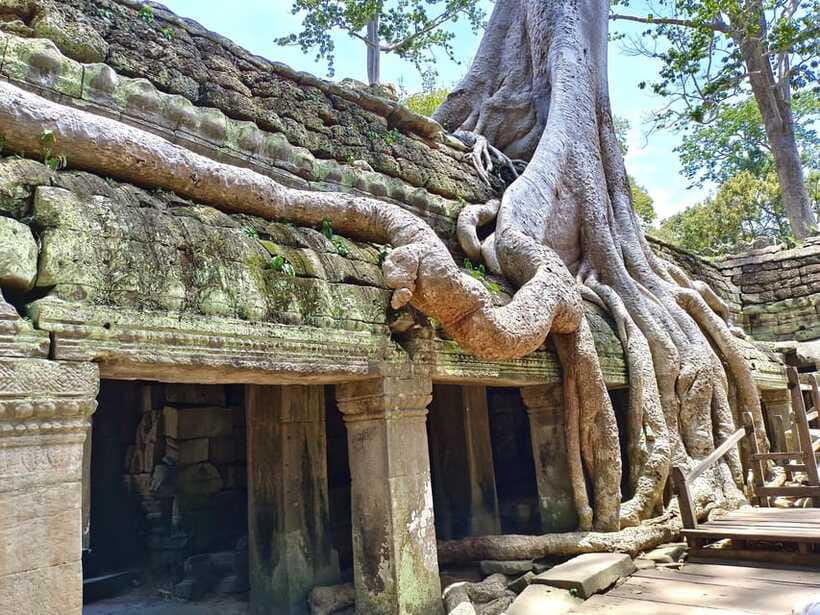
The route also includes the Terrace of the Leper King and the Terrace of the Elephants. These terraces once formed part of Angkor Thom’s ceremonial center and help you picture the scale of the old city.
The Terrace of the Elephants is known for its carved elephant imagery and its long platform. The Terrace of the Leper King has detailed carvings and a name tied to a statue whose meaning has been debated. The tour gives you a short look rather than a long separate visit.
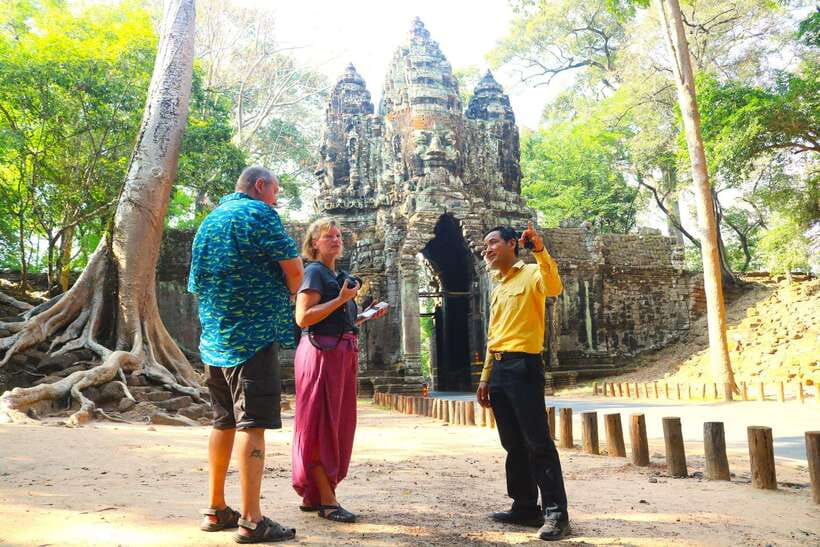
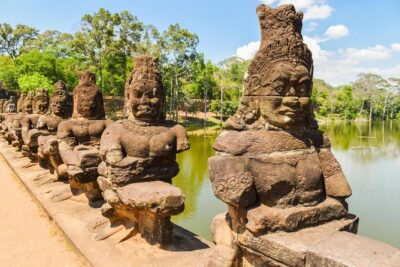
You then reach the South Gate of Angkor Thom, where a row of 54 stone figures lines each side of the approach. Gods appear on the left and demons on the right, creating a dramatic entrance to the fortified city.
This is a quick stop of about 30 minutes. It is best understood as part of the wider Angkor Thom story. You may have time for photographs and an explanation, but not an extended exploration of the gate and surrounding roads.
The sequence is well chosen for a first visit. Angkor Wat shows the grand religious center, Ta Prohm shows the ruins touched by jungle, Bayon shows the enigmatic faces, and Angkor Thom supplies the setting of a once-powerful royal city.
What the $29 price really covers

At $29 per person, the tour price is modest for an eight-hour guided morning with hotel pickup, an air-conditioned vehicle, a Spanish-speaking guide, water, and cooling towels.
But the temple entrance is not included. The pass costs $37 per person for all the temples visited. That brings the basic combined cost to $66, before breakfast and any personal spending.
At that real price, the value depends on what you want from the day. If you are comfortable arranging transport and reading about the temples yourself, you could prefer a do-it-yourself visit. If you want a Spanish-speaking guide, a planned route, and no need to negotiate separate rides between the sites, the package is easier to justify.
The price also includes hotel pickup and drop-off in Krong Siem Reap. That saves time and removes one practical worry on a morning when you are leaving before dawn. Confirm that your hotel is within the pickup area when you book.
Free cancellation is available up to 24 hours before the activity for a full refund. You can also reserve now and pay later, which helps if your plans are still taking shape.
Who should book this Angkor morning?
I would choose this tour if you are visiting Angkor for the first time and want the major sights in one guided morning. It is especially suitable if you prefer explanations in Spanish or want someone to help you understand the bas-reliefs and temple layouts.
It also suits you if you value convenience. The vehicle, hotel service, water, and cooling towels remove several small chores from a demanding day.
You should think twice if you dislike pre-dawn starts, prefer very slow photography, or want to spend a full day at only one or two temples. The schedule is active, and each stop has a time limit.
The tour is not suitable for wheelchair users or people over 95, according to the activity requirements. Pets and baby strollers are not allowed. Because there is a lot of walking, uneven temple ground, heat, and some upper-level access, you should consider your mobility before booking.
Final verdict: a strong first look at Angkor
I recommend this tour for a first visit, especially if Spanish guidance is important to you. The best features are the early eastern entrance at Angkor Wat, the full two-hour visit inside the main temple, and the personal help associated with guides such as Chhut and Sokha.
The route gives you a useful cross-section of Angkor in one morning. You see the grand temple, the tree-covered ruins of Ta Prohm, Bayon’s stone faces, the terraces of Angkor Thom, and the South Gate.
Just budget honestly. The $29 tour fee does not include the $37 temple pass or breakfast, and the early start is part of the bargain. If you can handle the alarm, the walking, and the extra entrance cost, this is a practical and well-focused way to meet Angkor.
FAQ
Does the tour include the Angkor temple entrance fee?
No. Temple admission costs $37 per person for all the temples visited and must be paid separately.
Is breakfast included?
No. The tour stops outside the temple for breakfast, but food and drinks are not included.
What language does the guide speak?
The live guide speaks Spanish. Guides named in the service information include Chhut and Sokha.
What time does the tour start?
The tour begins before dawn for the Angkor Wat sunrise. Starting times vary, so you need to check availability for your chosen date.
How long does the activity last?
The advertised duration is eight hours. The described visit ends between 12:30 and 1:30 p.m.
Is hotel pickup included?
Yes. Hotel pickup and drop-off are included for hotels in Krong Siem Reap.
What should I bring?
Bring a flashlight for entering Angkor Wat in the dark, along with sunglasses, a sun hat, and sunscreen. Water and damp towels are provided.
New around Siem Reap
- Siem Reap Temple and Waterfall 3-Day Tour★ 4.5 · 3 reviews
- Savor the Countryside: Tours with Authentic Cooking Classes”★ 5.0 · 3 reviews
- Siem Reap Private Tour: Angkor Wat Sunrise And Banteay Srei★ 5.0 · 3 reviews
- Siem Reap: Guided Day Trip to Local Village & Cooking Class★ 5.0 · 3 reviews
- Angkor Wat Sunset In Private and Small-In-Group★ 4.3 · 3 reviews
- Angkor Wat Sunrise TukTuk Tour★ 5.0 · 3 reviews
- Full Day to Banteay Srei, Kulen National Park and Beng Mealea★ 5.0 · 3 reviews
- Exclusive Angkor temples and Small group temples tours★ 5.0 · 3 reviews
Angkor Wat Tours, compared.
Angkor Wat Sunrise or Sunset Tour with Guide from Siem Reap
Read our review →
Angkor Wat: Small-Group Sunrise or Sunset Tour
Read our review →
Angkor Wat Sunrise tour with Small – Group and Guide tours
Read our review →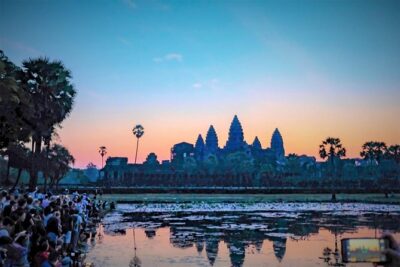
Angkor Wat Highlights and Sunrise Guided Tour from Siem Reap
Read our review →
Angkor Wat Sunset Small Group Tour with Lunch Included
Read our review →
Full-Day Angkor Wat Sunrise Private Tour with Guide from Siem Reap
Read our review →