
Reviewed · SIEM REAP TOURS
Siem Reap: 2-Day Temple Highlights Sunrise and Sunset Option
Angkor is too large for a rushed one-day visit. This two-day tour gives you the famous faces and towers, but also takes you to quieter sites where the stones, trees, and old waterworks tell a fuller story. The payoff is sunrise at Angkor Wat, followed by Ta Prohm and Angkor Thom while your guide explains the Hindu and Buddhist ideas behind the carvings.
I like the careful pacing and the cool air-conditioned van waiting after each hot walk. I also like the guides’ personal touch. Guides such as Sak, Pi, Bun, Chhay, and Pal have been praised for clear storytelling, good photo help, and explaining modern Cambodian culture alongside temple history. The main drawback is simple: two days of temple steps and heat can be tiring, and the $46 tour price does not include the required $62 two or three-day temple pass.
Key points at a glance
- Sunrise from Angkor Wat’s eastern side: Enter in the dark with a torch and reach a less-used approach before the temple fills.
- Banteay Srei’s fine carvings: This smaller sandstone temple rewards close attention more than a quick photo stop.
- Nine or more temples in two days: You see the major names plus atmospheric sites such as Neak Pean, Preah Khan, and Ta Nei.
- Cold water and towels after temple walks: Drivers regularly meet the group with bottled water and cool towels, a real help in Cambodia’s heat.
- Flexible small-group feel: Groups have been reported at roughly 6 to 15 people, with some private options available.
- Two different sunset arrangements: Private tours include a rice-field sunset drink, while small groups include sunset at Bakheng Temple.
Why two days works better than one at Angkor
Angkor is not a single temple. It is a large archaeological area spread across the countryside around Siem Reap, with grand state temples, smaller shrines, reservoirs, terraces, and jungle-covered ruins. Trying to see the main sites in one long day often turns the visit into a parade of stone corridors and hurried photographs.
This plan divides the sightseeing sensibly. Day one goes farther from the central Angkor Thom area, with Banteay Srei as the long-distance highlight. Day two begins before dawn at Angkor Wat, then moves through Ta Prohm, Ta Nei, and Angkor Thom.
I like that contrast. You get the polished scale of Angkor Wat, the delicate carving of Banteay Srei, and the more broken, quiet character of Preah Khan and Ta Nei. You also get time to ask questions in the van, rest between stops, and cool off instead of spending every minute under the sun.
The tour costs $46 per person, which is a fair price for two days of transport, an English-speaking licensed guide, hotel pickup and drop-off, and a small-group setup when available. The extra cost to plan for is the Angkor pass: $62 per person for a two or three-day pass. Meals are also separate, though the schedule includes time for breakfast and lunch stops.
More Sunset Tours in Siem Reap:
- Angkor Wat Sunrise or Sunset Tour with Guide from Siem Reap
★ 5.0 · 12,109 reviews - Siem Reap: Angkor Wat: Small-Group Sunrise or Sunset Tour
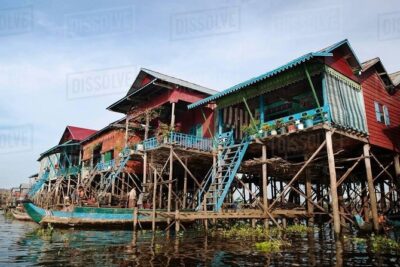
★ 5.0 · 9,444 reviews - Sunset tour of Kampong Phluk stilts home village on the Tonle Sap
★ 5.0 · 4,865 reviews
Day one begins at Pre Rup
The first temple is Pre Rup, a Hindu temple built as the state temple of King Rajendravarman in 961 or early 962. Its design is classic temple-mountain architecture, using brick, laterite, and sandstone to create a strong upward form.
Pre Rup is a useful first lesson in how Khmer temples were conceived. The structure is not merely a building to enter. Its rising levels represent a sacred mountain, and the climb gives you a sense of the vertical design that appears in larger Angkor monuments.
Expect stairs and uneven stone here, so comfortable shoes matter. The upper levels can also feel exposed in the morning sun. Your guide may point out construction details and religious symbols that are easy to miss when you are focused only on the view.
The temple is often associated with sunset in standard Angkor circuits, but on this tour it begins the first day before the longer drive to Banteay Srei. That order helps spread out the sights instead of saving every major stop for the afternoon.
Banteay Srei rewards a slow look
Banteay Srei is smaller than Angkor Wat, but its sandstone carvings are among the most finely worked in Cambodia. The reliefs are unusually detailed, with figures and decorative patterns cut into warm pink and red sandstone.
This is the place to listen closely. A guide can explain the Hindu stories and identify details that look like decoration at first glance. The compact scale also makes Banteay Srei feel different from the huge ceremonial spaces elsewhere in Angkor.
Banteay Srei was only accessible to ordinary visitors from the late 1990s, after the Khmer Rouge left the area. That modern context matters. You are not just looking at an old monument; you are also seeing a site whose access and preservation have been shaped by Cambodia’s difficult recent past.
The tradeoff is the drive. Banteay Srei lies well outside the central temple circuit, so this stop takes more road time than Ta Prohm or Bayon. I think it earns that time, especially if you care about carving, design, and smaller-scale places rather than only the biggest monuments.
Neak Pean and Preah Khan change the mood
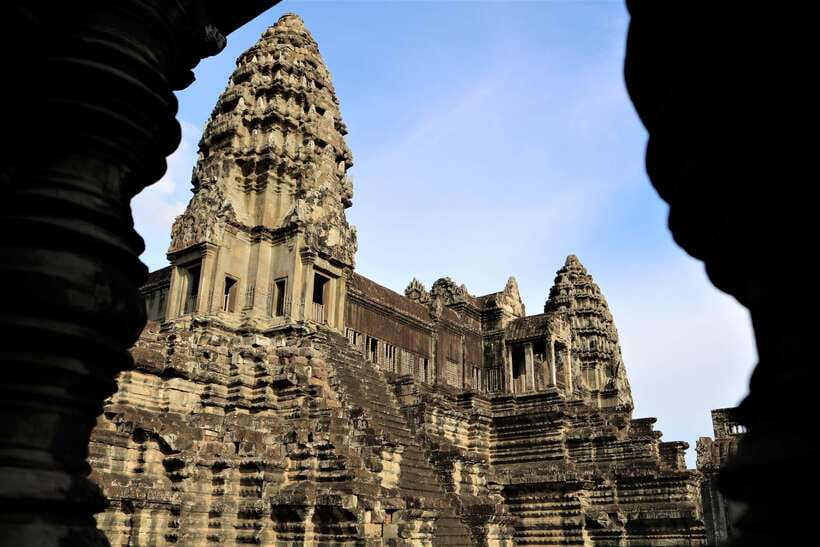
Neak Pean sits on an artificial island in the Jayatataka Baray, a large reservoir associated with the reign of Jayavarman VII. The Buddhist temple occupies a circular island, giving the site a strong relationship with water and healing imagery.
The approach to Neak Pean is part of its appeal. You cross through the reservoir setting toward the central shrine, and the open space feels quite different from the enclosed galleries at Angkor Wat. Depending on water levels and conditions, the visit may feel more like a short walk to a small shrine than a full temple exploration.
Preah Khan offers the opposite mood. It is a broad, damaged complex of stone corridors, courtyards, and trees, built by Jayavarman VII in honor of his father. Roots and crumbling walls give it the atmospheric look many people hope to find at Angkor.
Preah Khan is also useful for seeing restoration in progress. The World Monument Fund is working on parts of the site, while other areas retain their worn, overgrown character. I would not come here expecting perfect symmetry or a polished monument. Come for the scale, texture, and sense of a living archaeological site.
The guide makes a real difference at both temples. Guides such as Chhay and Pi have been praised for using maps, pictures, and stories during transfers, helping you understand what you are about to see before you step out of the van.
More things to do after dark in Siem Reap:
- Siem Reap: Angkor Wat 2-Day Tour with Sunrise and Sunset
★ 4.9 · 4,429 reviews - Siem Reap: Full-Day Angkor Wat Guided Tour with Sunset
★ 4.9 · 3,803 reviews - Angkor Wat Sunset Small Group Tour with Lunch Included
★ 5.0 · 3,059 reviews - Angkor 2-Day Sunset & Sunrise Small-Group Tour
★ 5.0 · 2,567 reviews
Sunset depends on the booking type
The final part of day one varies by tour type. On the private option, the plan includes a rice-field sunset drink. That is a quiet way to finish a temple-heavy day, with open rice fields replacing stone towers and crowds.
On the small-group option, sunset is at Bakheng Temple. Phnom Bakheng is a hilltop temple, so this version involves a climb and may feel more crowded at the end of the day. The view is the draw, but you should be ready for a wait and limited space at the popular time.
Check the exact sunset arrangement when booking. The description refers to both the rice-field drink and Bakheng Temple, and they are not the same setting. This is one of the few details that needs confirming before you pay.
Sunrise at Angkor Wat starts before dawn
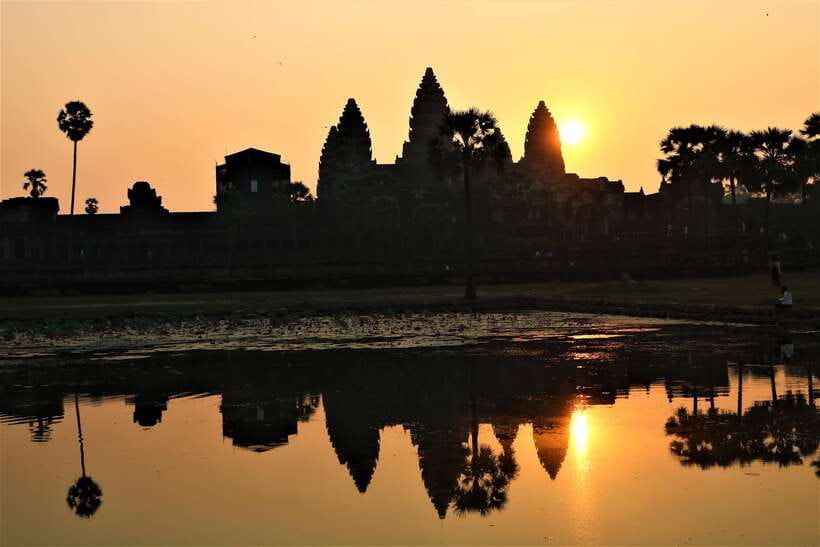
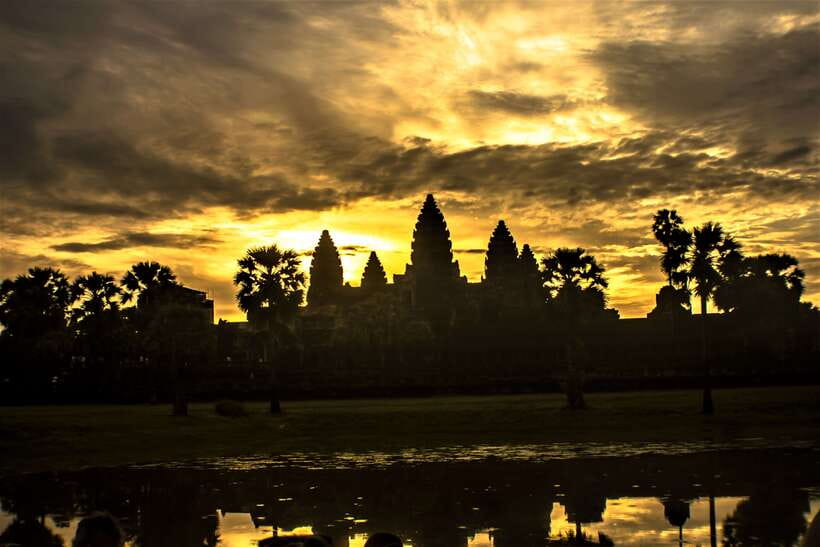
Day two begins with a pre-dawn hotel pickup. You enter Angkor Wat in darkness from the eastern side, bringing a torch for the walk through the cloisters.
This eastern approach is a smart part of the plan. Most people focus on the famous western front and the reflection pools, while the eastern side offers a different way to enter the monument. Moving through the dark corridors before sunrise gives the temple a hushed, almost theatrical beginning.
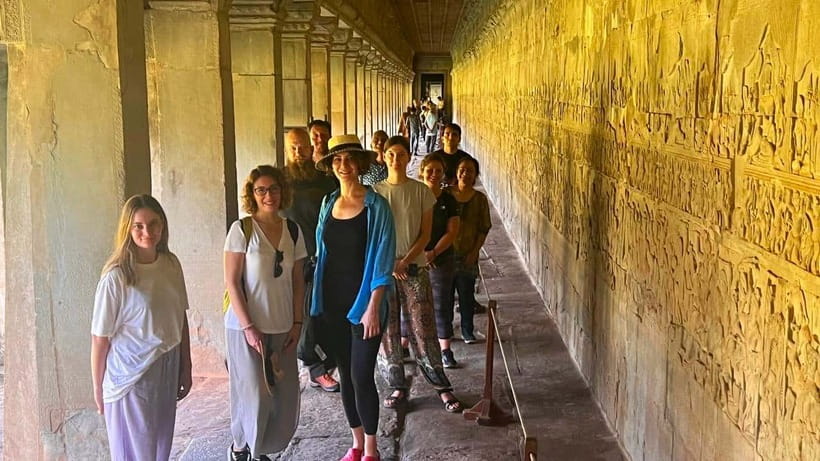
As daylight arrives, you can see the bas-reliefs more clearly. Angkor Wat contains one of the world’s longest stretches of carved narrative relief, and a guide can help you read scenes rather than simply walk past them.
You will want to bring a torch, wear shoes that handle uneven surfaces, and dress for the early start. Covered shoulders and knees are required at the temples. The sunrise itself is weather-dependent, so keep your expectations sensible. Even without a perfect orange sky, being inside Angkor Wat as the light changes is the main value of this early departure.
Breakfast is taken outside the temple afterward. Meals are not included, so carry cash and allow for the fact that prices and food choices at temple-area stops may differ from those in Siem Reap.
Ta Prohm is the atmospheric favorite
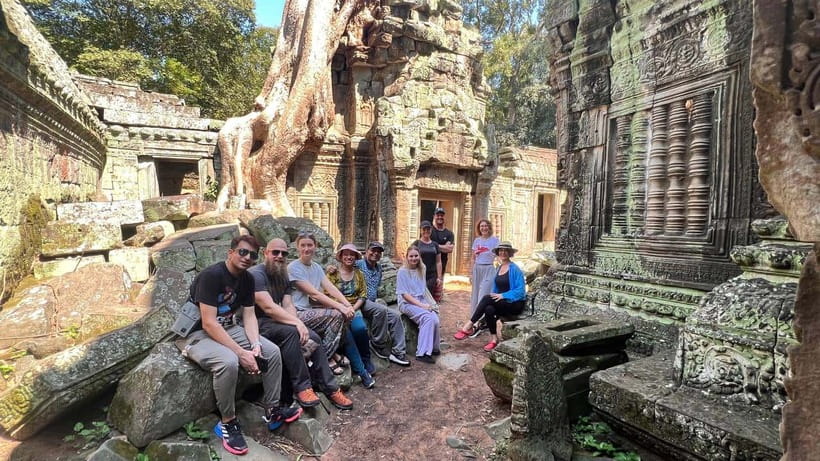
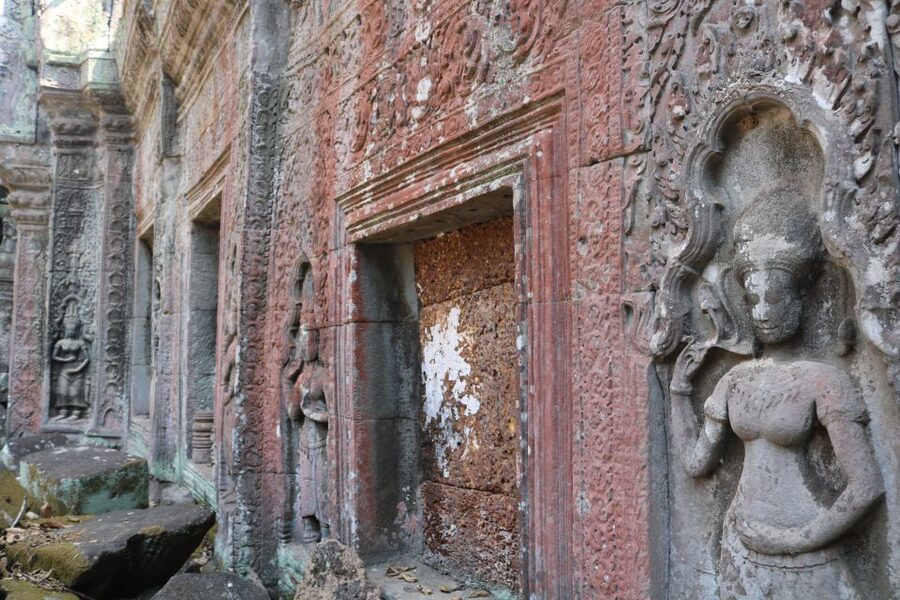
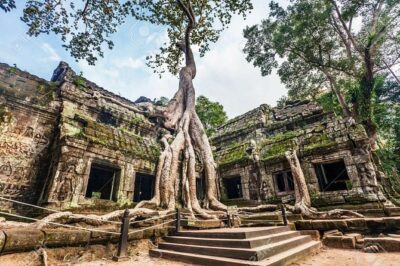
After breakfast, the tour moves to Ta Prohm, the temple made famous by its jungle setting and large tree roots growing over the stone. It was once home to 2,740 monks and remains one of the most visually striking stops in Angkor.
Ta Prohm is not simply a ruin with trees. Its damaged galleries show how nature, neglect, and conservation have interacted over time. The temple has been left with much of its early nineteenth-century appearance, when French explorer Henri Mouhot helped bring wider European attention to the site.
This is also one of the busiest stops, so the timing and route matter. Your guide may take you to less crowded corners and give you room for photographs. Still, do not expect solitude at the best-known tree-root views.
The ground can be uneven, and some passages are narrow. If you have knee trouble or tire easily, tell the guide at the start. One recent guest with a knee problem and an elderly mother described receiving patient, careful help, but the tour is officially not suitable for people with mobility impairments.
Ta Nei offers a quieter counterpoint
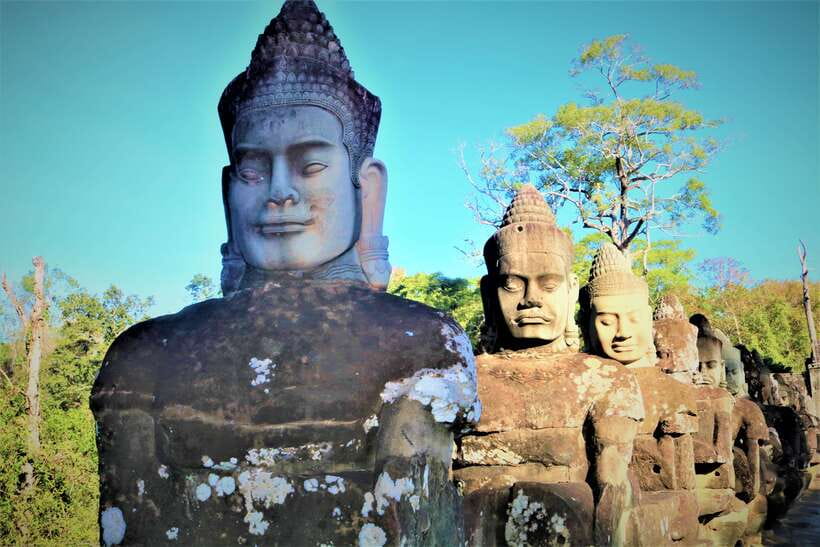
Ta Nei is a late twelfth-century stone temple in the Angkor area. It is smaller and less famous than Ta Prohm, which makes it useful after the crowds and spectacle of the jungle temple.
I like the inclusion of Ta Nei because it gives you a pause from the headline sights. You can think about the basic shape and purpose of a Khmer temple without the same visual overload. It also shows that Angkor is not just a collection of famous postcard locations.
The condition is rougher than at the best-restored sites, and the stop may feel less immediately impressive. That is exactly why it works. Your guide can help you see the site as part of a larger religious and urban system, rather than judging it only by how dramatic it looks in a photograph.
Angkor Thom and Bayon bring the big finish
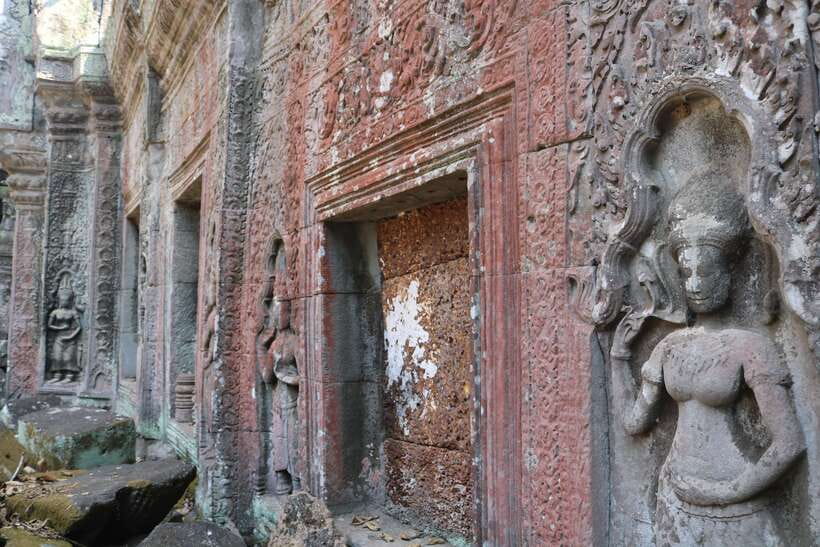
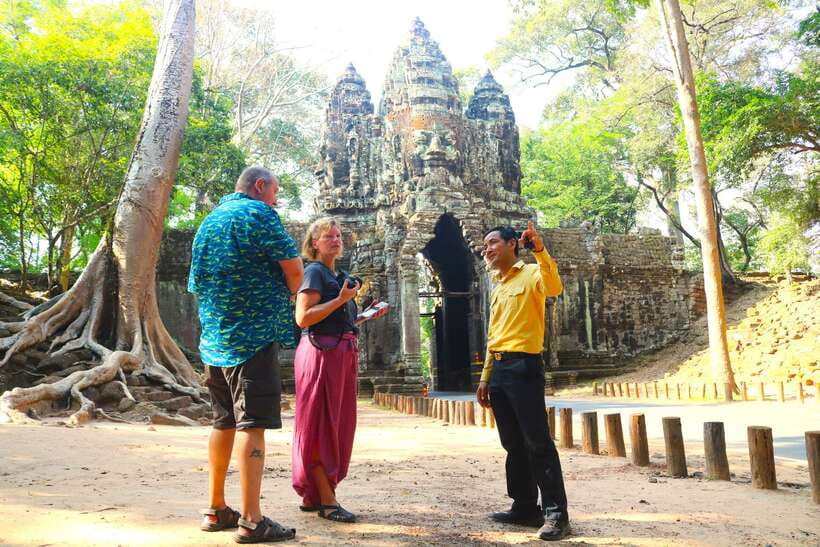
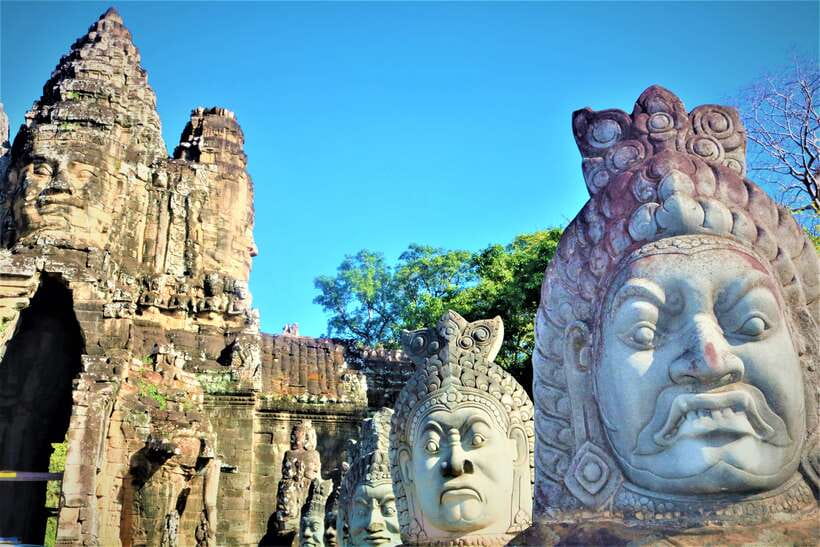
The tour enters Angkor Thom through the southern gate. A row of 54 stone figures lines each side, with gods on one side and demons on the other. The figures appear to pull a naga, or serpent, creating a memorable entrance to the fortified city.
Inside, Bayon is the star. Its central towers carry more than 200 enormous carved faces, giving the temple a strange and watchful character. The faces are best appreciated from several angles, since the expression changes as you move through the galleries.
A good guide will connect the architecture to Jayavarman VII’s Buddhist rule and explain how Bayon differs from the Hindu temples built by earlier kings. Guides named Sak, Bun, Pi, and So have been praised for explaining religion, symbolism, craftsmanship, and Cambodian culture in plain English.
The final stops are the Terrace of the Leper King and the Terrace of Elephants. These long platforms are less enclosed than Bayon, so they help you finish the day with a wider sense of Angkor Thom’s ceremonial center.
By this point, you may be tired. The schedule covers many temples, and heat builds quickly. The strength of the tour is that the van, cold bottles, and cooling towels create regular breaks. The weakness is that even a well-paced itinerary remains physically demanding.
The guide and driver shape the day
The listed guides are licensed, experienced, and English-speaking, but your individual guide will determine the tone. Names frequently associated with strong guiding include Sak, Chhay, Pi, Bun, Pal, Sam, So, and Yuth.
The best guides on this route do more than recite dates. They explain Hinduism and Buddhism, point out construction choices, answer questions about Khmer culture, and connect temple life with modern Cambodia. Several guides also help with photographs and know where to stand for a better angle.
Driver service is another major strength. Drivers such as Vichet, Keal, Mao, Naroo, Seyha, and Sal have been praised for safe driving, prompt pickups, and keeping cold water and towels ready. That may sound minor until you are walking in high heat and return to the van with a hot face and dusty feet.
The group size can vary. Small groups have been reported at around 6, 8, 12, and 15 people, and some tours become smaller on the second day. A small group is easier to manage at sunrise and makes it simpler to ask questions, though it is not the same as having a private guide.
What to pack and who should book
Bring comfortable walking shoes, insect repellent, a torch for the pre-dawn entrance, and clothing that covers your shoulders and knees. You should also bring money for the temple pass and meals.
This tour suits you if you want the major Angkor sights but do not want to arrange separate transport, route planning, sunrise timing, and temple explanations yourself. It is particularly useful for a first visit, since the guide helps connect the sites instead of leaving you to decode them alone.
It is less suitable if you want a slow, photography-only schedule. You will visit many sites in two days, and the early start plus heat can wear you down. It is also not wheelchair accessible and is not suitable for children under eight, people with mobility impairments, or wheelchair users.
Free cancellation is available up to 24 hours before the activity, and you can reserve now and pay later. Pickup is available from hotels throughout Siem Reap City.
Should you book this two-day temple tour?
I would choose this tour if you want a strong first look at Angkor with solid transport and an active guide. The route balances Angkor Wat, Ta Prohm, Bayon, and Angkor Thom with less obvious stops such as Banteay Srei, Neak Pean, Preah Khan, and Ta Nei.
The $46 price is good value once you understand that the $62 temple pass and meals are extra. Book it knowing that day two starts before dawn, the walking is real, and sunset arrangements differ between private and small-group options.
For the best fit, confirm the sunset plan, tell the guide about any knee or stamina concerns, and choose comfortable clothing and shoes. If you want history, religion, practical care, and a broad two-day route, this is an easy tour to recommend.
FAQ
How much does the tour cost?
The tour costs $46 per person. The Angkor temple pass is not included and costs $62 per person for a two or three-day pass. Meals are also separate.
Does the tour include the temple entry fee?
No. The required temple entry pass must be purchased separately.
Is hotel pickup included?
Yes. Pickup and drop-off are included from hotels throughout Siem Reap City.
What language does the guide speak?
The live guide speaks English.
What happens at sunset?
The private option includes a rice-field sunset drink. The small-group option includes sunset at Bakheng Temple. Confirm the exact arrangement when booking.
Is sunrise at Angkor Wat included?
Yes. Day two begins with a pre-dawn departure for sunrise at Angkor Wat, entering from the eastern side. Bring a torch.
Are meals included?
No. Meals are not included, though the itinerary allows time for breakfast outside Angkor Wat and a lunch stop.
Is the tour wheelchair accessible?
No. The activity is not wheelchair accessible and is not suitable for wheelchair users or people with mobility impairments. It is also not suitable for children under eight.
More 2-Day Experiences in Siem Reap
- 2 Days Exclusive Temple Highlights with Sunset and Sunrise Tour
★ 5.0 · 1,157 reviews - Siem Reap: Angkor Sunrise 1- or 2-Day Guided Temples Tour
★ 4.9 · 1,132 reviews - 2 Days Guided Historical Tour in Angkor
★ 5.0 · 855 reviews - 2-Day Angkor Wat With Small, Big Circuit and Banteay Srei Tour
★ 5.0 · 545 reviews
More early starts in Siem Reap
- Angkor Wat Sunrise tour with Small – Group and Guide tours
★ 5.0 · 3,655 reviews - Angkor Wat Highlights and Sunrise Guided Tour from Siem Reap
★ 5.0 · 3,213 reviews - Full-Day Angkor Wat Sunrise Private Tour with Guide from Siem Reap
★ 5.0 · 2,920 reviews - Angkor Wat Sunrise & 3 Main Temples with Breakfast – Small Group
★ 5.0 · 2,857 reviews
New around Siem Reap
- Kulen Mountain With Ticket included Plus Banteay Srei Temple Tour★ 5.0 · 7 reviews
- 2 Days Angkor temples with Sunrise & Sunset★ 5.0 · 7 reviews
- Private Siem Reap Airport Transfer to hotel in town★ 5.0 · 7 reviews
- 1-Day private Angkor Temple Tour with Sun Rise by Tuk Tuk from Siem Reap★ 4.5 · 7 reviews
- War Museum, Killing Field, and APOPO Hero RATs Tour★ 5.0 · 7 reviews
- Siem Reap: Morning Cooking Class & Market Tour★ 5.0 · 7 reviews
- Kulen Mountain, Killing Fields and War Museum Tour★ 5.0 · 7 reviews
- Half-Day: Silk Farm, Senteur Angkor, and Satcha Workshop★ 4.6 · 7 reviews
Siem Reap Tours, compared.
Angkor Wat Sunrise or Sunset Tour with Guide from Siem Reap
Read our review →
Angkor Wat: Small-Group Sunrise or Sunset Tour
Read our review →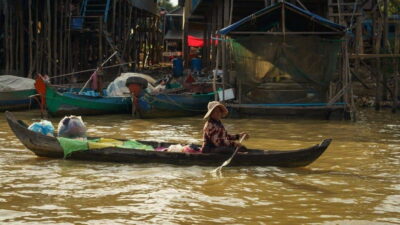
Sunset tour of Kampong Phluk stilts home village on the Tonle Sap
Read our review →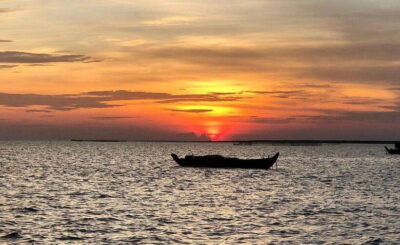
Kampong Phluk Floating Village Tour with Boat
Read our review →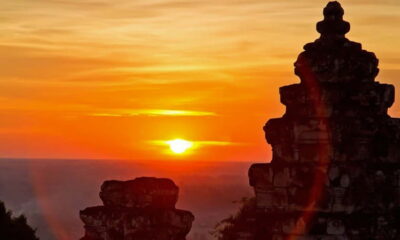
Angkor Wat Sunrise tour with Small – Group and Guide tours
Read our review →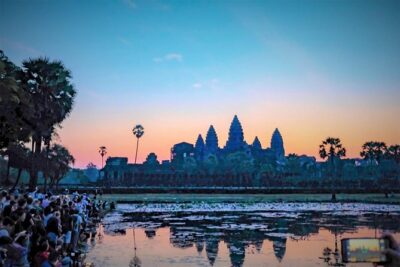
Angkor Wat Highlights and Sunrise Guided Tour from Siem Reap
Read our review →Browse the lists this tour appears in