
Reviewed · ANGKOR TEMPLE TOURS
2 Days Angkor temples with Sunrise & Sunset
Angkor is too large for a quick look, and this two-day private tour gives you a useful sweep of the ancient Khmer capital. You’ll see Angkor Wat at sunrise, walk through tree-wrapped Ta Prohm, and reach Banteay Srei, the small pink temple famous for delicate carvings. The route also includes quieter temples that many first-time visitors miss.
I like the private format, since guide Bunpheng can adjust the pace and shape the visit around your needs. I also like the practical setup: an air-conditioned car, minivan, or minibus, an English-speaking guide, and cold drinking water. The main drawback is the early start and the packed schedule, especially on the second day.
Key points at a glance
- Sunrise at Angkor Wat: Leave around 4:30 or 5 a.m., depending on the season, then spend three hours exploring the temple.
- A private, adjustable route: Only your group participates, and Bunpheng has been praised for adapting plans to short stays and special requests.
- Banteay Srei included: See the finely carved pink sandstone temple far beyond Angkor’s central cluster.
- Two very full days: Fifteen major stops cover Buddhist and Hindu temples from several periods of Khmer building.
- Transport and water included: Ride in air-conditioned transportation, with cold bottled water provided.
- Budget beyond the tour price: The $115 fee does not include the required $62 three-day Angkor Pass, meals, drinks, or lodging.
What two days in Angkor really gives you
At $115 per person, this is not an all-inclusive temple package. You must add the $62 three-day Angkor Pass, bringing the known cost to $177 per person before food and drinks. Still, that price can make sense if you want a private vehicle and a guide to handle the route across a very large archaeological area.
The pass is useful beyond this tour because it covers the required three-day access period, while the experience itself lasts about two days. The entrance fee is not included, so build it into your budget before comparing this tour with a cheaper group option.
The value comes from the range. You are not simply seeing Angkor Wat and Ta Prohm, then calling it done. You’ll visit major monuments in the central area, smaller temples, a temple mountain, an artificial island sanctuary, and Banteay Srei, which lies farther from the main Angkor group.
The private format matters here. You do not have to match the pace of a large bus group, and the itinerary can be adjusted. Bunpheng has handled airport pickup, hotel transfers, specific route requests, and tight 48-hour stays, so this is a useful choice if your time in Siem Reap is limited.
More Angkor Temple Tours in Siem Reap:
- Siem Reap Tour: Angkor Wat Sunrise, Bayon, Ta Prohm, Banteay Srei
★ 5.0 · 931 reviews - Siem Reap: Bike the Angkor Temples – Full-Day 30km Tour
★ 5.0 · 463 reviews - Angkor Wat one Day Private Tour for All Highlight Angkor Temples
★ 5.0 · 199 reviews
Day one: brick towers, tree roots, and Angkor Thom
The first day begins with Prasat Kravan, a small 10th-century temple made of five reddish brick towers on a raised terrace. It lacks the scale of Angkor Wat, but that is part of its appeal. The stop takes about 20 minutes and gives you a quick look at early Khmer brick construction before the larger monuments take over.
Banteay Kdei follows, with about 40 minutes to explore. Its name means Citadel of Chambers, and the late 12th or early 13th-century Buddhist temple has a maze-like feel. This is one of the places where a guide helps you read the layout rather than simply walk through a series of doorways.
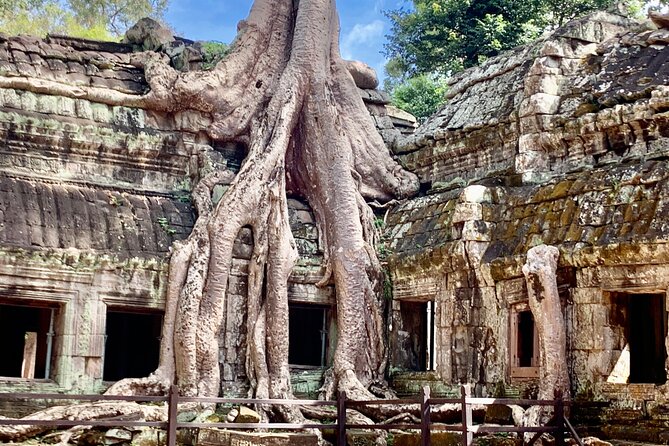
You then spend about an hour at Ta Prohm. Built under Jayavarman VII as a Buddhist monastery and university, it is one of Angkor’s most memorable settings. Parts of the temple remain entwined with large trees, giving you the famous combination of stone, roots, shadow, and narrow passageways.
Ta Prohm can be crowded, and the uneven ground and damaged galleries call for careful walking. The one-hour visit is enough for a strong first look, though you may wish you had more time if temple photography is a major reason for your trip.
Ta Keo is a sharp change of mood. This unfinished temple mountain was begun in 975 under Jayavarman V as a state temple. Its plain, massive structure shows you the power of scale without relying on the fine surface carving found at Banteay Srei. You have about 30 minutes here.
Angkor Thom and the late afternoon light
The longest first-day stop is Angkor Thom, the ancient capital of the Khmer Empire. Two hours gives you time for more than a quick photo at the South Gate. The area includes Bayon, the Royal Palace, the Terrace of the Elephants, and the Terrace of the Leper King.
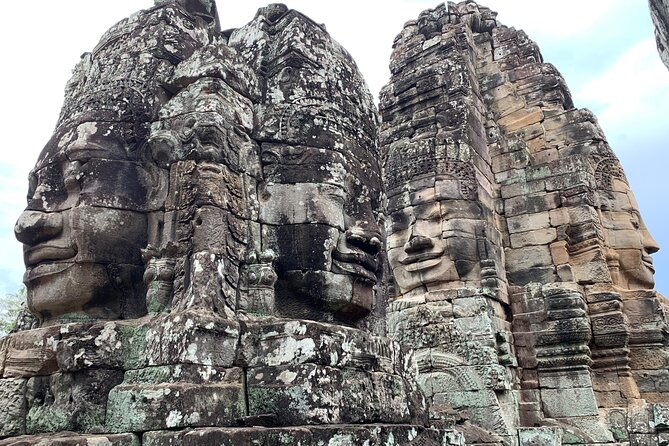
Bayon is especially important because its towers carry the calm, enigmatic faces often associated with Angkor. The temple can feel confusing at first, with galleries and towers packed closely together. Your guide can point out the relationship between the central sanctuary, the faces, and the surrounding reliefs.
The South Gate is one of the easiest places to recognize, with a bridge lined by figures pulling a serpent. It is also a common arrival point, so stopping there does not guarantee quiet. The advantage of seeing it as part of a two-hour Angkor Thom visit is that you get beyond the gate and into the old capital.
The day ends at Phnom Bakheng, a hilltop temple dedicated to Shiva and built under King Yasovarman near the end of the 9th century. The stop is planned for about 40 minutes, with sunset at Phnom Bakheng or at Angkor Thom’s South Gate depending on the plan and conditions.
Phnom Bakheng is a temple mountain, not just a lookout. The climb and the limited time may be tiring after a full day, so ask your guide how the sunset stop will work when you meet. If you prefer less exertion, the South Gate may be the simpler choice, though the viewpoint and sunset plan should be confirmed in advance.
Day two starts before dawn at Angkor Wat
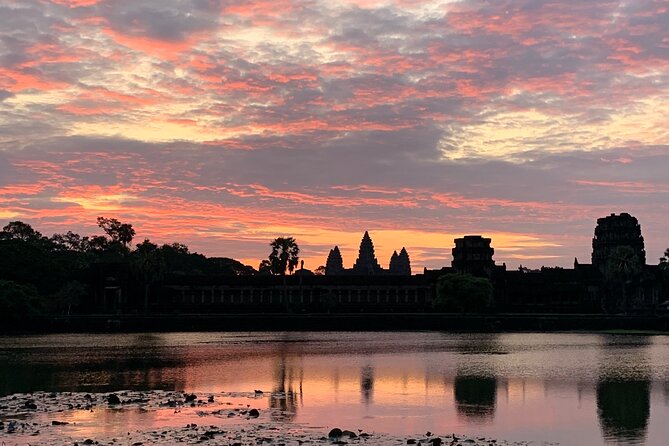
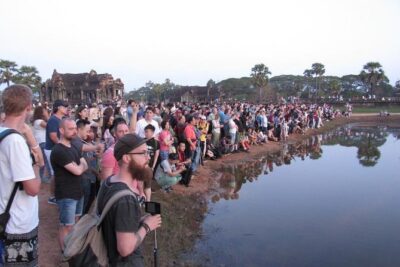
Day two begins around 4:30 or 5 a.m., with the exact departure changing by season. That early alarm is the price of seeing sunrise at Angkor Wat, but the schedule gives you a quieter start than arriving later in the morning.
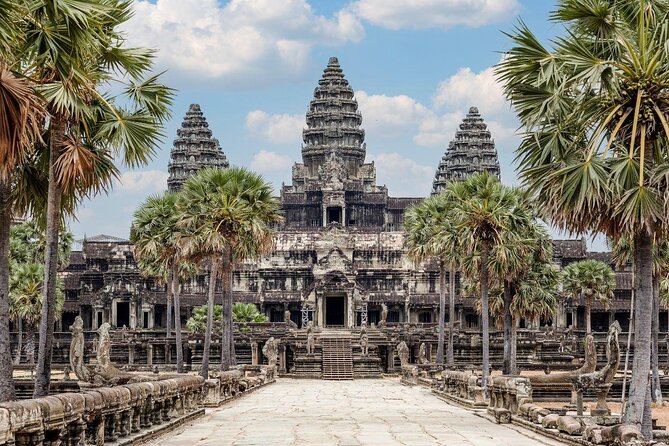
After sunrise, you spend about three hours at the main temple. Angkor Wat is the largest religious structure in the site, and three hours is a sensible minimum for its galleries, towers, courtyards, and reliefs. You will have time to see the famous front view at dawn and then move inside for a closer look.
Sunrise itself is not guaranteed to produce dramatic color. Clouds, haze, and crowds are part of the experience. The real value is having the morning arranged around Angkor Wat, rather than trying to squeeze it into the middle of a hot day.
Wear clothing that covers your shoulders and thighs. The temple complex has a strict dress code, and you may be refused entry if your clothing does not meet the rules. Bring water, though cold bottled water is supplied, and remember that this is a long morning on foot.
More Sunset Tours in Siem Reap:
- Angkor Wat Sunrise or Sunset Tour with Guide from Siem Reap
★ 5.0 · 12,109 reviews - Siem Reap: Angkor Wat: Small-Group Sunrise or Sunset Tour
★ 5.0 · 9,444 reviews - Sunset tour of Kampong Phluk stilts home village on the Tonle Sap
★ 5.0 · 4,865 reviews - Siem Reap: Angkor Wat 2-Day Tour with Sunrise and Sunset
★ 4.9 · 4,429 reviews
The eastern temples: Pre Rup, East Mebon, and Ta Som
The second-day route continues to the eastern side of the Angkor area, where the temples tend to feel more spread out and less monumental than Angkor Wat. The plan includes a stop listed as Pre Rup, but its description refers to East Mebon, and Eastern Mebon appears later as a separate stop.
That inconsistency is worth clearing up before you book or before departure. Pre Rup and East Mebon are different temples, so ask the operator which one is intended in that first 30-minute slot and whether both will be visited. The route does separately include Eastern Mebon for about 20 minutes, but the written timing should be confirmed.
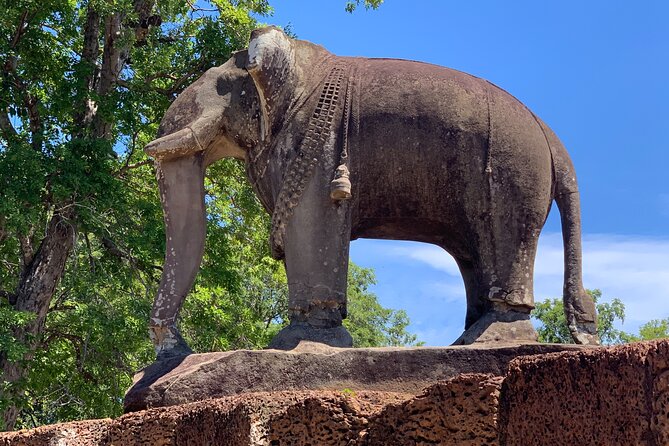
East Mebon is a 10th-century example of early Khmer architecture. Built on an island in the former East Baray reservoir, it is known for its temple-mountain design and stone elephants at the corners. If the itinerary means Pre Rup instead, you will see another 10th-century temple mountain with a strong brick structure and broad upper terraces.
Ta Som receives about 20 minutes. This late 12th-century Buddhist temple was built by Jayavarman VII and dedicated to Lokesvara Buddha. It is smaller than the headline monuments, but that makes it easier to grasp in a short stop. The eastern entrance, with vegetation growing into the stone, provides one of the route’s more atmospheric scenes.
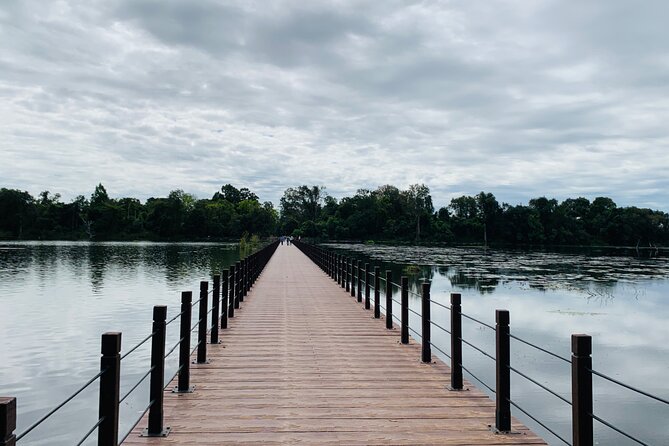
Neak Pean takes about 30 minutes and offers a different setting again. The 12th-century Buddhist sanctuary sits on a man-made island in a man-made lake. The name means Entwined Serpents, and the approach across the water gives you a break from the enclosed temple corridors.
Banteay Srei and Banteay Samre
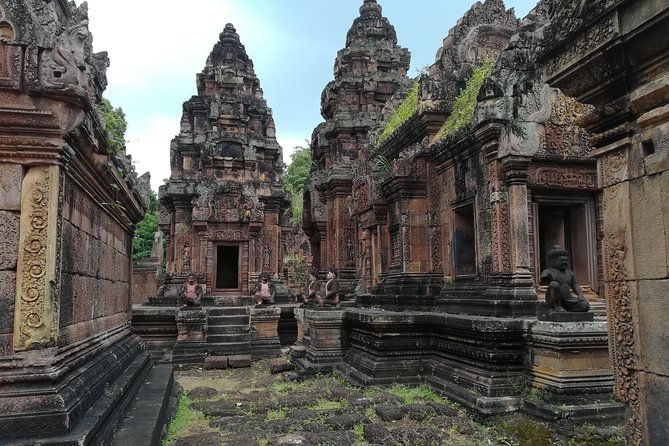
Banteay Srei is the second-day highlight for many people. The name is commonly translated as Citadel of the Women, and the temple is known for fine, delicate carvings in pink stone. Its smaller scale and careful detail make it feel different from the giant state temples.
You have about an hour there. Take time to look closely at the carved lintels, pediments, and figures rather than rushing from one doorway to the next. Banteay Srei is farther from the central Angkor group, so its inclusion is valuable if you want more than the standard short circuit.
The tour data lists admission as free at Banteay Srei, but the general temple admission note says you need one three-day Angkor Pass for each visitor. Treat the pass requirement as the rule for the visit, and confirm current admission arrangements when booking.
Banteay Samre follows, with about 40 minutes. This early 12th-century Hindu temple was dedicated to Vishnu and is often described as a smaller version of Angkor Wat. It gives you a compact look at the same broad religious and architectural world, without the vast scale of the main temple.
The tradeoff is time. Fifteen stops across two days means you will see a lot, but several visits last only 20 or 30 minutes. If you care most about detailed photography or quiet study, ask Bunpheng to remove a less important stop and give you longer at Banteay Srei, Ta Prohm, or Bayon.
Preah Khan closes the temple circuit
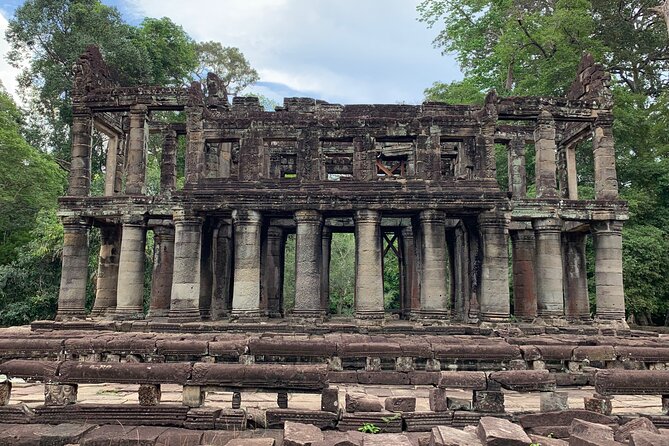
The final major stop is Preah Khan, a large 12th-century Buddhist temple built by Jayavarman VII and dedicated to his late father. Its name means Royal Sword, and its location north of Angkor Thom makes it a natural finish to the circuit.
You have about 50 minutes here. Preah Khan is sprawling, with long corridors, courtyards, carved doorways, and a mixture of Buddhist and Hindu imagery. It feels less like one compact monument and more like a full sacred complex that you gradually work through.
This is a good place to end because it brings together several themes from the two days: Jayavarman VII’s building program, Buddhist religious architecture, enclosed passageways, and the slow return of vegetation around abandoned stone. You may be tired by this point, but the air-conditioned ride between stops helps keep the schedule manageable.
Guide, vehicle, and the rhythm of the day
The tour includes an English-speaking guide and transportation in an air-conditioned car, minivan, or minibus. The exact vehicle depends on the size of your private group. Cold bottled water is also included, which is a small but useful comfort in Cambodia’s heat.
Guide Bunpheng is the name connected with the strongest praise in the supplied feedback. He is described as punctual, professional, friendly, attentive, and good at adapting the plan. One particularly useful detail is his skill as a photographer, which may help if you want assistance with family or honeymoon pictures, though photography help should be treated as a request rather than a guaranteed service.
The private arrangement means only your group joins the activity. That is helpful for families, couples, and anyone who wants to ask questions without holding up a large party. It is also useful for a short Siem Reap stay, since the company has arranged airport pickup, hotel transfers, and tailored itineraries.
The schedule is demanding. Day one begins at 9 a.m. according to the meeting information and runs through an afternoon or sunset stop. Day two begins before dawn and includes eight stops. Wear practical shoes, cover your shoulders and thighs, and tell the guide early if you need a slower pace.
Who should book this private Angkor plan
I would choose this tour if you have about two days in Siem Reap and want a broad first look without organizing several separate rides. It suits couples, families, honeymooners, and small groups who value an adjustable schedule and a named guide.
It is also a sensible choice if you want Banteay Srei included. Many short Angkor visits stay closer to the central temples, while this route reaches the pink temple and Banteay Samre as well.
I would think twice if you dislike early mornings, prefer long quiet visits, or want every temple explained in great depth. The route is ambitious, and the short stops can feel brisk. A private tour gives you room to adjust, but it cannot turn two days into a leisurely archaeological study.
Free cancellation is available when you cancel at least 24 hours before the start time. Changes or cancellations inside that window are not accepted for a refund.
Should you book it?
Book it if you want maximum temple coverage in two days, an English-speaking guide, private transportation, sunrise at Angkor Wat, and the flexibility to shape the route. The $115 tour fee is reasonable once you understand that the $62 Angkor Pass, food, drinks, and lodging are extra.
Before confirming, ask two practical questions: Which guide will lead the tour, and is the first eastern temple stop Pre Rup or East Mebon? If Bunpheng is available and the route is clarified, this is a strong, efficient introduction to Angkor for a short visit.
FAQ
What is included in the two-day Angkor tour?
The tour includes an English-speaking guide, transportation in an air-conditioned car, minivan, or minibus, and bottles of cold drinking water.
Is the Angkor entrance pass included?
No. Each visitor must have a three-day Angkor Pass. The listed price is $62 per person, and the pass is not included in the $115 tour price.
What time does the sunrise day begin?
The sunrise day begins around 4:30 or 5 a.m., depending on the season. The general meeting information also lists a 9 a.m. start, which applies to the regular tour schedule, so confirm the exact pickup time for your dates.
Is this a private tour?
Yes. Only your group participates in the activity.
What clothing is required at the temples?
You must cover your thighs and shoulders when entering the temple complex. If your clothing does not meet the dress code, you may be refused entry.
Can I cancel for a full refund?
Yes, if you cancel at least 24 hours before the experience start time. Cancellations or changes made less than 24 hours in advance are not accepted for a refund.
More early starts in Siem Reap
- Angkor Wat Sunrise tour with Small – Group and Guide tours
★ 5.0 · 3,655 reviews - Angkor Wat Highlights and Sunrise Guided Tour from Siem Reap
★ 5.0 · 3,213 reviews - Full-Day Angkor Wat Sunrise Private Tour with Guide from Siem Reap
★ 5.0 · 2,920 reviews - Angkor Wat Sunrise & 3 Main Temples with Breakfast – Small Group
★ 5.0 · 2,857 reviews
More things to do after dark in Siem Reap
- Siem Reap: Full-Day Angkor Wat Guided Tour with Sunset
★ 4.9 · 3,803 reviews - Angkor Wat Sunset Small Group Tour with Lunch Included
★ 5.0 · 3,059 reviews - Angkor 2-Day Sunset & Sunrise Small-Group Tour
★ 5.0 · 2,567 reviews - Siem Reap: Angkor Wat Sunrise or Sunset Guided Tour
★ 4.9 · 2,123 reviews
New around Siem Reap
- Kulen Mountain With Ticket included Plus Banteay Srei Temple Tour★ 5.0 · 7 reviews
- Private Siem Reap Airport Transfer to hotel in town★ 5.0 · 7 reviews
- 1-Day private Angkor Temple Tour with Sun Rise by Tuk Tuk from Siem Reap★ 4.5 · 7 reviews
- Kulen Mountain, Killing Fields and War Museum Tour★ 5.0 · 7 reviews
- War Museum, Killing Field, and APOPO Hero RATs Tour★ 5.0 · 7 reviews
- Siem Reap: Morning Cooking Class & Market Tour★ 5.0 · 7 reviews
- Half-Day: Silk Farm, Senteur Angkor, and Satcha Workshop★ 4.6 · 7 reviews
- Angkor Explorer by Cambodiajeep★ 5.0 · 7 reviews
Angkor Temple Tours, compared.
1-Day private Angkor Temple Tour from Siem Reap
Read our review →
Private Full-Day Angkor Temple and Sunset Viewing with Lunch
Read our review →
Private one-day tuktuk ‘small tour’ of the oldest Angkor temples
Read our review →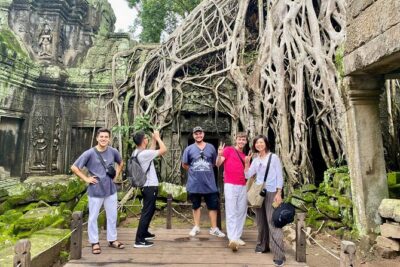
Explore Angkor Temple & Other – Private Vehicle with Tour Guided
Read our review →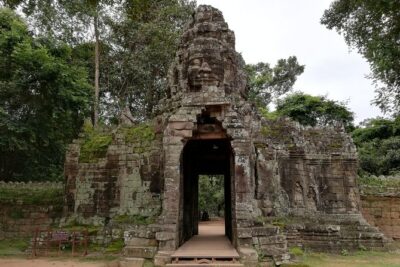
Angkor Wat Private Driver Tours to Angkor Wat Sunrise, Angkor Thom & Ta Prohm
Read our review →Browse the lists this tour appears in