
Reviewed · SIEM REAP TOURS
Private 3 Day Tour to Discover the ancient temples
Angkor Wat may be Cambodia’s headline attraction, but this three-day private tour gives you far more than one famous temple. You’ll see the jungle-wrapped stones of Ta Prohm, the smiling faces of Bayon, the delicate pink carvings at Banteay Srei, and the floating communities of Chong Kneas.
I like the private format because your group can move at its own pace, and I like the mix of major monuments with smaller sites such as Ta Som, Neak Pean, and Preah Khan. The main consideration is price: the advertised $110 does not include the $62 temple pass, $15 boat fee, meals, or drinks.
Key points to know before booking
- Banteay Srei opens the tour with fine pink sandstone carving, far from the scale of Angkor Wat but rich in detail.
- Day two covers the essential Angkor circuit, including Angkor Thom, Bayon, Ta Prohm, and three hours at Angkor Wat.
- A private vehicle and English-speaking guide make long temple days easier in Siem Reap’s heat.
- Chong Kneas adds a modern Cambodian perspective, with a boat trip through communities connected to Cambodia, Cham, and Vietnam.
- Artisans Angkor gives the final day a cultural craft stop, with wood and stone carving, lacquer work, silver plating, and silk painting.
- Guide Buth Chansip is associated with the experience, and his educational background can add useful context to the temples.
What the $110 price really covers
The base price is $110 for the three-day private experience. That includes air-conditioned private transportation, hotel pickup and drop-off, an English-speaking guide, drinking water, and travel insurance.
The important extra is the temple ticket, listed at $62 per person. The boat at Tonle Sap costs another $15 per person. Meals and beverages are also on you, so the practical cost is at least $187 per person before food if you are paying the listed admission and boat fees separately.
That is not a small add-on. Still, the value depends on how you travel. A private car, driver, guide, and three full days of sightseeing can be useful for a couple or family that wants direct hotel pickup and no shared group schedule. For a solo visitor, the total cost feels heavier.
The private setup also matters at the temples. You can ask for more explanation at Bayon, move faster through a smaller stop, or spend extra time at Preah Khan instead of being tied to a large group. The exact amount of flexibility is best confirmed with the operator before you go.
A few more Siem Reap half-days to weigh up
- From Siem Reap: Angkor Wat and Floating Village 3-Day Trip
★ 5.0 · 100 reviews - 3-Day Angkor Wat with All Interesting Major Temples, Banteay Srei & Beng Mealea
★ 5.0 · 70 reviews - 3-Day Angkor Wat & All Interesting Major Temples & Kulen Mount Waterfall
★ 5.0 · 63 reviews
Day one: Banteay Srei and the quieter northern temples
Your first day begins with hotel pickup and a drive to Banteay Srei, a 10th-century temple often called the jewel of classical Khmer art. Its name is commonly translated as Citadel of the Women, and its appeal comes from its scale and decoration rather than massive towers.
The temple uses pinkish sandstone, which allows for remarkably fine carving. Give yourself time to look closely at the lintels, doorways, and figures. This is a place where a guide can point out details you might otherwise walk past.
The scheduled visit is about one hour. Admission is not included, so you need the temple pass before entering. Banteay Srei is a strong first stop because it shows a more delicate side of Khmer design before the larger royal complexes take over.
Next comes Ta Som, a late 12th-century Buddhist temple built during the reign of Jayavarman VII. Allow about 40 minutes. It is much smaller than the great central monuments, which makes it a good contrast after Banteay Srei.
Ta Som has the compact, towered form associated with the Bayon period. You can take in its layout without the scale and crowds that make some of the larger sites feel demanding. The tradeoff is that the stop is brief, so it works best if you already have some basic temple context from your guide.
Neak Pean follows, with about 30 minutes on site. This small island temple sits in the middle of the last baray, or reservoir, built by a Khmer king in the Angkor area.
Neak Pean is less about wandering through rooms and more about its setting and design. The approach gives the visit a different rhythm from the enclosed temple compounds. It is also a reminder that Angkor was not only a collection of shrines. Water management was central to the old capital.
After lunch, you visit Preah Khan for about an hour. Built by Jayavarman VII in the late 12th century, Preah Khan is a large monastic complex with plenty to explore.
I would save energy for this stop. Preah Khan rewards slow walking through its corridors, courtyards, and carved stonework. The size can be tiring after a morning on foot, but it also makes the temple feel less like a quick photo stop.
You then return to your hotel. Day one includes four temples, and the listed visit times add up to about three hours and ten minutes, not counting driving, lunch, and entry procedures. Expect a full day rather than a quick outing.
Day two: Angkor Thom, Bayon, Ta Prohm, and Angkor Wat
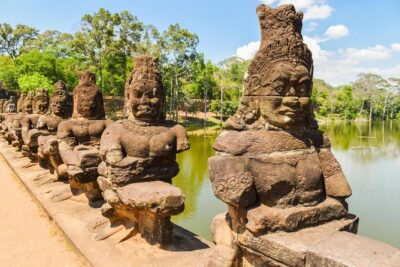
Day two is the tour’s big temple day. It starts at the South Gate of Angkor Thom, where 54 devas, or guardian gods, pull one side of the serpent and 54 asuras, or demons, pull the other.
The causeway and moat introduce the scale of Angkor Thom. You have about 15 minutes here, which is enough for a look and some photographs, but not a long examination of the sculptures. Ask your guide to explain the scene before you move on. It gives a useful introduction to Khmer religious imagery.
Bayon comes next, with about one hour. Its towers carry large carved faces, and the temple’s bas-reliefs show scenes of daily life, including markets, fishing, festivals, cockfights, jugglers, and historical events.
This is one of the best places to have a guide. The stone faces are the obvious attraction, but the reliefs reward someone who can help you read what is happening. Bayon can also feel confusing because its towers and passageways crowd together. A clear explanation turns that confusion into part of the fun.
Baphuon follows for about 30 minutes. Built in the middle of the 11th century by Udayadityavarman II, it was dedicated to Shiva. Its long raised approach and tall structure give it a different look from Bayon’s face towers.
After Baphuon, you visit Phimeanakas for another 30 minutes. Built in the late 10th or early 11th century under Jayavarman V and Udayadityavarman I, it was also dedicated to a Hindu deity.
These two stops are shorter and less famous than Bayon, but they help you see the range of Angkor Thom. The drawback is that the morning contains several sites in succession. If you want detailed commentary at every temple, the schedule may feel tight.
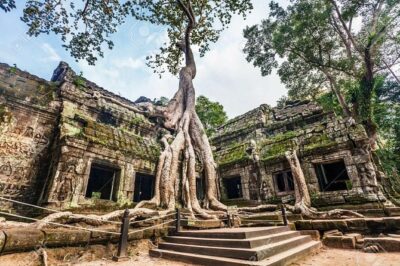
Ta Prohm is the final major stop before Angkor Wat, with about one hour planned. Known as the Jungle Temple, it is famous for enormous fig, banyan, and kapok roots spreading over the stonework.
Ta Prohm has a strong visual identity, but it is not only a setting for dramatic photographs. The trees and fallen blocks show how the temple looked before full restoration, while the carved galleries reveal the original ambition of the complex.
You’ll want sturdy shoes and water here. The ground can be uneven, and the day’s walking adds up. The private vehicle helps because you can return to it between sites instead of carrying everything through every temple.
In the afternoon, you spend about three hours at Angkor Wat. Built by Suryavarman II in the early 12th century, it began as a Hindu temple and later became a Buddhist complex. It is the largest religious monument in the world.
Three hours is a sensible amount of time for a first visit. You can study the outer galleries, see the bas-reliefs, cross the courtyards, and take in the central towers without treating the temple as a rushed photo stop.
Angkor Wat is also physically demanding. You are covering a large complex after several other temples, so keep some energy in reserve. The schedule puts Angkor Wat in the afternoon, rather than promising a sunrise visit. That may suit you if you prefer a later start, but it will not meet your expectations if sunrise photography is your main goal.
Day three: Chong Kneas on Tonle Sap
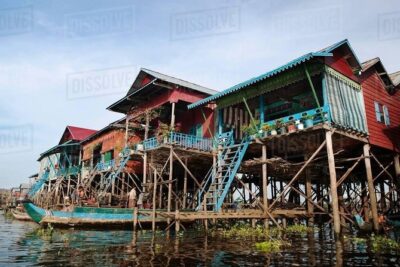
The final day shifts from ancient stone to present-day life on Tonle Sap. You travel to Chong Kneas, a floating village, and spend about two hours taking a boat through communities described as Cambodian, Cham, and Vietnamese.
This stop matters because it widens the tour beyond temple architecture. You see how water shapes daily life and how different communities share the lake environment. It is a change of pace after two demanding days among ruins.
The boat fee is not included and is listed at $15 per person. That extra cost should be part of your booking decision. The visit is also weather and water dependent in character, so keep your expectations focused on seeing the community and lake setting rather than treating it as another monument.
After Chong Kneas, you visit Artisans Angkor for about an hour. This fine arts school and workshop focuses on wood and stone carving, lacquer work, silver plating, and silk painting.
Artisans Angkor is included in the tour price. It gives you a practical look at Cambodian craft traditions and provides a calmer final stop after the boat ride. If you are choosing souvenirs, the workshop setting can help you understand how the objects are made.
The third day is shorter in listed sightseeing time than the temple days, but it still has transfers and a boat journey. It works well as a closing day because it connects Cambodia’s ancient achievements with living craft and community life.
A completely different sort of day from the same base:
- Angkor Wat Sunrise or Sunset Tour with Guide from Siem Reap
★ 5.0 · 12,109 reviews - Siem Reap: Angkor Wat: Small-Group Sunrise or Sunset Tour
★ 5.0 · 9,444 reviews - From Siem Reap: Kampong Phluk Floating Village Tour by Boat
★ 4.9 · 6,979 reviews - Sunset tour of Kampong Phluk stilts home village on the Tonle Sap
★ 5.0 · 4,865 reviews
Why the private format helps
This is a private activity, so only your group participates. That makes a real difference at Angkor, where the combination of heat, long walks, and repeated entry points can make a fixed group schedule tiring.
Your transport is private and air-conditioned. You are picked up and returned to your hotel each day, and drinking water is included. Those details sound basic, but they matter when you are moving between multiple temples.
The English-speaking guide is the other main value. Buth Chansip is associated with this experience, and a previous booking specifically credited his educational background and temple explanations. If he is assigned to your group, ask him to compare the Hindu and Buddhist features, explain the everyday scenes at Bayon, and point out how the temples changed under different kings.
Do not assume every guide will offer the same style. Guide quality can shape this tour more than the vehicle or water. If detailed history is important to you, ask whether Buth Chansip is available or request a guide who gives substantial explanation rather than only escorting you between entrances.
Who will get the most from these three days
I would recommend this tour to a first-time Siem Reap visitor who wants the major temples but does not want to spend every day on the same central circuit. The inclusion of Banteay Srei, Preah Khan, Neak Pean, Ta Som, Tonle Sap, and Artisans Angkor gives the trip useful variety.
It also suits families and small groups. Private transport, hotel pickup, and the ability to stay together simplify a busy three-day plan. Most people can participate, according to the activity information, and the tour is near public transportation, though the sightseeing itself involves walking around temple grounds.
You should think twice if your main goal is a slow, photographic study of only Angkor Wat. The schedule covers many places, and some stops have only 15 or 30 minutes. It is designed for broad coverage, not long quiet sessions at every monument.
You should also budget carefully. The $110 headline price is only the tour service. Add the temple ticket, boat fee, meals, and drinks before comparing it with other private options.
Practical details that affect your decision
Confirmation is provided when you book, and mobile tickets are supported. Hotel pickup and drop-off are included, but you should provide accurate accommodation details so the daily collection runs smoothly.
Temple admission is not included on any of the temple stops. The listed price is $62 per person. The Chong Kneas boat is also separate at $15 per person, while Artisans Angkor admission is included.
The cancellation terms are straightforward: you can cancel at least 24 hours before the local start time for a full refund. Cancellations or changes made inside that 24-hour window are not accepted for a refund.
The tour includes travel insurance, but the supplied details do not explain its limits or coverage. If that matters to you, ask the provider for the policy terms before booking.
Should you book this Siem Reap temple tour?
Book it if you want a private three-day overview of Angkor and nearby cultural sights, with hotel transport and an English-speaking guide included. The strongest parts are the range of temples, the private vehicle, and the chance to pair ancient monuments with Tonle Sap and Cambodian craft.
The best value comes when two or more people share the private arrangement. Add the $62 temple pass, $15 boat fee, and meals to the $110 price before deciding.
I would choose it for a first visit, especially if you want guidance at Bayon and Angkor Wat but also want smaller temples and a day away from the main ruins. I would look for a slower custom itinerary if you have already seen Angkor or prefer spending an entire morning at one site.
FAQ
Is this a private tour?
Yes. Only your group participates in the activity.
How long does the tour last?
The tour lasts approximately three days.
Is hotel pickup included?
Yes. Hotel pickup and drop-off are included.
Is transportation included?
Yes. The tour includes private, air-conditioned transportation.
Is an English-speaking guide included?
Yes. A private English-speaking tour guide is included.
Is the Angkor temple ticket included?
No. The temple ticket costs $62 per person and is not included in the tour price.
Is the Tonle Sap boat ride included?
No. The boat fee for Chong Kneas is listed at $15 per person.
Are meals and drinks included?
No. Meals and beverages are not included. Drinking water is included.
Can I cancel for a full refund?
Yes. You can cancel at least 24 hours before the experience start time for a full refund. Changes or cancellations made less than 24 hours before the start time are not accepted for a refund.
New around Siem Reap
- Siem Reap Temple and Waterfall 3-Day Tour★ 4.5 · 3 reviews
- Siem Reap: Guided Day Trip to Local Village & Cooking Class★ 5.0 · 3 reviews
- Savor the Countryside: Tours with Authentic Cooking Classes”★ 5.0 · 3 reviews
- Siem Reap Private Tour: Angkor Wat Sunrise And Banteay Srei★ 5.0 · 3 reviews
- Angkor Wat Sunset In Private and Small-In-Group★ 4.3 · 3 reviews
- Angkor Wat Sunrise TukTuk Tour★ 5.0 · 3 reviews
- Exclusive Angkor temples and Small group temples tours★ 5.0 · 3 reviews
- Angkor Wat: Highlights and Sunrise with Spanish Guide★ 4.8 · 3 reviews
Siem Reap Tours, compared.
Angkor Wat Sunrise or Sunset Tour with Guide from Siem Reap
Read our review →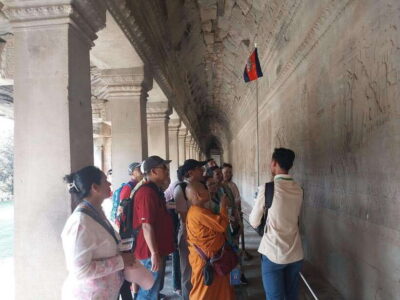
Angkor Wat: Small-Group Sunrise or Sunset Tour
Read our review →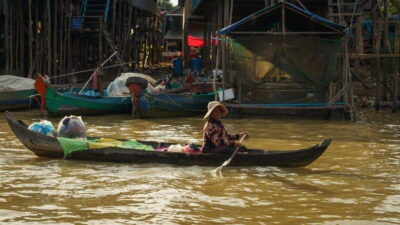
Sunset tour of Kampong Phluk stilts home village on the Tonle Sap
Read our review →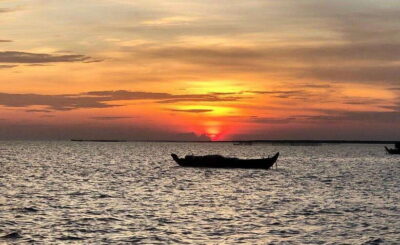
Kampong Phluk Floating Village Tour with Boat
Read our review →
Angkor Wat Sunrise tour with Small – Group and Guide tours
Read our review →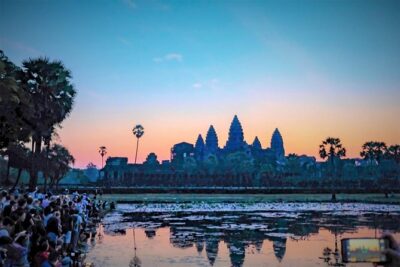
Angkor Wat Highlights and Sunrise Guided Tour from Siem Reap
Read our review →Browse the lists this tour appears in