
Reviewed · SIEM REAP TOURS
Angkor Cab: Siem Reap 3 day private tour: ‘off the beaten track’
Angkor Cab’s three-day route pairs Cambodia’s famous temples with quieter places such as Banteay Srei and Beng Mealea. I like the private format, which lets you set a relaxed pace, and I like the practical comfort of a driver, air-conditioning, and bottled water between sites. The main drawback is cost: at $550 for up to three people, it is good value for a full car and guide, but less attractive for solo visitors.
I also like that the schedule is not locked into one rigid pattern. You get a 5am start for Angkor Wat, a 9am departure for Beng Mealea, and room to request a different start or finish time in advance. Just remember that food, admission tickets, and extra activity fees are not included, so your final cost will be higher.
Key points to know before booking
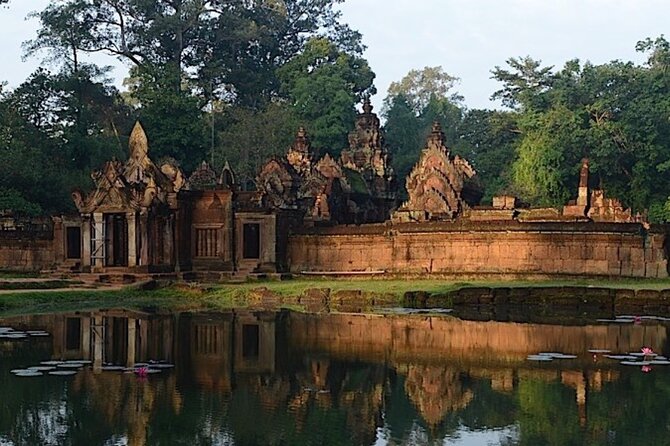
- Banteay Srei brings finely carved pink sandstone and a long, scenic drive through rural Cambodia.
- Angkor Wat at sunrise starts at 5am, so this is a full sightseeing program, not a late-rising holiday.
- Beng Mealea adds a wilder temple setting far beyond the main Angkor circuit.
- Tonle Sap gives you a change of scene, with two hours at Southeast Asia’s largest freshwater lake.
- The $550 private rate covers up to three people, including a driver, professional guide, and bottled water.
- Temple passes and meals are extra, with lunch estimated at $5 to $10 per person.
Why this three-day route works well
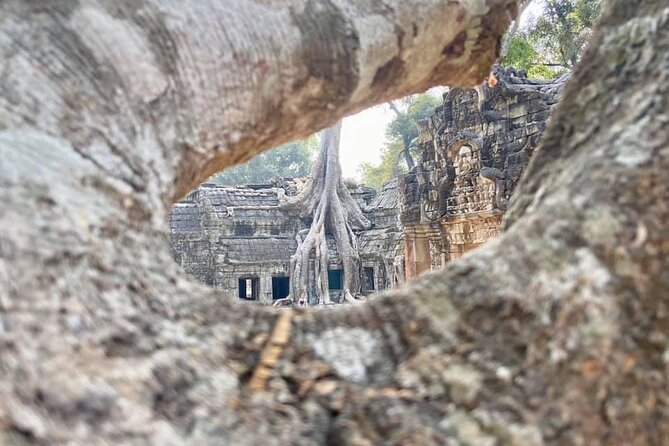
Many Siem Reap visitors see Angkor Wat, Ta Prohm, and the Bayon, then leave with only a partial sense of the wider temple region. This program gives you those essential monuments, but also reaches Banteay Srei, Beng Mealea, Tonle Sap, and the early Khmer capital at Hariharalaya.
That mix matters. You get the grand scale of Angkor Wat, the famous tree-covered ruins at Ta Prohm, smaller temples with delicate carvings, and a look at village life along the roads. You also spend time in the countryside rather than circling only the most popular monuments.
The tour is private, so only your group takes part. That makes the $550 group price easier to assess. For three people, the tour works out to about $183 per person before tickets and meals. For two, it is $275 each. A solo visitor pays the full group rate, which is a much harder bargain.
The package includes a driver, a professional English-speaking temple guide, and bottled water. A private Lexus has been used for at least one small family group, though you should confirm the vehicle type when booking if that matters to you. The important point is that you are not joining a large bus. You have a private car and the chance to ask for changes in the plan.
Panha is the named contact associated with the operation, and the experience is designed around safe driving, clear English instruction, and flexible timing. Ask in advance about your preferred pickup time, vehicle, and any place you want added or removed.
A few more Siem Reap half-days to weigh up
- From Siem Reap: Angkor Wat and Floating Village 3-Day Trip
★ 5.0 · 100 reviews - 3-Day Angkor Wat with All Interesting Major Temples, Banteay Srei & Beng Mealea
★ 5.0 · 70 reviews - 3-Day Angkor Wat & All Interesting Major Temples & Kulen Mount Waterfall
★ 5.0 · 63 reviews
Day one: Banteay Srei and the quieter eastern temples
The first day begins with a drive of about 45 minutes to Banteay Srei. The road itself is part of the appeal. You pass local activity and see more of the area around Siem Reap before reaching the temple.
Banteay Srei dates to the 10th century and is known for its pink sandstone and careful carving. It is smaller than Angkor Wat, but the detail rewards close attention. Your guide explains the carvings and the temple’s design during roughly an hour on site.
Admission is not included, so you need the correct temple pass separately. The schedule also gives you only about an hour here. That is enough for a focused visit, though people who love carved stone may want more time.
Next comes Banteay Samre, a 12th-century temple about 400 meters east of the East Baray. The site usually feels more contained than Angkor Wat, and its position makes it a useful contrast with Banteay Srei. You have about 45 minutes for the visit and an explanation from your guide.
The route then pauses for a local lunch before continuing to Banteay Kdei. Lunch is not included. The stated estimate is $5 to $10 per person, depending on what you choose, and you can also bring your own food.
Banteay Kdei means Citadel of Chambers. It was built in the mid-12th to early 13th century under Jayavarman VII as a Buddhist temple. You spend about an hour here, with the guide pointing out details that can be easy to miss when you walk among the galleries and chambers.
After Banteay Kdei, you walk across to Srah Srang. This large reservoir was built in the mid-10th century and later modified under Jayavarman VII. The stop lasts around 30 minutes. It is less about entering another major monument and more about seeing how water shaped Khmer cities and ceremonial spaces.
The final stop is Tonle Sap Lake, about a two-hour visit. The lake changes greatly with the seasons, covering about 10,000 square kilometers during the wet season and around 3,000 in the dry season. It touches five Cambodian provinces and is central to life in the region.
Tonle Sap gives the first day a useful change of rhythm. After hours of stone temples, you see a major natural feature and the communities connected to it. The exact activities available at the lake are not specified, and any extra activity fees are excluded, so ask what your visit will include before you set out.
Day two: the 5am Angkor Wat sunrise start
Day two begins around 5am, with about a 30-minute drive from your hotel to Angkor Wat. Sunrise is one of the most popular times to visit, so you should expect an early start and a busy setting even though the wider route aims to avoid as many crowds as possible.
The visit lasts about three hours. That gives you time to see the famous exterior view, enter the temple complex, and listen to the guide explain its structure and decoration. Angkor Wat is not a quick photo stop. The scale can be tiring, especially after waking before dawn, so wear practical shoes and use the supplied water.
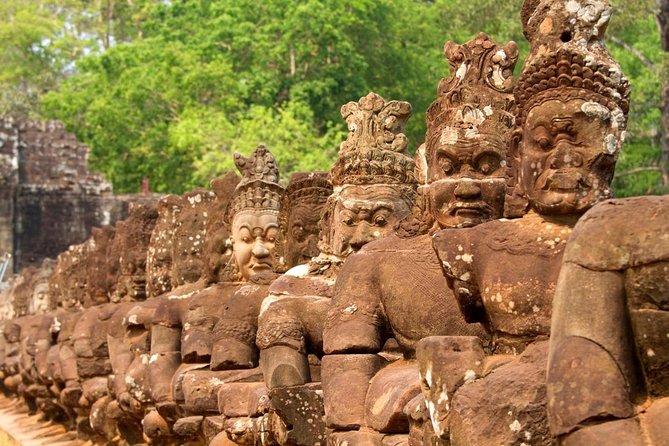
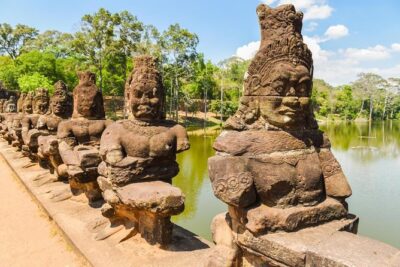
After Angkor Wat, it is about a five-minute drive to Angkor Thom. The route includes a stop at the South Gate for photographs before you continue into the ancient capital. The full Angkor Thom visit lasts about two hours.
Angkor Thom is best understood as a city area rather than a single temple. The route description does not name every monument included within the stop, so ask your guide which parts you will see. The two-hour window gives you a useful amount of time, but it can pass quickly if you want detailed explanations at every structure.
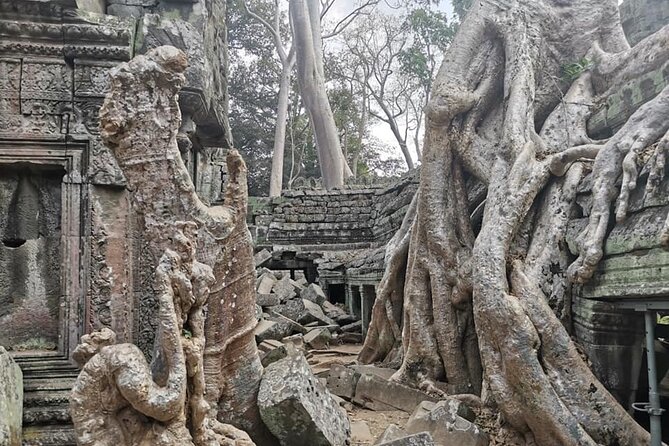
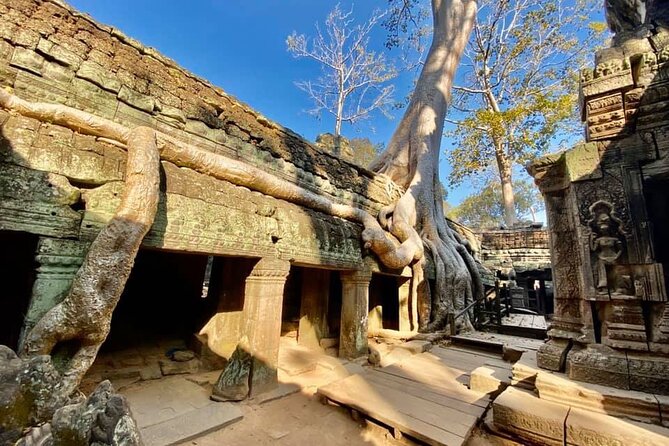
Ta Prohm follows, about a 15-minute drive away. On the way, the route pauses at a stone bridge with a tree growing over it. That small stop adds variety and gives you a chance to see how vegetation has become part of the visual character of several Angkor sites.
You spend about an hour at Ta Prohm, with lunch arranged during the day at your own expense. Ta Prohm is famous for trees growing over its stonework, but the appeal is not only photographic. The site shows how a large religious complex can feel enclosed, tangled, and very different from the open scale of Angkor Wat.
Day two is the most demanding day physically. You leave before dawn, walk across several temple areas, and spend much of the day outdoors. The stated fitness level is moderate. If you prefer slow walks and long explanations, tell the guide early so the pace can be adjusted where possible.
Day three: Beng Mealea and the first Khmer capital
The third day starts around 9am, a welcome change after the sunrise morning. You drive about an hour and a half to Prasat Beng Mealea. The journey passes local activity and gives you another look at daily life outside central Siem Reap.
Beng Mealea receives about three hours, making it the longest temple stop of the tour. That is sensible. The site is far from the central Angkor group, and the longer visit makes the drive worthwhile rather than treating it as a rushed photo stop.
The itinerary describes Beng Mealea as an ancient temple setting away from the main crowds. Its distance and three-hour schedule make this the strongest part of the tour for people who want a less standard Angkor day. Admission is extra, and you should confirm the ticket requirement before departure.
After Beng Mealea, the route continues to Bakong. This temple belonged to Hariharalaya, an early Khmer capital, and was built in the 9th century under King Indravarman I. The stop lasts about 40 minutes.
Bakong is a useful historical counterpoint to the later temples. Its earlier date helps you see how Khmer temple design developed before the huge monuments of Angkor. Your guide can connect the site to the wider story of the early capital and explain what changed in later centuries.
Preah Ko is the final stop. Its name means Sacred Bull, and it was built in 879 by the Hindu King Indravarman I and dedicated to Shiva. You have about 30 minutes here.
Preah Ko and Bakong work well together because both relate to Hariharalaya and the early period of Khmer construction. The final stop is brief, so this is not the place for a long, slow study. It is a compact finish after Beng Mealea’s bigger block of time.
A completely different sort of day from the same base:
- Angkor Wat Sunrise or Sunset Tour with Guide from Siem Reap
★ 5.0 · 12,109 reviews - Siem Reap: Angkor Wat: Small-Group Sunrise or Sunset Tour
★ 5.0 · 9,444 reviews - From Siem Reap: Kampong Phluk Floating Village Tour by Boat
★ 4.9 · 6,979 reviews - Sunset tour of Kampong Phluk stilts home village on the Tonle Sap
★ 5.0 · 4,865 reviews
The guide, car, and pace
The private setup is the tour’s strongest practical feature. You are not waiting for a large group to gather at every entrance, and you can ask questions without competing for the guide’s attention. That is especially useful at Banteay Srei, where small carvings and decorative details deserve explanation.
The driver is included, and the operation emphasizes safe driving. Air-conditioning is important in Siem Reap, where long temple days can become hot and tiring. Bottled water is included, and a private vehicle can be kept ready between stops.
The schedule is flexible, but do not confuse flexible with effortless. This is still a packed three-day program. Day one includes several temples and Tonle Sap. Day two starts at 5am. Day three involves a long drive to Beng Mealea and back through more temple sites.
You should tell the operator about your preferred start and finish times before the tour. The general meeting information gives a 9am start, but the day two plan clearly begins at 5am. Day three begins around 9am. Confirm the exact pickup plan for each day rather than assuming one start time applies to all three.
What the $550 price really covers
The $550 rate is for a private group of up to three people. It includes the driver, professional guide, bottled water, and private transportation. It does not include food and drinks, lunch, the Angkor Temple Pass, or other activity fees.
For a group of three, the rate offers a practical way to combine private transport and guiding over three days. You avoid arranging separate rides to distant temples and do not have to build the route yourself. For two people, the value depends on how much you care about privacy and flexibility.
The price is less convincing for one person. A solo visitor pays the same group rate, then adds tickets and meals. If you are alone, compare the cost with a shared group tour. If you are a couple or small family, the private format is easier to justify.
Bring money for lunches and any lake activities. The lunch estimate of $5 to $10 per person helps with planning, but your total will depend on your food choices. Temple admission is also a separate expense, and the exact pass needed should be confirmed before you arrive.
Free cancellation is available when you cancel at least 24 hours before the start time. Changes made within that final 24-hour window are not accepted, so settle your pickup and itinerary requests early.
Who should book this private Siem Reap tour
I would choose this for a first visit to Siem Reap if I wanted the major Angkor temples without giving up the quieter sites. The route provides a solid first orientation, then adds countryside, a lake, an early Khmer capital, and Beng Mealea.
It suits couples, families, and small groups of friends who value their own car and a private guide. It is also a good fit if you want to request a different starting time or add a preferred place in advance.
I would hesitate if you dislike early mornings, long drives, or walking on uneven temple ground. The 5am Angkor Wat start is not optional in the stated plan, and day three’s Beng Mealea drive takes about 90 minutes each way.
FAQ
How long is the Angkor Cab private tour?
The experience lasts approximately three days.
How much does the tour cost?
The price is $550 per private group of up to three people.
Is the tour private?
Yes. Only your group participates in the activity.
What is included in the price?
The price includes bottled water, a driver, a professional guide, and private transportation.
Are temple admission tickets included?
No. The Angkor Temple Pass and other admission tickets are not included.
Are meals included?
No. Food and drinks are excluded. Lunch is estimated at $5 to $10 per person, depending on what you choose, and you may bring your own food.
What time does the tour start?
The general meeting information gives a 9am start, but day two begins around 5am for the Angkor Wat sunrise. Day three begins around 9am. Confirm each day’s pickup time in advance.
Is Tonle Sap Lake part of the tour?
Yes. The first day includes about two hours at Tonle Sap Lake. Any extra activity fees are not included.
What level of fitness is needed?
A moderate level of physical fitness is recommended. The program includes several temple visits, walking, an early morning start, and a long day at Beng Mealea.
Should you book it?
Book this tour if you want three days of private transport and guiding that reach well beyond the standard Angkor Wat circuit. The best reasons are the quiet eastern temples, the long Beng Mealea visit, the Tonle Sap stop, and the freedom to shape the pace for your own group.
Think twice if you are traveling alone or want a slow holiday with late starts. With separate temple tickets and meals, the cost rises, and day two begins at 5am. For a small group ready for full days, careful planning, and a useful mix of famous and less-visited places, Angkor Cab offers a strong, practical way to see Siem Reap.
New around Siem Reap
- Kulen Mountain With Ticket included Plus Banteay Srei Temple Tour★ 5.0 · 7 reviews
- 2 Days Angkor temples with Sunrise & Sunset★ 5.0 · 7 reviews
- Private Siem Reap Airport Transfer to hotel in town★ 5.0 · 7 reviews
- 1-Day private Angkor Temple Tour with Sun Rise by Tuk Tuk from Siem Reap★ 4.5 · 7 reviews
- Siem Reap: Morning Cooking Class & Market Tour★ 5.0 · 7 reviews
- Kulen Mountain, Killing Fields and War Museum Tour★ 5.0 · 7 reviews
- War Museum, Killing Field, and APOPO Hero RATs Tour★ 5.0 · 7 reviews
- Half-Day: Silk Farm, Senteur Angkor, and Satcha Workshop★ 4.6 · 7 reviews
Siem Reap Tours, compared.
Angkor Wat Sunrise or Sunset Tour with Guide from Siem Reap
Read our review →
Angkor Wat: Small-Group Sunrise or Sunset Tour
Read our review →
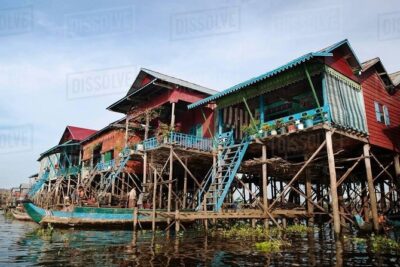
Sunset tour of Kampong Phluk stilts home village on the Tonle Sap
Read our review →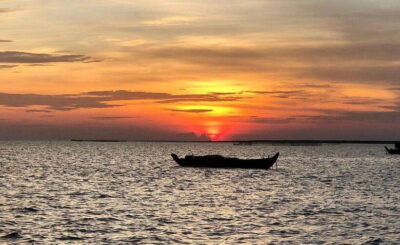
Kampong Phluk Floating Village Tour with Boat
Read our review →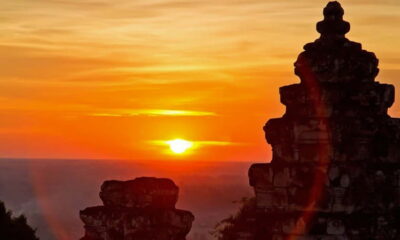
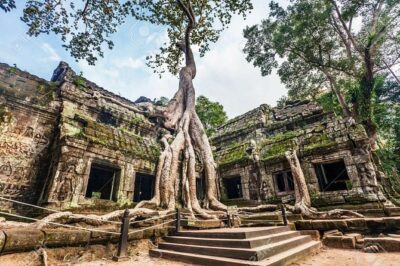
Angkor Wat Sunrise tour with Small – Group and Guide tours
Read our review →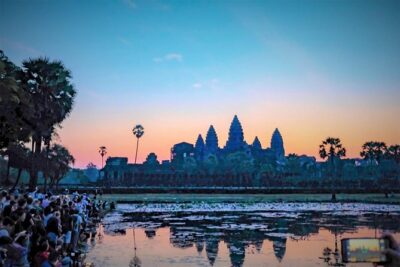
Angkor Wat Highlights and Sunrise Guided Tour from Siem Reap
Read our review →Browse the lists this tour appears in