
Reviewed · ANGKOR WAT TOURS
Angkor Wat 2-Day Tour
Angkor Wat is only the beginning here. This private two-day Siem Reap tour takes you through the great temples of Angkor Thom, the smiling towers of Bayon, tree-covered Ta Prohm, and smaller sites that are easy to miss on a rushed visit. The experience also includes an attempt at sunset at Angkor Wat or Phnom Bakheng.
I like the private format, since your group can work with the guide and driver on the pace and route. I also like the simple comforts: transport, drinking water, and cold towels matter a great deal after walking through hot stone courtyards. The main drawback is that temple tickets, lunch, and personal expenses are not included, and the second day is not described in the same detail as the first.
Key points to know before booking
- Bayon’s 216 carved faces give Angkor Thom its most memorable encounter.
- Ta Prohm and its giant trees provide the tour’s best-known photo stop, made famous by Tomb Raider.
- Private transport lets your group request reasonable changes, as drivers such as Ly Hol and Vutha have done for past bookings.
- Cold towels and drinking water are included, a small touch that becomes valuable in Cambodia’s heat.
- Temple tickets and lunch are extra, so budget beyond the $360 tour price.
- The itinerary needs clarification for day two, since the advertised highlights are the River of a Thousand Lingas and another major Angkorian site, while the detailed stop-by-stop plan focuses mainly on day one.
Why two days works better than one long temple day
Angkor Archaeological Park is not one compact monument. It is a large collection of temples, gates, terraces, reservoirs, and forest paths spread around the former Khmer capital. A two-day visit gives you time to see the famous places without treating every stop as a quick photograph from the vehicle.
The first day begins at 8:00 am with transport from Siem Reap. That is not an early sunrise departure, so you get a more manageable start, though you will miss the classic dawn reflection at Angkor Wat unless you arrange a separate early visit with the operator.
The plan then follows the familiar small circuit around Angkor Thom and the nearby temples. At the end of the day, you head toward a sunset site at Angkor Wat or Phnom Bakheng. The second day is presented as a visit to the River of a Thousand Lingas and another major example of Angkorian art, but you should ask for the exact route before paying.
That missing detail matters. Day two could be the part that makes the price worthwhile, yet the information provided does not name every stop, explain the departure time, or say how long you will spend at each site. A quick message to Cambodia Golden Tours can clear this up.
More Angkor Wat Tours in Siem Reap:
- Angkor Wat Sunrise or Sunset Tour with Guide from Siem Reap
★ 5.0 · 12,109 reviews - Siem Reap: Angkor Wat: Small-Group Sunrise or Sunset Tour
★ 5.0 · 9,444 reviews - Siem Reap: Angkor Wat 2-Day Tour with Sunrise and Sunset
★ 4.9 · 4,429 reviews
Angkor Wat: begin with the monument everyone came to see
Angkor Wat is the first major stop and the anchor of the tour. It is the largest religious building in the world, with broad galleries, towers, courtyards, and long views across the temple grounds. Even after you have seen countless photographs, the scale becomes clear only when you walk through it.
I would give this stop real time. The outer walls and approach can feel orderly and grand, while the interior galleries reward slower attention. Look for carved scenes and architectural details rather than racing straight to the central towers.
The practical issue is heat. The tour includes water and cold towels, but you will still spend much of the day walking outdoors and on uneven stone. Wear sturdy footwear and clothing that covers the shoulders and knees, since a temple dress code applies.
Temple admission is not part of the $360 price. This is one of the first costs to add to your calculations, along with lunch near the temples. The mobile ticket feature makes the booking convenient, but it does not mean the temple pass is included.
South Gate and Bayon: the strongest part of Angkor Thom
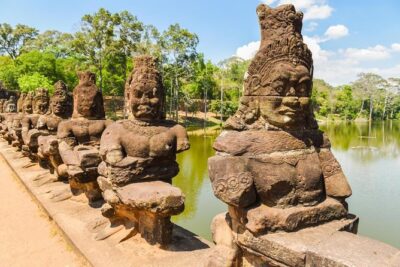
The South Gate is a fine introduction to Angkor Thom. A causeway leads toward the gate between two rows of figures, devas and asuras from the Hindu story of the Churning of the Sea of Milk. These carved figures once gave the approach a ceremonial force, and they still make the entrance more than a simple checkpoint.
From the gate, it is about one kilometer to Bayon. Bayon was the state temple of King Jayavarman VII and the central religious monument of Angkor Thom. Its 54 towers carry 216 carved faces associated with Avalokiteshvara, giving the temple an unusual human presence.
This is the place where a guide can add real value. The towers overlap in a maze of galleries, and it is easy to look up, take a picture, and leave without understanding the plan. An English-speaking guide can point out the faces, reliefs, and changing angles of the temple.
Bayon is also a difficult site for anyone who dislikes crowds or tight passageways, although the private format gives you more control over how long you stay. I would not rush this one. The faces change expression as you move around them, and the best views are not all from the same courtyard.
Baphuon and the royal terraces
Baphuon is the second-largest temple in Angkor Thom and was built in the mid-11th century as a state temple dedicated to Shiva. Its three-tiered, pyramid shape gives it a different character from Bayon, which feels enclosed and intricate.
You will notice the effort required to reach higher levels. Stone steps and elevated platforms are part of the experience, so this stop may feel more demanding than a flat walk around a courtyard. The reward is the architecture and the sense of how the temple dominated its surroundings.
Next come the Terrace of Elephants and the Terrace of the Leper King. The Terrace of Elephants stretches about 350 meters along the front of the former royal palace. It served as a viewing platform for public ceremonies and as a place where the king could watch military training.
The Terrace of the Leper King is beside it, to the north. Its carved interior walls are the reason to look beyond the broad outer face. These terraces are less about entering a single temple and more about reading the old royal center as a ceremonial zone.
A few more Siem Reap half-days to weigh up
- Angkor 2-Day Sunset & Sunrise Small-Group Tour
★ 5.0 · 2,567 reviews - 2 Days Exclusive Temple Highlights with Sunset and Sunrise Tour
★ 5.0 · 1,157 reviews - Siem Reap: Angkor Sunrise 1- or 2-Day Guided Temples Tour
★ 4.9 · 1,132 reviews - 2 Days Guided Historical Tour in Angkor
★ 5.0 · 855 reviews
Chau Say Tevoda, Thommanon, and Takeo
Outside Angkor Thom, the route includes Chau Say Tevoda, Thommanon, and Takeo. These temples are smaller than Angkor Wat and Bayon, but that is part of their appeal. You can focus on details without the sheer scale of the main monuments taking over every view.
Chau Say Tevoda and Thommanon are especially useful for seeing how related temple forms can differ in decoration and condition. Takeo has a more severe, block-like appearance and a strong stepped design.
The itinerary says these temples should not be missed, but it does not give a precise time allowance for each. That is another point worth discussing with your guide. If your group wants detailed explanations, ask the guide to protect enough time here instead of spending the whole afternoon at the most famous sites.
Ta Prohm, where stone and trees share the frame
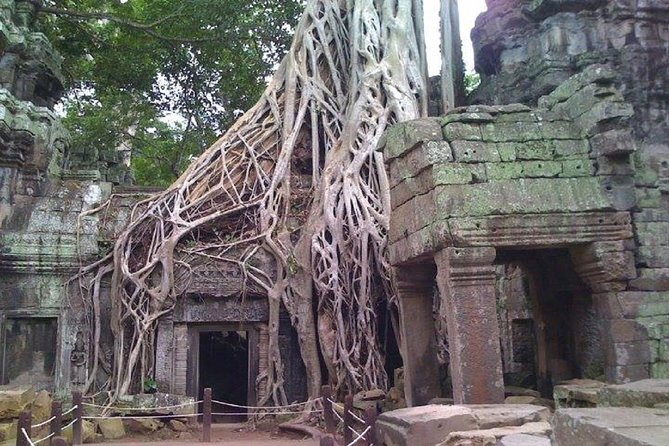
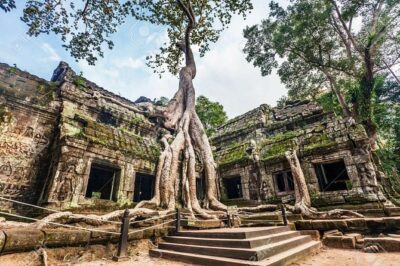
Ta Prohm is the most theatrical stop on the route. It was used as a Buddhist monastery and university during the Angkor period, and large trees now grow through parts of the temple. The result is a place where roots, galleries, fallen stones, and carved doorways occupy the same view.
The Tomb Raider connection has made Ta Prohm one of Angkor’s busiest photo stops. That fame can work against the atmosphere, especially around the best-known tree. Still, the temple is worth your time because its condition gives you a clearer sense of how forest and weather affected the ruins.
I would let the guide lead you beyond the first obvious picture spot. The most useful visit is not simply a photograph under a tree. Look at how the roots press against the walls and how the corridors open and close as you walk.
Uneven surfaces and confined passages can make Ta Prohm slower than it looks on a map. Keep your phone and other belongings secure, and do not climb on the ruins. The tour is private, so you can ask for a slower pace if someone in your group needs it.
Banteay Kdei and Srah Srang for a quieter change of pace
Banteay Kdei lies near Ta Prohm and has recently been restored, while the surrounding forest helps keep the setting quiet and somewhat mysterious. It is a good counterpoint to the more famous temples, particularly if you want to notice small carvings and the way the jungle frames the buildings.
Next to Banteay Kdei is Srah Srang, a baray, or reservoir, connected with the temple complex. The water gives the stop a wide, open feel after the enclosed galleries of Ta Prohm and Bayon.
Srah Srang is promoted as a sunrise and sunset location. On this tour, the stated sunset choice is Angkor Wat or Phnom Bakheng, so do not assume Srah Srang is part of the sunset plan unless the guide confirms it. It may be included at another time, but the timing is not specified.
Sunset at Angkor Wat or Phnom Bakheng
The day ends with a sunset attempt at Angkor Wat or Phnom Bakheng. Angkor Wat offers the familiar silhouette of towers and broad temple views. Phnom Bakheng sits on a hill and is valued for its elevated position and temple setting.
Your actual choice may depend on conditions, access, and the guide’s plan. The description presents these as alternatives rather than promising both. Sunset locations can also be busy, so keep expectations sensible. You are choosing a striking end to a long temple day, not guaranteed solitude.
This final stop is one reason the 8:00 am start can turn into a full day. You will have walked through several large compounds before reaching the sunset point. The cold towel waiting with the driver can be more useful at this hour than it sounds on paper.
What the guides and drivers add
The operator assigns an English-speaking guide and transportation for your private group. Named staff connected with this experience include Vutha, Ly, Lucky, Pheach, Bunanal, and Ten, though you should confirm who will lead your booking.
The strongest pattern in the service is flexibility. Ly Hol has accommodated suggested detours, while Vutha has arranged alternatives when a preferred guide was unavailable. One booking also included airport pickup and help choosing a hotel, but you should treat those as arrangements to confirm, not automatic parts of this temple package.
Lucky has also worked as a guide and professional photographer. If photographs matter to you, ask in advance if that service is available for your dates. Do not assume every guide offers photography simply because it has been part of some tours.
The drivers are repeatedly praised for punctuality, friendliness, and care with water and cold towels. A private driver is especially useful at Angkor because you return to the vehicle between sites, rather than staying with a fixed large group all day.
An optional Tonle Sap Lake visit has also been arranged for some bookings, including a boat ride through a fishing village on stilts. That is not listed among the included features here, so ask about price, timing, and availability before adding it.
Is $360 good value?
At $360, the tour is not a cheap way to see Angkor. Its value depends on what that figure covers and how many people share the private vehicle and guide. Since the experience is private, a couple or family may find the cost more reasonable than a solo visitor paying the full amount.
You are paying for two days of transport, an English-speaking guide, and a flexible private arrangement. Water and cold towels are included, which are modest but useful benefits in the heat. You are not paying for temple tickets, lunch, or personal expenses.
For a solo visitor, the price deserves closer comparison with group tours. One person was able to arrange a private tour with a driver and English-speaking guide through the same operator, so solo booking is possible, but the cost per person will naturally be higher.
For families, the private format has a stronger case. Vutha has been praised for being good with children, including a three-year-old, and the ability to pause or adjust the day can make a major difference. Still, confirm the vehicle type and seating setup if you are traveling with young children.
Small details that make the day easier
Start with the temple dress code. Wear clothing that covers your shoulders and knees, and choose shoes that can handle uneven paths and stairs. The rules apply at the temples, so packing a light layer or cover-up is sensible.
Bring extra money for the temple tickets, lunch near the temples, and personal purchases. The tour price does not cover those items, and the provided water should not be treated as a substitute for planning your own daily needs.
Keep the day flexible. You can ask the guide about the order of stops, the sunset choice, and possible detours, but the practical limit is the length of the day. More flexibility does not mean unlimited time at every temple.
The experience is private, and confirmation is provided at booking. Cancellation is free if you cancel at least 24 hours before the local start time. A cancellation or change made inside that 24-hour window is not refunded or accepted.
Who should book this two-day Angkor tour?
I would choose this tour if you want a private guide, a driver who can respond to your requests, and a full first day covering the essential Angkor temples. It suits couples, families, and small groups that value control over the pace more than the lowest possible price.
It also works well if you want help making sense of Bayon, Baphuon, the royal terraces, and Ta Prohm instead of simply being dropped at each gate. The English-speaking guide is an important part of the value.
I would hesitate if you need a fully specified schedule before booking. The second day is not laid out with the same precision as the first, and the $360 price excludes temple tickets and meals. Ask for the exact day-two route, the number of people covered by the price, and the guide’s name before committing.
Should you book it?
Book this Angkor Wat tour if private transport, flexible planning, and personal temple explanations matter to you. The first day covers a strong run of major sites, and the water, cold towels, and attentive drivers make the long hours easier.
Before booking, get the second-day itinerary in writing and confirm the ticket cost, lunch arrangements, sunset location, and assigned guide. If those details suit your plans, this is a practical way to see Angkor at a human pace without being tied to a large group.
FAQ
What time does the tour start?
The stated start time is 8:00 am from Siem Reap.
Is the tour private?
Yes. Only your group participates in the activity.
What is included in the $360 price?
Transportation, cold towels, drinking water, and an English-speaking guide are included.
Are Angkor temple tickets included?
No. Temple tickets are not included in the tour price.
Is lunch included?
No. Lunch near the temples and personal expenses are separate.
What is the cancellation policy?
You can cancel at least 24 hours before the local start time for a full refund. Cancellations or changes made less than 24 hours before the start are not accepted or refunded.
New around Siem Reap
- Kulen Mountain With Ticket included Plus Banteay Srei Temple Tour★ 5.0 · 7 reviews
- 2 Days Angkor temples with Sunrise & Sunset★ 5.0 · 7 reviews
- Private Siem Reap Airport Transfer to hotel in town★ 5.0 · 7 reviews
- 1-Day private Angkor Temple Tour with Sun Rise by Tuk Tuk from Siem Reap★ 4.5 · 7 reviews
- Siem Reap: Morning Cooking Class & Market Tour★ 5.0 · 7 reviews
- Kulen Mountain, Killing Fields and War Museum Tour★ 5.0 · 7 reviews
- War Museum, Killing Field, and APOPO Hero RATs Tour★ 5.0 · 7 reviews
- Half-Day: Silk Farm, Senteur Angkor, and Satcha Workshop★ 4.6 · 7 reviews
Angkor Wat Tours, compared.
Angkor Wat Sunrise or Sunset Tour with Guide from Siem Reap
Read our review →
Angkor Wat: Small-Group Sunrise or Sunset Tour
Read our review →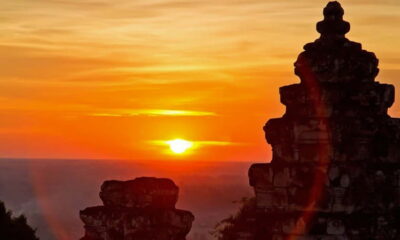
Angkor Wat Sunrise tour with Small – Group and Guide tours
Read our review →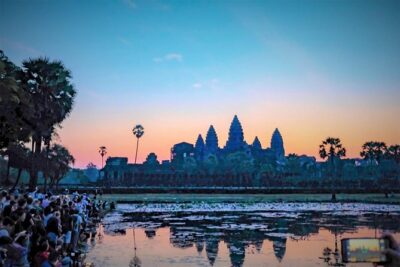
Angkor Wat Highlights and Sunrise Guided Tour from Siem Reap
Read our review →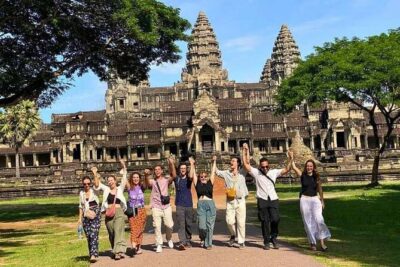
Angkor Wat Sunset Small Group Tour with Lunch Included
Read our review →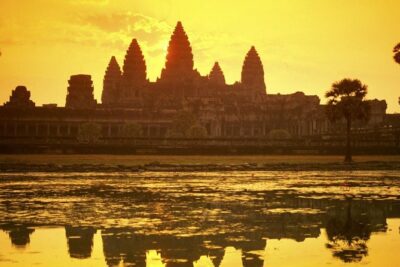
Full-Day Angkor Wat Sunrise Private Tour with Guide from Siem Reap
Read our review →
Angkor Wat Sunrise & 3 Main Temples with Breakfast – Small Group
Read our review →Browse the lists this tour appears in