
Reviewed · ANGKOR WAT TOURS
3-Day Angkor Wat with All Interesting Major Temples, Banteay Srei & Beng Mealea
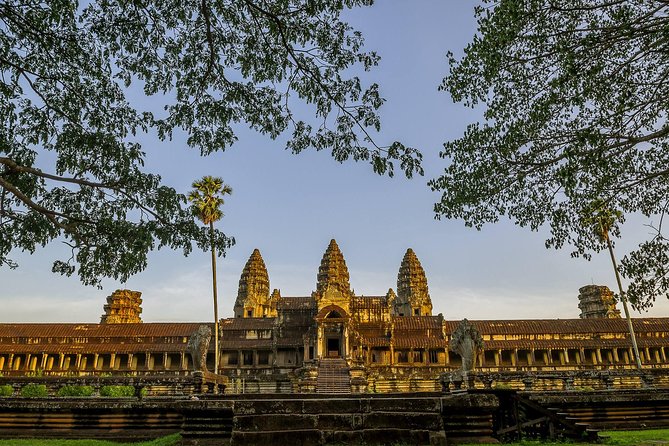
Angkor Wat is only the beginning here. This three-day private tour moves from the famous temple circuits to pink sandstone Banteay Srei, jungle-covered Beng Mealea, and the early Khmer ruins at Roulous. You get a broad look at Cambodia’s temple story rather than spending all three days around one famous monument.
I like the practical setup: your driver picks you up at your Siem Reap hotel, returns you each evening, and keeps cold water and wet towels in the air-conditioned vehicle. I also like the guide-led approach, especially if you are matched with guides such as Mony, Vanna, Mr. Khmer, or Mr. Thou, who are praised for history, photography, and local stories.
The main catch is the pace. Day one and day two are long, and the $261 price does not include the $62 temple pass or lunch. You will see a great deal, but this is not a slow, leisurely temple holiday.
Key points to know before booking
- Sunrise and sunset are both included: Begin day two at Angkor Wat around 5:00 a.m., then finish day one at Phnom Bakheng if the sunset crowd and climb suit you.
- The route covers far more than Angkor Wat: Ta Prohm, Bayon, Preah Khan, Banteay Srei, Beng Mealea, and the Roulous group are all part of the plan.
- Your transport is private: Only your group joins the activity, with hotel pickup, hotel return, parking, and road tolls covered.
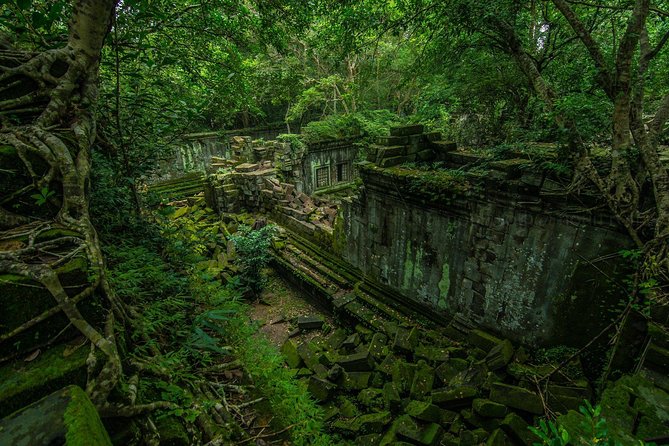
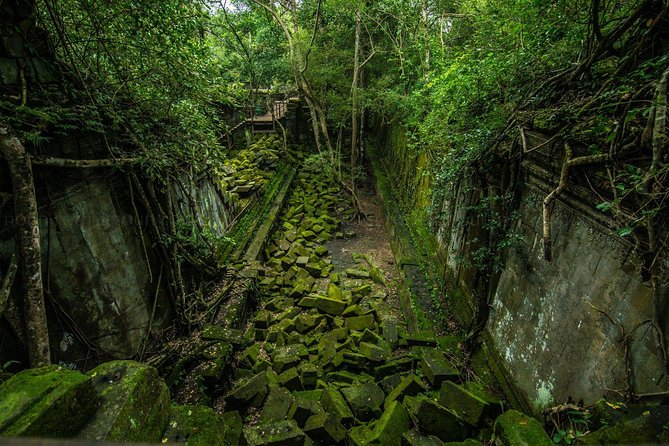
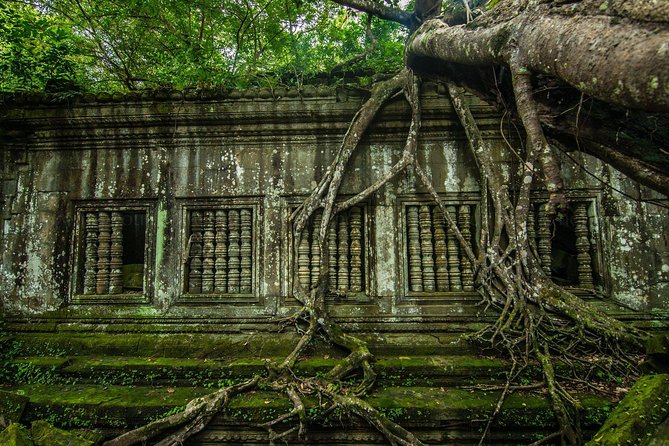
- Beng Mealea adds a wilder experience: Expect a temple where trees, fallen stones, and jungle growth are central to the visit.
- The extra costs are clear: Budget $62 per person for the Angkor temple pass, plus about $5 per person for each lunch.
- The guide makes a real difference: The strongest feedback centers on guides who explain carvings, religious ideas, construction, and Cambodian culture.
Why this three-day Angkor route works
Many first visits to Siem Reap focus on Angkor Wat and a quick stop at Ta Prohm. This route gives you the grand monuments, but it also takes you into quieter corners and farther ruins. You see royal city gates, temple mountains, small Buddhist sanctuaries, pink sandstone carvings, and jungle-swallowed stonework.
The private format is useful in a place where heat and distance can wear you down. You are not waiting for a large group to catch up, and the guide can spend more time explaining the details that interest you. The vehicle also gives you a cool break between temples, which matters after several hours outdoors.
At $261 per person, the value depends on your group size and priorities. The price covers three days of private guiding, an air-conditioned vehicle, hotel transfers, water, wet towels, parking, and tolls. Add the $62 pass and lunch costs, and the total rises, but you are paying for a full route with private transport rather than piecing together separate rides and guides.
More Angkor Wat Tours in Siem Reap:
- Angkor Wat Sunrise or Sunset Tour with Guide from Siem Reap
★ 5.0 · 12,109 reviews - Siem Reap: Angkor Wat: Small-Group Sunrise or Sunset Tour
★ 5.0 · 9,444 reviews - Siem Reap: Angkor Wat 2-Day Tour with Sunrise and Sunset
★ 4.9 · 4,429 reviews
Day one: Angkor Wat, Ta Prohm, and the royal city
Pickup begins at about 8:00 a.m. from your hotel or guest house. The guide takes you to buy the temple pass before reaching the ruins, so you do not need to arrange that separately. The pass is not included in the tour price.
Angkor Wat gives you the grand opening
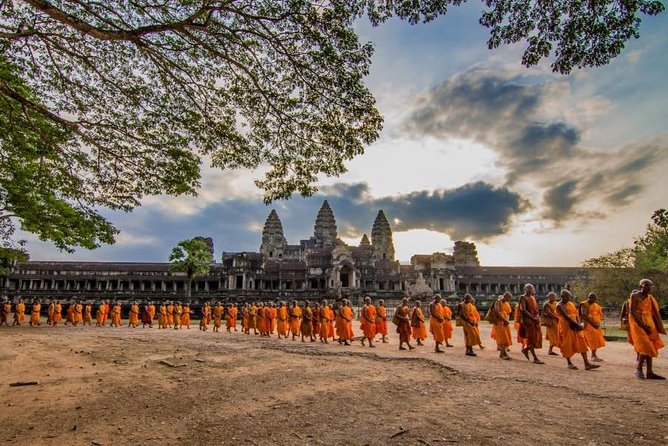
You spend about two and a half hours at Angkor Wat. That is enough time to appreciate its scale, walk through its galleries, and listen to an explanation of its religious purpose and carved scenes without rushing through in a few minutes.
The first visit is scheduled in the morning rather than at sunrise. That lets you begin at a more manageable hour, but it also means you will see the temple again on day two at dawn. This repeat visit is sensible. Angkor Wat feels entirely different in soft sunrise light, and a second look helps you notice details missed on the first day.
Wear clothing suitable for a temple visit and bring water. The stone surfaces and open courtyards can become hot, while the guide’s commentary helps turn a huge complex into something easier to understand.
Ta Prohm is the temple people picture
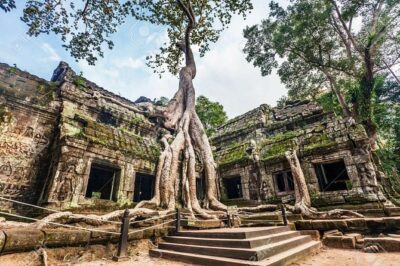
Next comes Ta Prohm on the small circuit. Its giant tree roots push over walls and towers, creating the famous meeting of stone and forest. The site is also linked with the film Tomb Raider, but the trees are more than a movie backdrop. They show how the temple changed as nature took over sections of the structure.
You have about two hours here, which allows time to look beyond the most photographed corners. The drawback is that Ta Prohm is one of the best-known stops on the circuit, so it can feel busy. A private guide helps you move with purpose instead of wandering around unsure of what you are seeing.
More Banteay Srei trips:
- Full-Day Banteay Srei & 4 Temples – Grand Tours Join-in Tour
★ 5.0 · 1,155 reviews - Siem Reap Tour: Angkor Wat Sunrise, Bayon, Ta Prohm, Banteay Srei
★ 5.0 · 931 reviews - 2-Day Angkor Wat With Small, Big Circuit and Banteay Srei Tour
★ 5.0 · 545 reviews - From Siem Reap: Banteay Srei Temple & Grand 5 Temple Tour
★ 4.8 · 262 reviews
Ta Nei offers a quieter pause
Ta Nei is smaller, less restored, and surrounded by large trees. The visit lasts about 45 minutes, making it a good contrast with Ta Prohm. If you want one stop where the setting feels less polished and the stonework remains closer to its ruined state, this is it.
Do not expect the same scale as Angkor Wat or Bayon. Ta Nei’s appeal is its quieter character and the chance to see a temple without spending another two hours in a major complex.
Angkor Thom brings faces, gates, and royal platforms
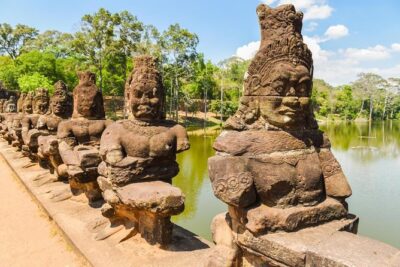
The route then moves through several sites inside Angkor Thom. You first stop at the Victory Gate on the east side for photographs before continuing to Bayon.
Bayon is the central temple of the old city. Its towers carry the famous serene faces associated with the Buddhist ruler Jayavarman VII. The tour description counts 49 towers and 196 faces, though what matters most on site is the way the faces appear and disappear as you walk around the crowded stone structure. Your guide can connect the carvings to the temple’s religious purpose and the wider plan of Angkor Thom.
Baphuon comes next, a large Hindu temple built before Angkor Wat in the 11th century. Behind it is a reclining Buddha added in the 16th century. The nearby Phimeanakas is a smaller pyramid temple from the 10th century, located within the area of the old royal palace.
The stops at Phimeanakas, the Royal Enclosure Wall, and the two terraces are brief. That is useful for covering ground, but you should not expect extended exploration at every monument.
The Terrace of the Elephants served as a platform from which kings watched returning armies. Its carved elephants give the site its name. Nearby, the Terrace of the Leper King has additional carved detail and sits on the north side of the elephant terrace.
Phnom Bakheng closes the first day
The final stop is Phnom Bakheng, where you can climb the hill and wait for sunset. The visit is planned for about two hours, but sunset access is limited by the number of people allowed at the top. You may spend much of that time waiting.
That is the important practical point. Phnom Bakheng can provide fine evening views, but it is not a guaranteed private sunset. If you would rather rest after a full day, the plan allows you to skip it.
Day two: sunrise, the grand circuit, and Banteay Srei
Day two starts around 5:00 a.m. for sunrise at Angkor Wat. Afterward, the schedule includes breakfast and another pickup before continuing to the grand circuit. Confirm the exact breakfast arrangement with your guide, since the published timing describes an early sunrise pickup followed by a later meeting after breakfast.
Sunrise at Angkor Wat is worth the early alarm
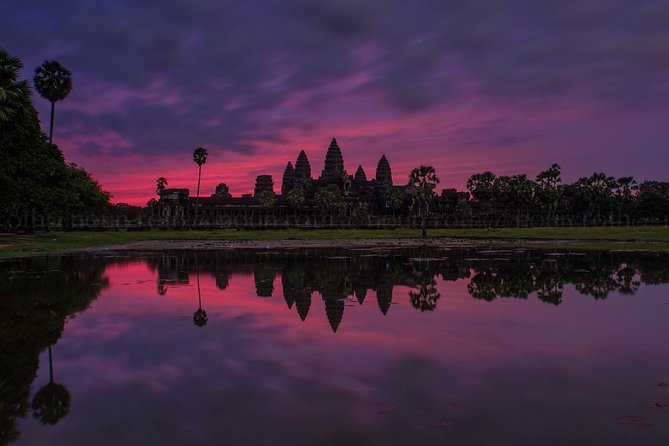
The dawn visit lasts about one hour and 45 minutes. You will see the temple silhouettes and reflecting pools in the morning light, then have a second chance to study the complex after the previous day’s introduction.
This is one of the tour’s strongest features, but it is also the hardest on your body. If you have just arrived in Siem Reap, the early start comes quickly. Plan for a short night and use the vehicle’s return to your hotel after the day’s route as a chance to rest.
Preah Khan and Neak Pean change the mood
Preah Khan is a large Buddhist temple built by Jayavarman VII and dedicated to his father. You have about an hour here, enough to walk through long corridors and see how the complex combines devotional spaces with an imposing scale.
Neak Pean is much smaller. It sits on an island in the middle of the last Baray, or reservoir, and takes about 30 minutes. The setting makes it different from the enclosed temple sites, though the route and walking conditions may depend on access at the time of your visit.
Ta Som follows, another small Buddhist temple on the east side of Neak Pean. Like Ta Prohm, it is associated with trees and ruined stone, but its smaller size makes it a quicker, more focused stop.
Eastern Mebon and Pre Rup show the temple mountain design
Eastern Mebon is a three-level temple mountain crowned by five towers. Large elephant statues mark its corners, giving you a clear detail to watch for as you explore.
Pre Rup is another temple mountain, built in the late 10th century and dedicated to Hindu gods. The name is often explained as turn the body, connected with beliefs about funeral rites. You get about an hour here, enough time to appreciate the stacked levels and views across the surrounding area.
These two stops are especially helpful if you want your guide to explain how Khmer builders developed recurring temple forms. They are less instantly famous than Angkor Wat, but their layout makes the architectural story easier to follow.
Banteay Srei rewards the drive
After lunch, you travel out to Banteay Srei. This temple is built from pink sandstone and dates to the 10th century. Its smaller scale and detailed carvings make it one of the most rewarding stops on the entire route.
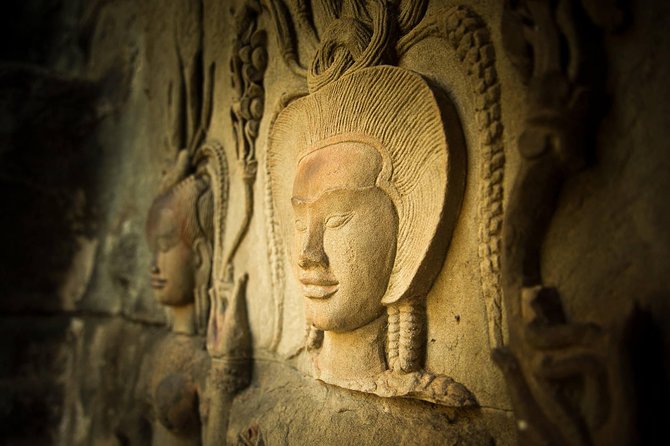
You spend about an hour here. I would pay close attention to the lintels, door frames, and fine figures rather than judging the temple by size. Banteay Srei is often called the Ladies Temple, though your guide can explain the name and the Hindu dedication more carefully.
The distance adds travel time, but this is exactly the sort of stop that justifies having a private car. You can reach a site that would be awkward to add to a short Angkor circuit, then return without arranging another ride.
Banteay Samre and Banteay Kdei round out the day
Banteay Samre is a 12th-century Hindu temple with an architectural style often compared with Angkor Wat. You have about 45 minutes to explore it. It is a useful follow-up to Banteay Srei because the two temples offer a clear contrast in stone color, scale, and carving style.
Banteay Kdei closes the temple portion of the day. This 12th-century Buddhist temple shares stylistic links with Ta Prohm and Bayon, and the visit lasts about 45 minutes.
Day two covers a lot of ground. By the final stop, you may prefer a shorter explanation and time to sit rather than another full lecture. The private format gives your guide room to adjust the pace.
Day three: Beng Mealea and the Roulous beginnings
The third day leaves the main Angkor circuits. It combines the most untamed temple on the route with the older Roulous group, then offers optional stops in Siem Reap.
Beng Mealea is the wildest stop
Beng Mealea lies about 68 kilometers northeast of Siem Reap, and the drive is a major part of the day. You spend about three and a half hours at the temple, where trees, fallen blocks, and jungle growth shape the experience.
This is not a neat procession from one intact building to another. You may find broken galleries, rough paths, and sections where nature dominates the ruins. That makes Beng Mealea appealing if you want something less orderly than the main Angkor monuments.
The long visit is justified because the site is large and atmospheric, but the distance may be too much for someone who wants only the famous temples. Ask your guide about walking conditions and the route through the ruins before setting out.
Roulous takes you closer to the early Khmer period
The Roulous group includes Lolei, Preah Ko, and Bakong. These temples belong to the cluster associated with Hariharalaya, an earlier Khmer capital.
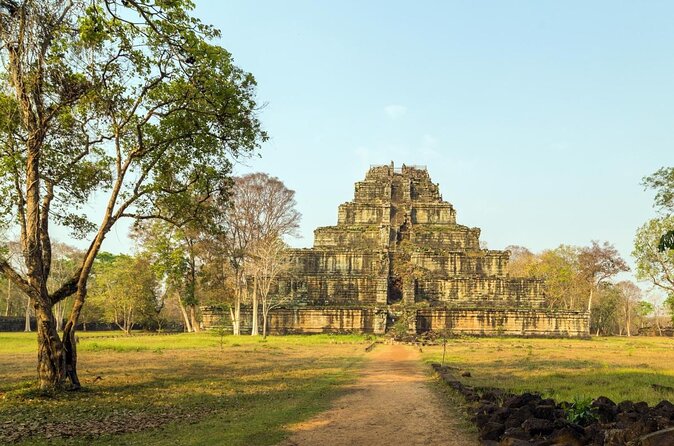
Lolei is a small Hindu temple from the 9th century, with about 20 minutes scheduled. Preah Ko was the first temple built in the ancient city and also receives about 20 minutes. These are short stops, but their age gives them importance. They help you see that Angkor’s monumental story began before the construction of Angkor Wat.
Bakong is the largest of the three and the first sandstone temple mountain built by Khmer rulers. You have about an hour here, including a lunch break along the route. Bakong gives the Roulous group its strongest visual finish, with a larger plan and a clearer sense of the temple mountain form.
Lunch is not included. The stated estimate is $5 per person, depending on the menu and restaurant.
Optional stops in Siem Reap
The return route can include Artisans Angkor, a center associated with stone carving, wood carving, lacquering, gilding, and silk processing. You can skip it if craft shopping is not part of your plan.
Psar Chaa, the Old Market in central Siem Reap, is also optional. It is a convenient final stop for browsing the city market, but after three temple-heavy days, you may prefer a direct hotel return.
Guide quality matters more than the vehicle
The most praised part of this experience is the guiding. Specific guides named in the feedback include Mony, Vanna, Mr. Khmer, Mr. Thou, and Mr. Chen. Their strengths include explaining temple history and myths, identifying the meaning of carvings, discussing construction methods, and sharing stories about Cambodia and local life.
One guide, Mr. Khmer, is described as an archaeologist and teacher. Another is praised as an expert photographer. Those details matter because the temples can blur together without context. A good guide helps you see why Bayon’s faces differ from the Hindu imagery at Pre Rup, or why Banteay Srei deserves more attention than its small size suggests.
You cannot assume a particular guide will be assigned, so ask when booking if a named guide is important to you. The tour is private, which means your group alone participates, but it does not mean the itinerary is fully unstructured. The schedule remains busy, especially on days one and two.
What is included, and what you still pay
The package includes:
- Air-conditioned private vehicle
- Licensed English-speaking guide
- Hotel pickup and return in Siem Reap
- Cold water and cool wet towels
- Parking fees and road tolls
You pay separately for the $62 Angkor Wat and temple admission pass. Lunch is also extra, estimated at $5 per person depending on the menu.
The wet towels are a small but useful touch in Cambodia’s heat. So is the hotel return each evening. You do not need to manage Siem Reap roads, find parking, or arrange a new driver for the distant temples.
The tour is rated five out of five from 70 reviews, with 100 percent recommendation shown in the supplied details. That is a strong record, especially given the number of sites covered. Still, the rating should not hide the early mornings, long drives, and extra admission cost.
Who should book this tour?
I would choose this tour if you have three days in Siem Reap and want the widest possible temple introduction with one private guide. It suits people interested in architecture, religion, Cambodian history, photography, and the contrast between restored monuments and jungle-covered ruins.
It is also a good fit if you value convenience. Hotel pickup and return, private transport, and a guide who can explain what you are seeing remove much of the planning work.
I would hesitate if you dislike early starts, long car rides, or tightly packed days. A slower two-day plan may suit you better. You should also allow extra money for the pass and lunches, rather than treating $261 as the complete cost.
FAQ
Is this a private tour?
Yes. Only your group participates in the activity.
Does the tour include hotel pickup and return?
Yes. Pickup and drop-off at your hotel or guest house in Siem Reap are included.
Is the Angkor temple pass included?
No. The Angkor Wat and all-temples admission fee is listed separately at $62 per person.
Are meals included?
No. Lunch is not included. The stated estimate is about $5 per person, depending on the food selected from the menu.
What time does the sunrise day begin?
The guide plans to meet you at about 5:00 a.m. at your accommodation for sunrise at Angkor Wat.
Is sunset at Phnom Bakheng guaranteed?
No. Access to the sunset viewpoint is limited by the number of people allowed. You can skip the sunset stop if you prefer.
Can I skip the optional Siem Reap stops?
Yes. Artisans Angkor and Psar Chaa, the Old Market, can be skipped.
Can most people participate?
The tour information states that most people can participate. It does not provide a more specific accessibility description, so ask the provider about any individual mobility needs before booking.
Should you book it?
Book this tour if you want a serious three-day survey of Angkor, not just a quick Angkor Wat photo stop. The combination of sunrise, sunset, major circuits, Banteay Srei, Beng Mealea, and Roulous gives you a strong range of temples, while the private vehicle keeps the logistics simple.
Just go in prepared: the pass and lunches cost extra, the mornings start early, and the schedule is demanding. If you accept that tradeoff, the route offers excellent coverage and the guide can turn a long list of ruins into a connected story about Khmer architecture, religion, and royal power.
More 3-Day Experiences in Siem Reap
- From Siem Reap: Angkor Wat and Floating Village 3-Day Trip
★ 5.0 · 100 reviews - 3-Day Angkor Wat & All Interesting Major Temples & Kulen Mount Waterfall
★ 5.0 · 63 reviews - 3 Days Siem Reap Explorer – Small Group
★ 5.0 · 50 reviews - Best of Siem Reap 3-Day Private Tour to Angkor Wat & Tonle Sap
★ 5.0 · 47 reviews
More Beng Mealea jungle-temple days
- Siem Reap: Kulen Mountain, Beng Mealea and Tonle Sap Tour
★ 5.0 · 1,483 reviews - Kulen Mountain with Beng Mealea and Tonle Sap Small Group Tour
★ 5.0 · 780 reviews - Koh Ker Temple Group & Beng Mealea Full-Day Join-in Tour
★ 5.0 · 710 reviews - From Siem Reap: Koh Ker and Beng Mealea Temples Tour
★ 4.9 · 293 reviews
New around Siem Reap
- Kulen Mountain With Ticket included Plus Banteay Srei Temple Tour★ 5.0 · 7 reviews
- Private Siem Reap Airport Transfer to hotel in town★ 5.0 · 7 reviews
- 2 Days Angkor temples with Sunrise & Sunset★ 5.0 · 7 reviews
- 1-Day private Angkor Temple Tour with Sun Rise by Tuk Tuk from Siem Reap★ 4.5 · 7 reviews
- Siem Reap: Morning Cooking Class & Market Tour★ 5.0 · 7 reviews
- Kulen Mountain, Killing Fields and War Museum Tour★ 5.0 · 7 reviews
- War Museum, Killing Field, and APOPO Hero RATs Tour★ 5.0 · 7 reviews
- Half-Day: Silk Farm, Senteur Angkor, and Satcha Workshop★ 4.6 · 7 reviews
Angkor Wat Tours, compared.
Angkor Wat Sunrise or Sunset Tour with Guide from Siem Reap
Read our review →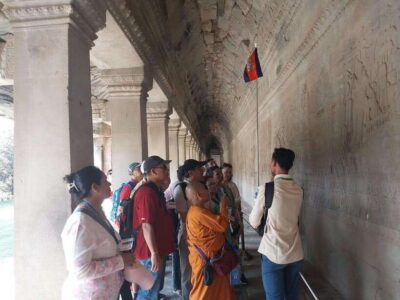
Angkor Wat: Small-Group Sunrise or Sunset Tour
Read our review →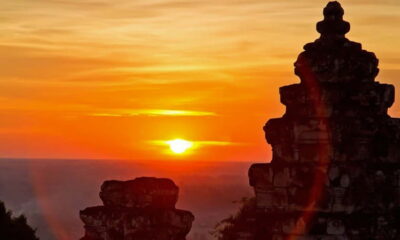
Angkor Wat Sunrise tour with Small – Group and Guide tours
Read our review →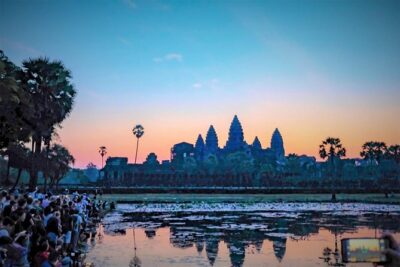
Angkor Wat Highlights and Sunrise Guided Tour from Siem Reap
Read our review →
Angkor Wat Sunset Small Group Tour with Lunch Included
Read our review →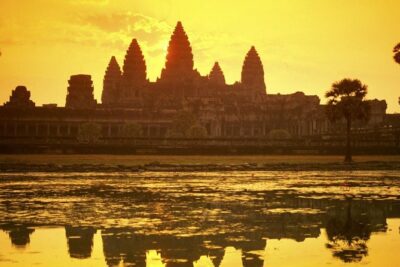
Full-Day Angkor Wat Sunrise Private Tour with Guide from Siem Reap
Read our review →
Angkor Wat Sunrise & 3 Main Temples with Breakfast – Small Group
Read our review →Browse the lists this tour appears in