
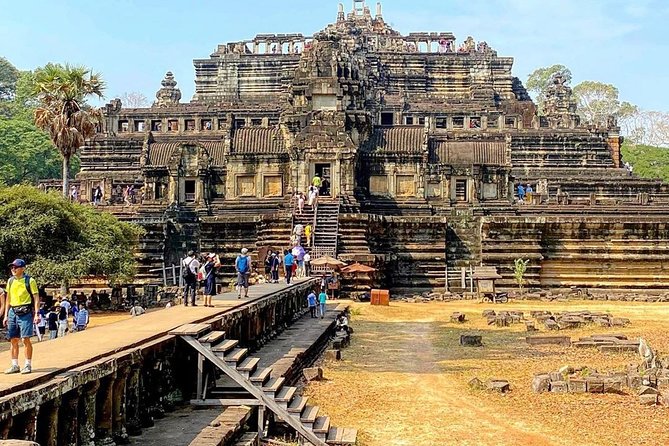
Reviewed · SIEM REAP TOURS
3-Day Tour (The Historical of Khmer Empire)
The best thing about this private three-day tour is its range. You move from Angkor Thom’s giant stone faces and Angkor Wat’s grand galleries to quiet forest temples, early Khmer sites, and the far-flung ruins of Koh Ker. Guides such as Veasna, Sophia, and Sophea are available on different departures, with other languages possible by request.
I like the one-group format, which lets you ask questions and adjust the pace. I also like the mix of famous temples and less-visited places such as Ta Nei and Beng Mealea. The main drawback is the long, hot schedule, especially on Day 3, when Koh Ker lies about 113 kilometers from Siem Reap and Beng Mealea is about 60 kilometers away.
Key points to know before booking
- Three full days, from 8 a.m. to 5 p.m.: Expect early starts, long temple walks, and plenty of time in the vehicle.
- Private guide and driver: Your group travels alone in an air-conditioned vehicle with cool water and wet towels.
- A strong historical sequence: The route links Angkor Thom, Angkor Wat, the Roluos Group, Koh Ker, and Beng Mealea.
- The Angkor pass costs extra: Entry to the Angkor Archaeological Site is not included, and the pass must be purchased separately in US dollars.
- Meals are not included: Lunch stops are arranged, but you pay directly for meals and personal purchases.
- Good for families and mixed-age groups: Past departures included families and groups ranging from children to adults, with guides adjusting the experience to the group.
Why three days works better than one
Siem Reap’s temple zone is too large for a quick checklist visit. A single day can cover Angkor Wat, Bayon, and Ta Prohm, but it leaves little room for smaller shrines or the early Khmer temples east of town.
This tour gives you three different views of Cambodian architecture. The first day focuses on the royal center of Angkor Thom and the delicate carvings of Banteay Srei. Day 2 pairs the best-known Angkor monuments with the older Roluos Group and Siem Reap’s Old Market. Day 3 takes you away from the main complex to Koh Ker and Beng Mealea.
That structure matters. You are not seeing the same style of temple all day, every day. You get political power, religious design, sculpture, jungle growth, rural roads, and later market life in one trip.
The schedule is still full. Each day runs roughly from 8 a.m. to 5 p.m., and you should expect heat, uneven stone, stairs, and repeated walking in the open sun. The private setup helps, since you can ask for explanations, short pauses, or some flexibility instead of moving with a large group.
More Historical Tours in Siem Reap
- 2 Days Guided Historical Tour in Angkor
★ 5.0 · 855 reviews - Siem Reap: Banteay Srei and Grand Circuit Heritage Tour
★ 4.9 · 163 reviews - Banteay Srei and Grand Circuit Heritage Tour from Siem Reap
★ 5.0 · 142 reviews
Day 1: Bayon faces, royal terraces, and Banteay Srei
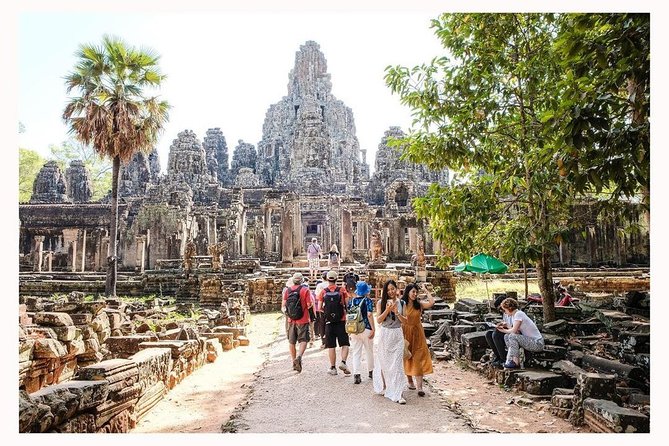
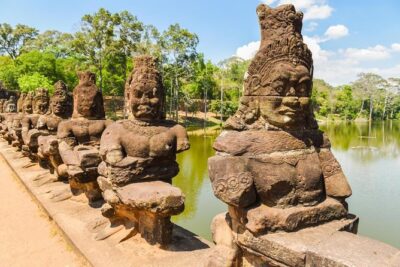
The first morning begins at Angkor Thom, the walled royal city that includes several important monuments. Bayon is the headline stop. Its towers carry the famous calm stone faces associated with classic Khmer art, and the lower galleries contain carved scenes of court life, warfare, ceremonies, and daily activity.
You have about an hour at Bayon. That is enough for a useful introduction, though not enough to study every relief. Ask your guide to explain how the towers and bas-reliefs fit together. Without context, Bayon can feel like a maze of gray stone. With a clear route, its faces and stories become much easier to read.
Next comes Baphuon, a three-tiered temple mountain dedicated to Shiva. Allow about 30 minutes here. Its tall central form gives you a sense of the scale and ambition of Angkor’s rulers, though the climb and exposed stone can feel demanding in the midday heat.
The Terrace of the Elephants follows. This long platform stretches about 300 meters and is decorated with elephants and garudas. It once formed part of the ceremonial heart of Angkor Thom. The stop takes around 30 minutes and works best as a short architectural pause between larger temple visits.
Nearby, the Terrace of the Leper King has tightly carved inner and outer walls filled with nagas, demons, and other mythological figures. The name comes from the statue on top and the old title associated with it. The terrace is not large, but the enclosed carvings reward a close look.
Preah Palilay is a quieter stop. Its sandstone and laterite tower sits in a shaded forest setting, and the eastern entrance has Buddhist carvings. You get about 30 minutes here. This is one of the morning’s more atmospheric pauses, especially after the broad ceremonial spaces of Angkor Thom.
Lunch is at a local restaurant in the Angkor area, but the meal is not included. You should budget time and money for your own lunch, drinks, and any extra purchases.
Banteay Srei and Banteay Samre
After lunch, the tour heads to Banteay Srei, usually the artistic high point of the first day. The name is commonly translated as citadel of women, a modern name linked to the temple’s delicate appearance. Its smaller scale and pinkish sandstone carvings differ sharply from the massive structures at Angkor Thom.
You have around two hours here, which is sensible. Banteay Srei’s value is in the detail: lintels, pediments, figures, and floral patterns are closely carved and easy to miss if you hurry. Your guide can point out scenes and design elements that are not obvious from a quick walk around the enclosure.
The temple is a popular stop, so the private format does not guarantee solitude. It does give you more control over how long you study the carvings and which details deserve attention.
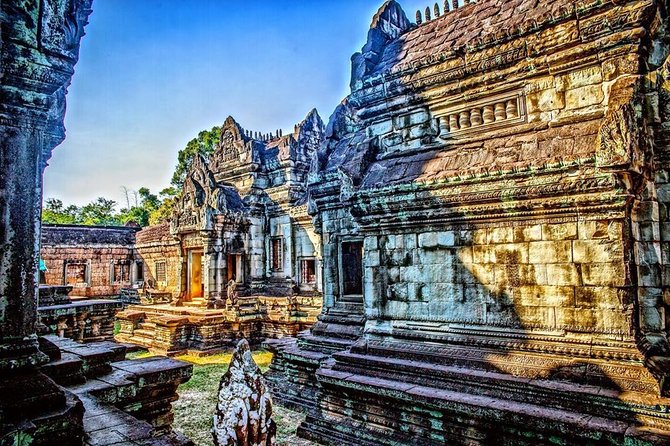
Banteay Samre closes the scheduled day with about an hour. This large, flat temple uses Angkor Wat-style architecture and artistry. Its strong walls and central towers give it a more defensive, enclosed feeling than Banteay Srei.
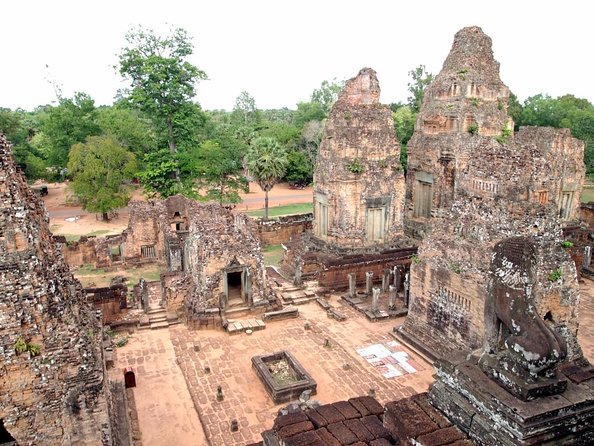
A sunset visit to Pre Rup may be offered as an optional stop. This temple mountain has carved false doors on its upper level and views toward the surrounding countryside. Because it is optional, you should confirm with your guide whether timing and conditions allow it.
Day 2: Angkor Wat, jungle ruins, and the first Khmer capital
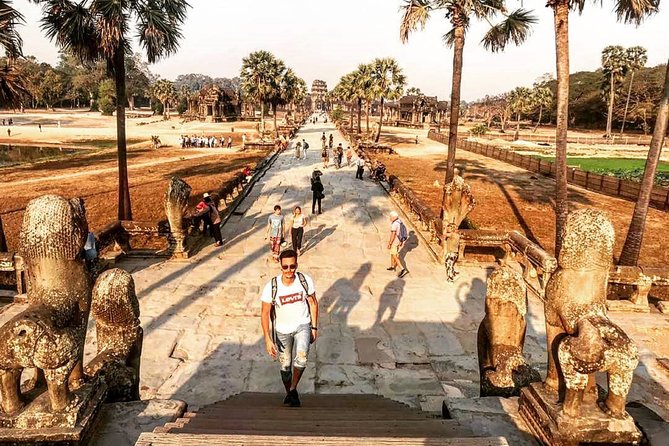
Day 2 begins with Angkor Wat, Cambodia’s most famous monument. Two hours gives you time to see the main approach, galleries, towers, and selected carvings, but the complex is too large to fully understand in one short visit.
The temple rewards a slow pace. Look for the relationship between the long causeway, outer galleries, courtyards, and central towers. The scale can be overwhelming, so a guide is especially useful here. Ask for a simple plan of the temple before you start, then use the remaining time to focus on a few areas rather than trying to remember everything.
Dress carefully. Shoulders and knees must be covered at some temple and palace areas, including Baphuon. Shirts with offensive images or words, as well as brightly colored clothing, may cause entry problems. Light clothing that still covers your shoulders and knees is the practical choice.
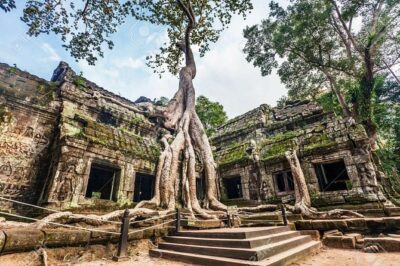
Ta Prohm follows, with about 90 minutes. This is the sprawling monastic complex where trees grow over and through sections of the stonework. Parts of the site remain uncleared, giving it a more tangled appearance than Angkor Wat.
Ta Prohm is excellent for understanding how nature and conservation interact. The trees are striking, but do not treat the temple as only a photo stop. The courtyards, galleries, and damaged passages show how large the complex once was. Crowds can gather around the best-known tree-covered sections, so listen for your guide’s suggestions about quieter corners.
Ta Nei is a smaller jungle temple with an atmosphere similar to Ta Som. It displays the style of Jayavarman VII, including apsara and lintel carvings. The stop is less famous than Ta Prohm and can feel like a welcome change of scale.
Lunch is again at your own expense, at a restaurant near the Angkor area or on the way back toward town.
A completely different sort of day from the same base:
- Angkor Wat Sunrise or Sunset Tour with Guide from Siem Reap
★ 5.0 · 12,109 reviews - Siem Reap: Angkor Wat: Small-Group Sunrise or Sunset Tour
★ 5.0 · 9,444 reviews - From Siem Reap: Kampong Phluk Floating Village Tour by Boat
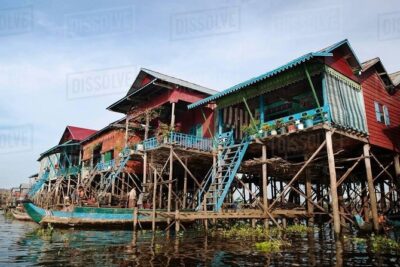
★ 4.9 · 6,979 reviews - Sunset tour of Kampong Phluk stilts home village on the Tonle Sap
★ 5.0 · 4,865 reviews
The Roluos Group: Bakong, Preah Ko, and Lolei
In the afternoon, you leave the central Angkor monuments for the Roluos Group. This cluster is important because it belongs to an early Khmer capital, Hariharalaya, before Angkor developed into the great royal center most people picture today.
Bakong is the largest and most impressive of the three. It is a temple mountain with a strong central structure and broad surrounding grounds. Give it about 45 minutes. Its design helps you see the early form of the temple mountain, a style later developed on a much larger scale.
Preah Ko means Sacred Bull. It was one of the first major temples of the empire and formed part of the early capital. The stop lasts around 40 minutes. Look closely at the carved bulls and the temple towers, then ask your guide to explain the site’s role in the early capital.
Lolei consists of the remains of an island temple built in the middle of a now-dry reservoir, or baray. You have about 40 minutes here. The broad setting helps you understand that water management was not a side project in Khmer planning. Reservoirs, temples, roads, and royal centers worked together.
The Roluos Group is less immediately famous than Angkor Wat, but it adds needed historical order. You are not only looking at beautiful ruins. You are seeing an earlier stage of Khmer building and state planning.
Old Market and Artisan d’Angkor
The day ends at Psar Chaa, or the Old Market, with about two hours. It is a practical place for souvenirs, curios, and local shopping. You will find vendors selling a wide range of goods, so this is the time to compare prices and decide what you really want.
Artisan d’Angkor is also included in the Day 2 plan. The visit gives the temple-focused tour a modern craft and shopping element. If you prefer archaeological sites to retail stops, tell your guide how much time you want to spend here and at the Old Market.
Day 3: Koh Ker and Beng Mealea beyond Siem Reap
Day 3 is the most ambitious. Koh Ker is about 113 kilometers from Siem Reap, so the journey itself takes a large part of the day. You should book this day because you want to see a more remote Khmer site, not because you want a relaxed final morning.
Koh Ker served as a temporary capital during a period of conflict within the Angkorian kingdom and was connected with King Jayavarman IV. The main temple rises in a pyramid form, giving the site a different character from the central Angkor complex.
You have about two hours at Koh Ker. That time lets you focus on the central structure and the wider setting, but the stop comes with a clear tradeoff: more road time for a less familiar chapter of Khmer history. The private air-conditioned vehicle is important here, since the drive would be tiring in a less comfortable setup.
In the afternoon, the tour continues to Beng Mealea, about 60 kilometers from Siem Reap. This Hindu temple was built around the end of the 11th century and covers a large area, with jungle growth spread through much of the site.
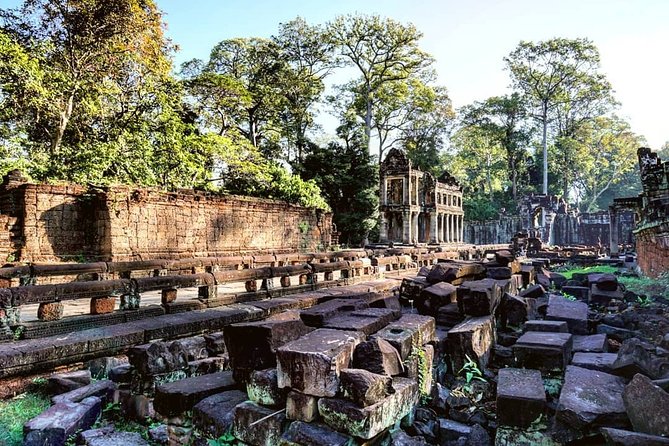
Beng Mealea is appealing because it feels less ordered than the restored central monuments. Broken galleries, collapsed stones, and trees help you picture the challenge of conserving such a large ruin. At the same time, uneven surfaces and thick growth mean you should watch your footing and avoid treating the site as a quick photograph.
You have about two hours here. That is enough to explore at a measured pace, though the long driving distances make Day 3 tiring. An optional sunset at Pre Rup may be possible, but confirm this with your guide before counting on it. Adding another temple after Koh Ker and Beng Mealea could make an already full day feel rushed.
What the private setup adds
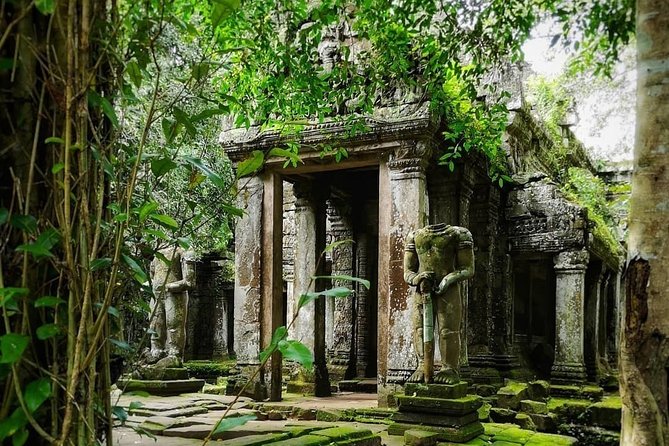
The tour includes an English-speaking guide, a professional driver, an air-conditioned vehicle, cool water, wet towels, taxes, and service charges. Pickup and return transfers apply to people staying inside Siem Reap.
The guide is the main reason to choose this format. Past departures have been led by people including Mr. Veasna, Mr. Sophia, Mr. Vutha, Mr. Sophea, and others. Veasna received repeated praise for explaining the temples clearly, adjusting plans, and helping families with different ages and interests.
That personal attention is useful at places such as Bayon and Angkor Wat, where a strong guide can turn carved stone into a readable story. It also helps on a private trip because the route is described as fully customizable. You can ask for more time at sculpture, less time shopping, or a different balance between famous and quieter sites.
The vehicle matters just as much. Three days of temple roads and long transfers would be much harder without air conditioning. Water and wet towels are small inclusions, but in Cambodia’s heat they are practical comforts.
The tour is private, meaning only your group participates. That makes it a good fit for families, couples, and groups of friends who want to stay together. Other languages may be available by request, with extra charges possible.
Price, extra costs, and overall value
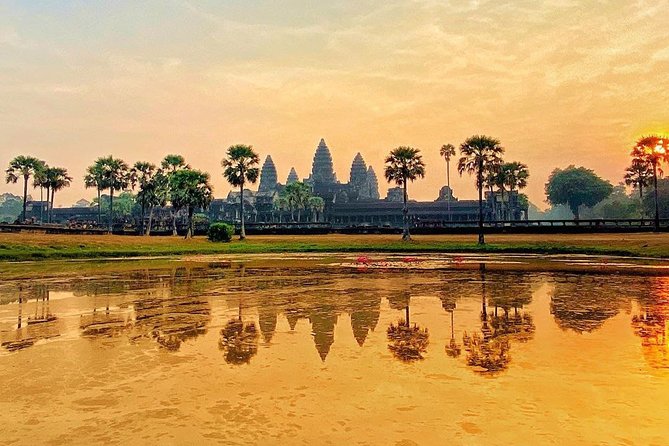
The listed price is $250.50 per person. That covers three days of private guiding and transportation, but it does not cover the Angkor Archaeological Site entrance pass, meals, hotel accommodation, insurance, drinks, shopping, or other personal expenses.
The missing Angkor pass is the most important budget detail. You are responsible for buying the pass at the main gate, with options ranging from one day to seven days. Fees are charged in US dollars, and the pass must remain visible. Children under 12 enter free of charge.
The value improves as your group grows. A couple pays more per person for privacy, but a family or group can spread the vehicle and guide cost across several people. The price also includes sites far outside the central complex, especially Koh Ker and Beng Mealea, where having organized transport is useful.
Still, you should compare the full cost, not just the advertised rate. Add the appropriate site pass, three lunches, drinks, shopping, and insurance. If you only want Angkor Wat, Bayon, and Ta Prohm, a shorter tour may be better value. If you want the wider Khmer story and prefer a private vehicle, the three-day plan earns its price.
Practical advice for a smoother three days
Wear light clothing that covers your shoulders and falls below your knees. This is not just a matter of comfort. Some temples and palaces enforce the dress rules, and unsuitable clothing can prevent entry.
Bring sturdy footwear. The program includes temple steps, uneven stones, forest paths, and long walks. Protect cameras and phones from rain, dust, and other natural conditions, since the tour provider places responsibility for electronic equipment on you.
Keep water nearby even though cool water is provided. Plan to pay for lunch each day, and carry US dollars for the entrance pass and personal expenses. The Old Market is useful for shopping, but you do not need to buy anything there.
Expect the exact pickup time to be confirmed in advance when possible. If operations prevent early confirmation, the time may be provided the day before departure. Pickup and return are limited to accommodations inside Siem Reap.
The tour requires good weather. If poor weather forces cancellation, you can receive a different date or a full refund. Standard cancellation allows a full refund if you cancel at least 24 hours before the start time. Cancellations or changes made later are not accepted for a refund.
Who should book this tour
I would choose this tour if you want more than the standard Angkor circuit. It suits people who care about the history of Khmer building, families who need a private pace, and groups that want an English-speaking guide without joining strangers.
It is also a good match if you want to combine major monuments with smaller stops. Bayon, Angkor Wat, and Ta Prohm deliver the essential Angkor experience, while Preah Palilay, Ta Nei, the Roluos Group, Koh Ker, and Beng Mealea add variety.
I would hesitate if you dislike long car rides, hot afternoons, or full sightseeing days. Day 3 is especially demanding, and the schedule leaves little room for a lazy morning. You also need to accept that food and the main temple pass are extra.
Should you book the three-day Khmer history tour?
Book it if you want a private, well-organized route that reaches beyond Angkor Wat. The strongest features are the private guide and driver, the flexible format, the clear historical range, and the inclusion of remote sites that are difficult to fit into a short visit.
Choose a shorter plan if your time is limited or you mainly want the famous Angkor monuments. For everyone else, this is a strong three-day framework. Just budget for the pass and meals, dress for temple rules, and save your energy for Koh Ker’s long road on Day 3.
FAQ
Is the tour private?
Yes. Only your group participates, and the tour operates with a private English-speaking guide and professional driver.
What time does each day begin and end?
The planned schedule runs from approximately 8 a.m. to 5 p.m. each day.
Is hotel pickup available?
Pickup and return transfers are included for customers staying inside Siem Reap.
Is the Angkor entrance pass included?
No. You must purchase the Angkor Archaeological Site pass separately at the main gate. Passes range from one day to seven days, are charged in US dollars, and must be visible while you visit the sites.
Are meals included?
No. Breakfast, lunch, and dinner are not included. Lunch stops are arranged, but you pay for your own meals, drinks, and personal purchases.
Can children join the tour?
Most travelers can participate, and the tour has served family groups with children. Children under 12 years old do not pay the Angkor Archaeological Site entrance fee.
What should I wear?
Wear light clothing that covers your shoulders and knees. Clothing with obscene or disrespectful images, and brightly colored clothing, may result in refused entry at some sites.
What happens if the weather is poor?
The tour requires good weather. If it is canceled because of poor weather, you will be offered another date or a full refund. You can also cancel for a full refund up to 24 hours before the experience starts.
More 3-Day Experiences in Siem Reap
- From Siem Reap: Angkor Wat and Floating Village 3-Day Trip
★ 5.0 · 100 reviews - 3-Day Angkor Wat with All Interesting Major Temples, Banteay Srei & Beng Mealea
★ 5.0 · 70 reviews - 3-Day Angkor Wat & All Interesting Major Temples & Kulen Mount Waterfall
★ 5.0 · 63 reviews - 3 Days Siem Reap Explorer – Small Group
★ 5.0 · 50 reviews
New around Siem Reap
- Kulen Mountain With Ticket included Plus Banteay Srei Temple Tour★ 5.0 · 7 reviews
- 2 Days Angkor temples with Sunrise & Sunset★ 5.0 · 7 reviews
- Private Siem Reap Airport Transfer to hotel in town★ 5.0 · 7 reviews
- 1-Day private Angkor Temple Tour with Sun Rise by Tuk Tuk from Siem Reap★ 4.5 · 7 reviews
- Siem Reap: Morning Cooking Class & Market Tour★ 5.0 · 7 reviews
- Kulen Mountain, Killing Fields and War Museum Tour★ 5.0 · 7 reviews
- War Museum, Killing Field, and APOPO Hero RATs Tour★ 5.0 · 7 reviews
- Half-Day: Silk Farm, Senteur Angkor, and Satcha Workshop★ 4.6 · 7 reviews
Siem Reap Tours, compared.
Angkor Wat Sunrise or Sunset Tour with Guide from Siem Reap
Read our review →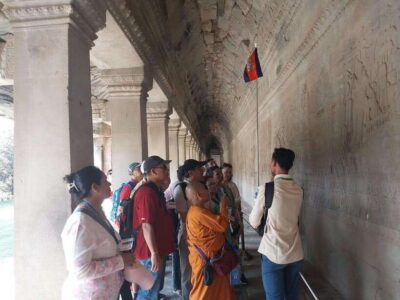
Angkor Wat: Small-Group Sunrise or Sunset Tour
Read our review →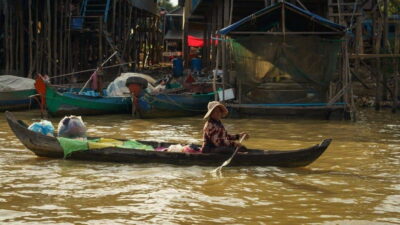
Sunset tour of Kampong Phluk stilts home village on the Tonle Sap
Read our review →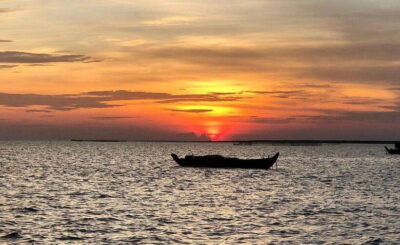
Kampong Phluk Floating Village Tour with Boat
Read our review →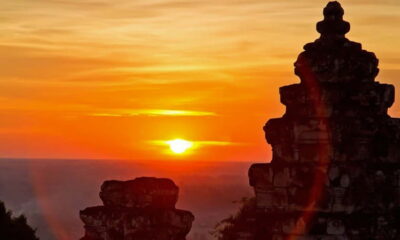
Angkor Wat Sunrise tour with Small – Group and Guide tours
Read our review →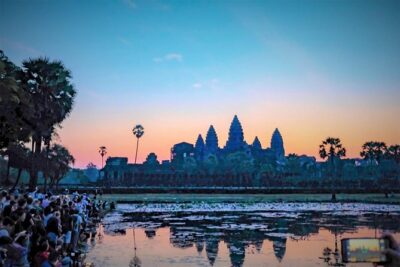
Angkor Wat Highlights and Sunrise Guided Tour from Siem Reap
Read our review →Browse the lists this tour appears in