
Reviewed · ANGKOR WAT TOURS
2days Explore Angkor wat Small Tour & Big Tour + Banteay Srei (Private tour)
Angkor’s best temples are spread across a large area, and this private two-day route gives you time to see the major sights without joining a fixed group. You move from the giant faces of Bayon and the jungle ruins of Ta Prohm to the finely carved pink sandstone of Banteay Srei.
I like the freedom to set your own pace, and I like the simple comforts: hotel pickup, an air-conditioned vehicle, cold mineral water, towels, and an English-speaking driver. The main catch is that temple admission is not included, so you need to budget for that separately.
Key points
- Two full temple circuits: Day one covers Angkor Thom, Ta Prohm, and nearby temples, while day two follows the grand circuit and adds Banteay Srei.
- Private transport: Only your group rides in the vehicle, with hotel pickup and drop-off in Siem Reap.
- Strong driver service: Heng, Kimsun, and Frank are named in past bookings, though your assigned driver may be different.
- Best for flexible sightseeing: You can spend more time at favorites and less time at smaller stops.
- Banteay Srei included: The distant pink-sandstone temple adds a very different style to the usual Angkor circuit.
- Tickets cost extra: The $159 price covers transport and listed services, not temple entry.
Two days, two very different sides of Angkor
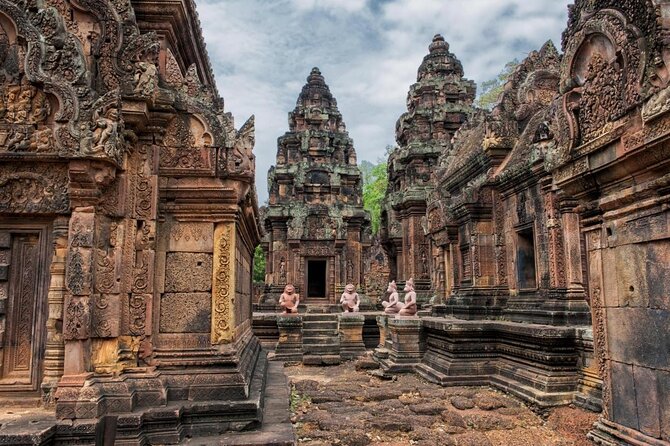
This tour works because it divides Angkor into two sensible days. Day one focuses on Angkor Thom and the familiar small-circuit temples. Day two covers the larger outer circuit and reaches Banteay Srei.
You are not simply ticking off one temple after another. The route moves through royal monuments, Buddhist complexes, Hindu temple mountains, jungle ruins, and quiet smaller sites. That range helps you understand why Angkor feels less like a single monument and more like an enormous former capital.
The private format matters here. A large group can make temple visits feel rushed, especially at places such as Bayon and Ta Prohm. With your own vehicle and driver, you can ask for a little more time at a favorite stop or move on when your attention starts to fade.
The schedule is still busy. Day one has 11 stops, and day two has six. You will see a lot, but this is not a slow archaeological study. It is a strong first visit for someone who wants the major sights in two days.
More Angkor Wat Tours in Siem Reap:
- Angkor Wat Sunrise or Sunset Tour with Guide from Siem Reap
★ 5.0 · 12,109 reviews - Siem Reap: Angkor Wat: Small-Group Sunrise or Sunset Tour
★ 5.0 · 9,444 reviews - Siem Reap: Angkor Wat 2-Day Tour with Sunrise and Sunset
★ 4.9 · 4,429 reviews
Day one at Angkor Thom, from the South Gate to royal terraces
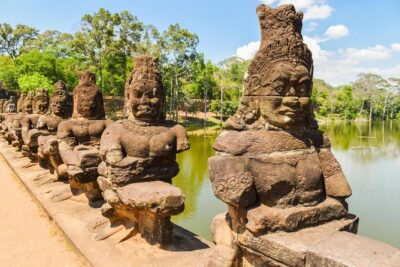
The first day begins at the South Gate of Angkor Thom. The gate is approached across a bridge lined with figures connected to the Hindu story of the Churning of the Ocean of Milk. You have about 20 minutes here, enough to look closely and take photographs before entering the ancient city.
The stop is short, but it sets up the rest of the morning. Angkor Thom was a large walled city, and the South Gate gives you a clear sense of entering a planned royal center rather than arriving at an isolated temple.
Bayon and its many stone faces
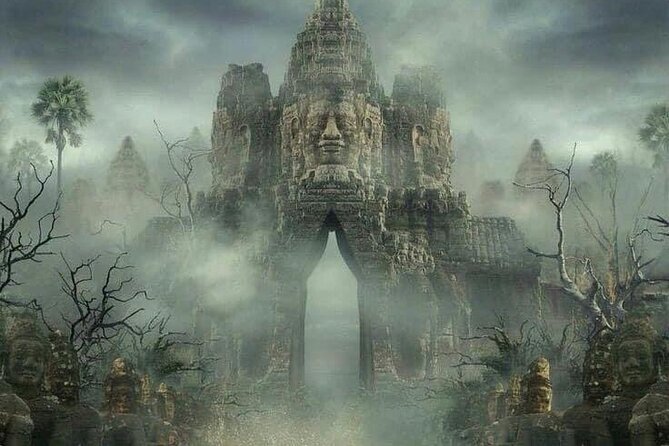
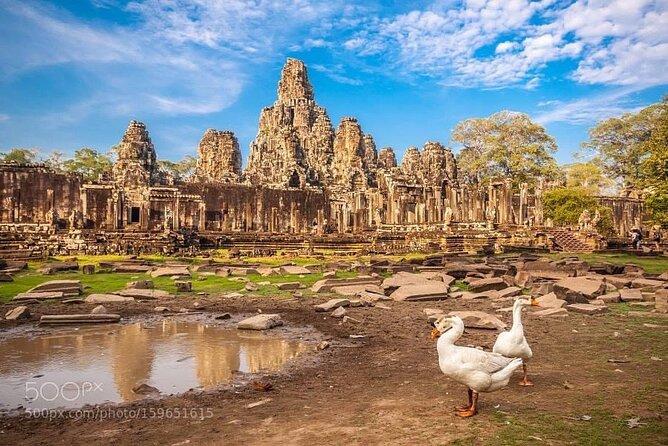
Inside Angkor Thom, Bayon is the main event. The temple is known for its towers carved with four smiling faces, and the route allows about an hour to explore.
Bayon can feel confusing at first. Towers, galleries, stairways, and carved faces overlap in a tight arrangement. Take your time looking upward and moving around the outer galleries. The faces appear from different angles, sometimes framed by stone doorways or partly hidden behind other towers.
This is one of the places where a private driver’s timing advice is useful. The driver can tell you how long you have and direct you to a convenient entrance, but the included information describes an English-speaking driver rather than a formal temple guide. If detailed interpretation is important to you, ask before booking whether guiding inside the monuments is part of your arrangement.
Baphuon, Phimeanakas, and the old royal center
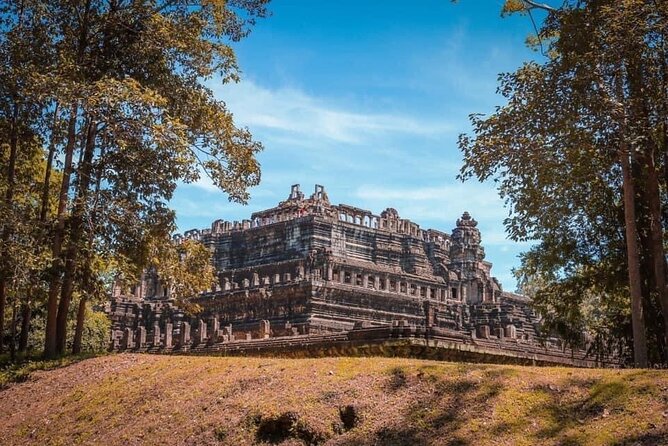
Baphuon sits close to Bayon and receives about 30 minutes. It is an 11th-century Hindu temple, built before Angkor Wat, with a tall stepped form that gives the site a different feel from Bayon’s crowded towers.
Behind Baphuon is a large reclining Buddha added in the 16th century. It is easy to miss if you only look at the main pyramid, so keep an eye out as you walk around the rear of the structure.
Next comes Phimeanakas, a smaller pyramid temple in the center of the former royal palace area. You have about 20 minutes here, along with time to see part of the ancient Royal Enclosure Wall.
Phimeanakas is less visually overwhelming than Bayon. I like it as a change of pace, especially because it helps you picture the temple within a royal complex rather than as a standalone ruin. The short visit is probably enough for most people, although anyone fascinated by Angkor’s layout may want to ask for more time.
More Banteay Srei trips:
- Full-Day Banteay Srei & 4 Temples – Grand Tours Join-in Tour
★ 5.0 · 1,155 reviews - Siem Reap Tour: Angkor Wat Sunrise, Bayon, Ta Prohm, Banteay Srei
★ 5.0 · 931 reviews - 2-Day Angkor Wat With Small, Big Circuit and Banteay Srei Tour
★ 5.0 · 545 reviews - From Siem Reap: Banteay Srei Temple & Grand 5 Temple Tour
★ 4.8 · 262 reviews
The Terraces of the Elephants and Leper King
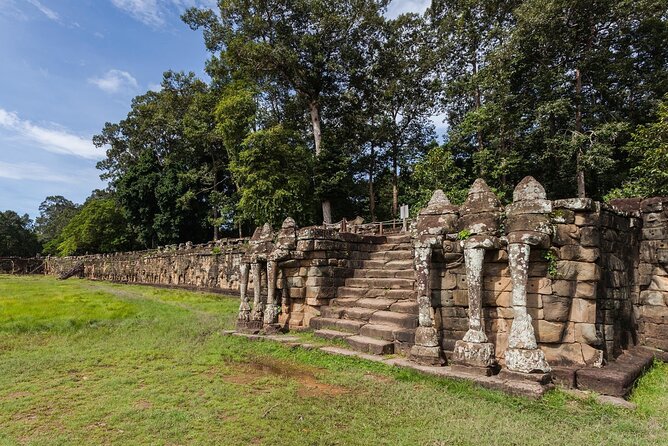
The Terrace of the Elephants takes about 15 minutes. This long platform was used by kings to watch returning armies, and elephant carvings cover parts of the wall.
The nearby Terrace of the Leper King is another 15-minute stop. It is smaller and sits north of the Elephant Terrace. Both are quick visits, but they help fill out the picture of Angkor Thom as a ceremonial and political center.
Do not expect the same scale or drama as Bayon. These stops work best as part of the larger route. They are useful for seeing carved details and royal spaces without taking too much energy from the major temples later in the day.
Small temples, a steep pyramid, and Ta Prohm
After Angkor Thom, the route continues to Chau Say Tevoda and Thommanon. Both are described as Brahmanical temples built in the late 11th or early 12th century under King Suryavarman II, and each receives around 20 minutes.
Their similar size and close location make them easy to compare. You can look at the layout, towers, and carved details without committing another hour to each site. For some people, these stops will feel like welcome quiet pauses. For others, they may seem less essential after Bayon.
Takeo is the shortest visit, at about 15 minutes. This pyramid rises through five levels to around 40 meters. The upper structure is reached by steep stairways, so the stop may appeal most to people who want to study temple design from the outside and are comfortable with a demanding climb.
The itinerary lists no admission charge for Takeo, while the other temples require the Angkor ticket. That does not mean the whole route is free of temple costs. You still need to purchase the required temple entrance separately.
Ta Prohm and the power of a famous image
Ta Prohm gets about an hour, and it deserves the time. This is the jungle temple associated with the film Tomb Raider, but its appeal is not limited to movie fame.
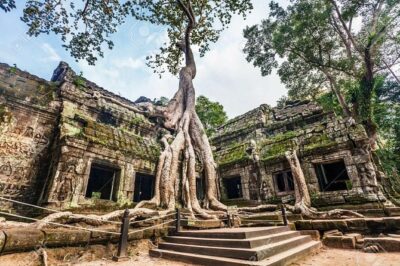
Trees grow over and around the stone buildings, with roots pressing into walls and doorways. The combination of carved galleries, broken chambers, and vegetation makes Ta Prohm feel different from the more orderly monuments of Angkor Thom.
It can also be one of the busiest places on the route. The private vehicle helps with getting to a convenient entrance, but it cannot remove crowds inside the temple. Follow your driver’s timing advice and be ready to move through some areas rather than stopping at every doorway.
Banteay Kdei, a calmer finish
Banteay Kdei closes the first day, with about 30 minutes planned. Its name means Citadel of Chambers, and the interior is a maze of rooms and passageways.
This is a good final stop because it is quieter in character than Ta Prohm. After the famous jungle temple, Banteay Kdei lets you focus on the shape of the ruins and the way one chamber leads into another. Half an hour is enough for an overview, though you may want more if you enjoy wandering through corridors.
Day two on the grand circuit
Day two begins with Preah Khan, a large monastic complex built by King Jayavarman VII and dedicated to his father. It served as a Buddhist monastery and school and once engaged more than 1,000 monks.
Allow about an hour. Preah Khan is long and complex, with galleries and courtyards that reward steady exploration. It has some of the same atmospheric qualities as Ta Prohm, but the experience is less tied to a single movie image. I find it particularly useful for showing how Angkor’s religious buildings operated as large institutions, not just places of worship.
Neak Pean and Ta Som
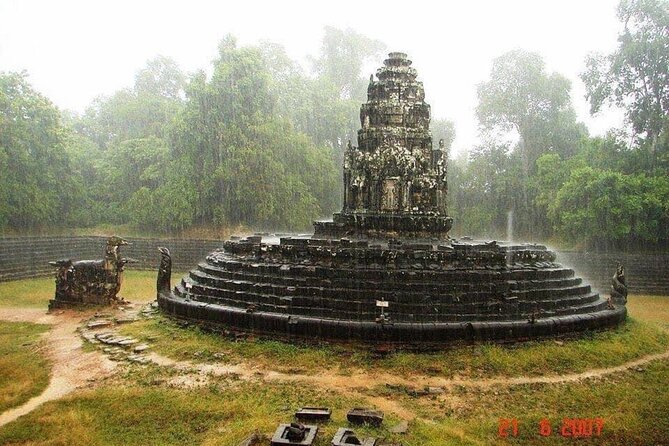
Neak Pean is a small island temple in the middle of the last baray, or reservoir, in the Angkor area. The walk to the temple takes you across a raised path over the water, and the setting makes this a welcome change after the enclosed galleries of Preah Khan.
The temple is associated with the horse Balaha, shown saving drowning sailors. Originally dedicated to Buddha, it reflects the religious changes found across Angkor’s monuments. About 40 minutes is planned here.
Ta Som follows with about 45 minutes. It is a smaller classic temple, best known for the large tree growing from the top of its eastern gopura, or entrance tower.
Ta Som is a useful reminder that size does not always decide which places you remember. The tree and compact layout give it a clear identity, while the shorter visit keeps the day moving.
Eastern Mebon and Pre Rup
Eastern Mebon is a three-level temple mountain crowned by five towers. You have about 45 minutes to explore it.
The temple’s elevated design gives it a strong, geometric shape. It is more open and orderly than Ta Prohm or Preah Khan, so you can compare how different Khmer builders used height, enclosure, and towers to create a sacred center.
Pre Rup receives about an hour. Built in the late 10th century and dedicated to Hindu gods, it is traditionally connected with funerary rites and the idea of turning the body.
The upper levels provide a broad view across the surrounding area, although the steep steps require care. Pre Rup is often a satisfying late-day stop because its brick towers and layered pyramid form are easy to read after you have seen several more tangled temple complexes.
Banteay Srei brings fine detail and pink sandstone
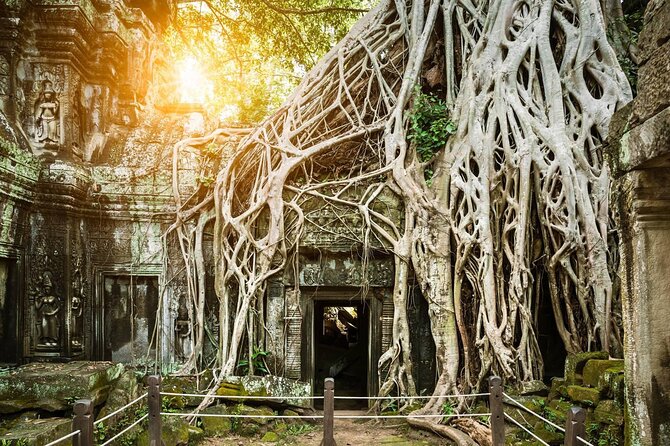
The final stop is Banteay Srei, also called the Ladies Temple. It is built from pink sandstone and dates to the second half of the 10th century. The temple was dedicated mainly to Shiva and to the Hindu trinity.
The one-hour visit gives you time to look closely at the carvings. Banteay Srei is smaller than Angkor Wat and Bayon, but its decoration is unusually fine, with detailed figures and patterns cut into the warm-colored stone.
It is also farther from the central Angkor group, so including it in a private route is useful. You do not need to arrange a separate trip just to reach it. The tradeoff is time on the road, and the second day remains full once you add Preah Khan, Neak Pean, Ta Som, Eastern Mebon, and Pre Rup.
If carved detail interests you most, Banteay Srei may become your favorite stop. If you prefer enormous structures and grand courtyards, Bayon, Preah Khan, or Pre Rup may leave a stronger impression.
What the $159 price really covers
At $159, the value depends mainly on how many people are in your private group and how you view transport. The price includes a private vehicle, air conditioning, parking fees, hotel pickup and drop-off, an English-speaking driver, tour information, cold mineral water, and towels.
Temple entrance is not included. That is the main extra cost to plan for, and it applies across the route. The price also does not describe meals, so plan separately for food and drinks beyond the supplied water.
For a couple, family, or small private group, the price can make sense because you are paying for two days of dedicated transport rather than separate rides between widely spread monuments. A family with a toddler may also value the private setup more than a solo visitor on a very tight budget.
The strongest service details are practical rather than flashy. Kimsun is described as driving safely with a family and toddler, while Frank is noted for strong English, patient waiting, cold drinks, and taking people to convenient temple entrances. Heng is associated with airport pickup as well as the Angkor touring and other Siem Reap arrangements.
Those names are useful when you contact the provider, but they do not guarantee who will drive your booking. Ask if you have a preference. The stated service is an English-speaking driver, not necessarily a licensed guide at every monument.
Comfort, pace, and who should book
This tour suits you best if you want to see a wide range of Angkor sites while keeping the vehicle and schedule private. It is also a practical choice if you are traveling with family, since one booking includes pickup, drop-off, air conditioning, and space for your group.
You should be comfortable with early starts or long sightseeing days, even though exact departure times are not provided. Eleven stops on day one and six on day two create a full program, with visits ranging from 15 minutes to one hour.
The plan is flexible, but flexibility works best when you discuss priorities in advance. Tell the driver if Bayon, Ta Prohm, or Banteay Srei matters most to you. You can then use the shorter stops as adjustable points if you need more time at a major temple.
Most people can participate, and the activity is described as being near public transportation, though the main arrangement is private hotel pickup. Steep temple steps at places such as Takeo and Pre Rup may be a consideration for anyone who finds uneven ruins difficult.
You receive booking confirmation at the time of booking. Free cancellation is available if you cancel at least 24 hours before the local start time. Changes or cancellations inside that window are not accepted for a refund.
Should you book this two-day Angkor route?
I would choose this tour if you want the main Angkor experience in two organized days and prefer a private vehicle to a larger shared group. The route has a good mix of major temples, smaller ruins, royal terraces, and Banteay Srei’s delicate stonework.
I would look elsewhere if you want a fully guided archaeological tour with detailed explanations inside every temple, since the listed service centers on an English-speaking driver and tour information. I would also avoid packing extra activities into these two days. The temple schedule is already full.
Before paying, confirm the exact driver, pickup time, vehicle arrangement, and temple ticket cost. If those details suit you, the combination of flexible pacing, strong transport support, and broad site coverage makes $159 a reasonable starting price for a private Angkor visit.
FAQ
Is this tour private?
Yes. Only your group participates in the activity, and transport is provided in a private vehicle.
How long does the tour last?
The tour lasts approximately two days, with one day covering the Angkor Thom and small-circuit sites and the second day covering the grand circuit and Banteay Srei.
Is hotel pickup included?
Yes. Pickup and drop-off at your hotel in Siem Reap are included.
Are temple entrance fees included?
No. Temple entrance fees are not included in the tour price.
Is transportation air-conditioned?
Yes. The tour includes an air-conditioned private vehicle.
Is an English-speaking driver included?
Yes. An English-speaking driver and tour information are included.
Are water and towels provided?
Yes. Cold mineral water and towels are included.
Can most people participate?
The activity states that most people can participate. Some temples have steep or uneven areas, including the pyramid structures at Takeo and Pre Rup.
Can I cancel for a full refund?
Yes, if you cancel at least 24 hours before the experience start time. Cancellations or changes made less than 24 hours before the start time are not accepted for a refund.
More 2-Day Experiences in Siem Reap
- Angkor 2-Day Sunset & Sunrise Small-Group Tour
★ 5.0 · 2,567 reviews - 2 Days Exclusive Temple Highlights with Sunset and Sunrise Tour
★ 5.0 · 1,157 reviews - Siem Reap: Angkor Sunrise 1- or 2-Day Guided Temples Tour
★ 4.9 · 1,132 reviews - 2 Days Guided Historical Tour in Angkor
★ 5.0 · 855 reviews
New around Siem Reap
- Siem Reap Temple and Waterfall 3-Day Tour★ 4.5 · 3 reviews
- Savor the Countryside: Tours with Authentic Cooking Classes”★ 5.0 · 3 reviews
- Siem Reap Private Tour: Angkor Wat Sunrise And Banteay Srei★ 5.0 · 3 reviews
- Siem Reap: Guided Day Trip to Local Village & Cooking Class★ 5.0 · 3 reviews
- Angkor Wat Sunrise TukTuk Tour★ 5.0 · 3 reviews
- Angkor Wat Sunset In Private and Small-In-Group★ 4.3 · 3 reviews
- Full Day to Banteay Srei, Kulen National Park and Beng Mealea★ 5.0 · 3 reviews
- Exclusive Angkor temples and Small group temples tours★ 5.0 · 3 reviews
Angkor Wat Tours, compared.
Angkor Wat Sunrise or Sunset Tour with Guide from Siem Reap
Read our review →
Angkor Wat: Small-Group Sunrise or Sunset Tour
Read our review →
Angkor Wat Sunrise tour with Small – Group and Guide tours
Read our review →
Angkor Wat Highlights and Sunrise Guided Tour from Siem Reap
Read our review →
Angkor Wat Sunset Small Group Tour with Lunch Included
Read our review →
Full-Day Angkor Wat Sunrise Private Tour with Guide from Siem Reap
Read our review →
Angkor Wat Sunrise & 3 Main Temples with Breakfast – Small Group
Read our review →Browse the lists this tour appears in