
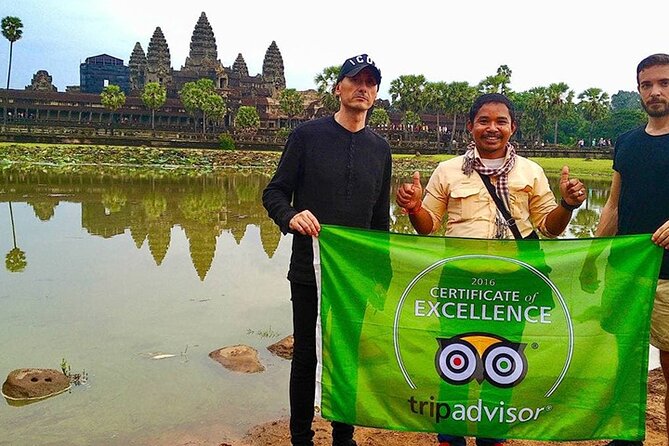
Reviewed · ANGKOR WAT TOURS
Private Day Angkor Wat Temple and Banteay Srei Temple Tour
Angkor Wat may be the headline, but this private day gives you a much fuller picture of the Khmer capital. You move from jungle-covered Ta Prohm to the delicate carvings of Banteay Srei, then through Angkor Thom before spending up to three hours at the great temple itself. The variety is the real strength.
I like the private format, since you can ask for a slower pace or adjust the day with your guide. I also like the practical help: an air-conditioned vehicle, cold water, towels, parking, road tolls, and pickup and drop-off at the airport are included. If you work with Chanra, communication through WhatsApp and tour customization are useful extras. The main drawback is the cost of the required temple pass, which adds $37 to the advertised $43 price, bringing the basic total to $80 per person.
Key points before you book
- Ten major stops in about eight and a half hours: You see the main Angkor sights in one demanding but efficient day.
- Private transport and guide: Your group travels alone in an air-conditioned vehicle with an English-speaking guide.
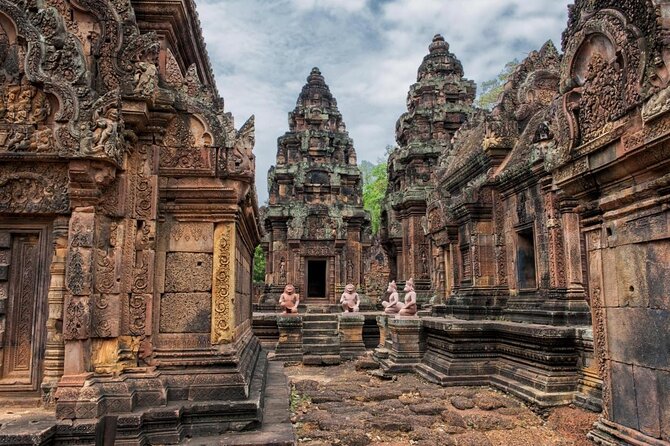
- Banteay Srei adds something different: Its small scale and fine pink sandstone carving contrast sharply with Angkor Wat.
- The temple pass costs extra: Budget $37 per person for the one-day pass, in addition to the tour price.
- Useful mobility support: The guide has helped a guest using crutches reach sites by arranging closer driving, a moped, and a tuk-tuk.
- Airport pickup and drop-off are included: This can make the tour useful at the beginning or end of a Siem Reap stay.
What the $43 tour price really covers
The advertised price is $43 per person. That pays for the private tour, air-conditioned vehicle, English-speaking guide, parking fees, road tolls, drinking water, towels, and airport pickup and drop-off.
You still need to buy the one-day temple pass for $37 per person. Your practical total is therefore $80 per person before any group discount. That distinction matters, since the lower headline price can look like the full cost at first glance.
For a private eight-and-a-half-hour day, the value is reasonable if you want transport and a guide without joining a larger group. You are paying for convenience as much as sightseeing. Siem Reap’s temple area is spread out, and the route includes Banteay Srei, which sits about 25 kilometers northeast of the main Angkor area.
A group of two pays more than it would for a shared outing, but gets a quieter vehicle and more control over the pace. Larger private groups may also benefit from available group discounts. Ask about the discount before booking rather than assuming it will be applied automatically.
More Angkor Wat Tours in Siem Reap:
- Angkor Wat Sunrise or Sunset Tour with Guide from Siem Reap
★ 5.0 · 12,109 reviews - Siem Reap: Angkor Wat: Small-Group Sunrise or Sunset Tour
★ 5.0 · 9,444 reviews - Siem Reap: Angkor Wat 2-Day Tour with Sunrise and Sunset
★ 4.9 · 4,429 reviews
A long day with a useful private rhythm
The schedule lists roughly 8 hours and 30 minutes, with ten stops. The time adds up quickly, and you should expect plenty of walking, steps, uneven ground, and repeated climbs. Angkor is not a quick series of roadside photo stops.
A private guide can make this pace work better. If you are fascinated by carvings, you can spend longer at Banteay Srei or Angkor Wat. If the heat catches up with you, the air-conditioned vehicle gives you a place to cool off between sites.
The day is also adjustable. Chanra, one of the guides associated with this experience, communicates through WhatsApp and can shape the route around what you most want to see. He also suggests additions or changes rather than simply following a rigid script. That flexibility is especially useful when you already know that Angkor Wat is your priority, or when you would rather focus on architecture than royal history.
The tour operates as a private activity, so only your group participates. That does not remove the need for planning. Ten stops is a lot, and a private tour still cannot turn a large archaeological park into a short visit.
Ta Prohm, where the jungle takes the lead
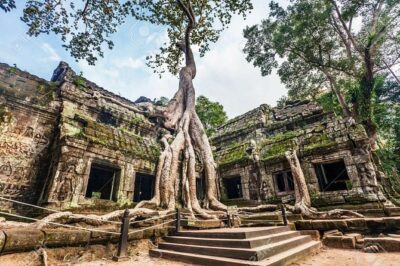
Your first stop is Ta Prohm, one of the most memorable temples in the Angkor area. Its original name was Rajavihara, meaning monastery of the King, and it was built in 1186 as a Mahayana Buddhist monastery and university.
Ta Prohm is known for trees and roots spreading across the stone ruins. Vines and giant roots reach over walls, courtyards, and doorways, creating the tangled look that makes this site different from the more orderly Angkor Wat.
You have about an hour here. That is enough to see the main areas without treating the temple as a hurried photo stop. The maze-like plan can make the place feel confusing, so a guide helps you understand how the courtyards and galleries fit together.
The same jungle growth that makes Ta Prohm special also creates a practical concern. The ground can be uneven, and the site involves walking. If someone in your group has a foot injury or uses mobility aids, tell the guide before the visit. The guide has arranged closer vehicle access and alternative transport, including a moped and tuk-tuk, for a guest on crutches. That kind of help can determine whether someone sees the site at all.
Pre Rup and the broad view from a 10th-century temple
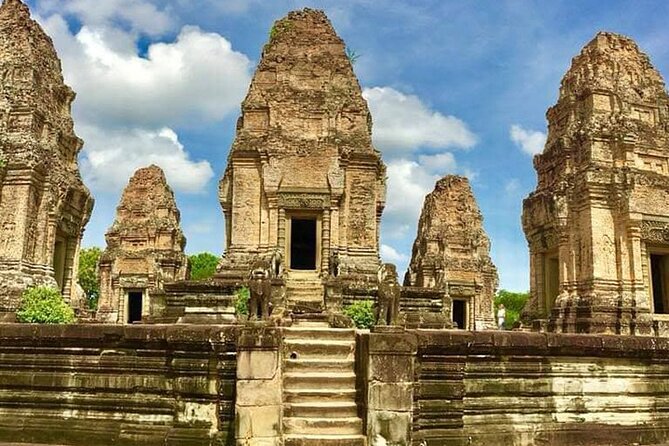
Pre Rup is a shorter visit, listed at about 20 minutes. King Rajendravarman built it as a state temple in 961 or 962, only nine years after East Mebon, located 1.3 kilometers to the north.
The temple is a useful change of mood after Ta Prohm. Instead of roots curling over enclosed ruins, you get a more open, strongly geometric monument. The brick and laterite structure rises in stepped levels, giving the stop a sense of height and form.
Twenty minutes is enough for a look, but not for a slow exploration. Think of Pre Rup as a compact architectural pause in a full day, not a main event. If you prefer to spend every available minute at Angkor Wat, this is one of the stops you may want to discuss with your guide.
More Banteay Srei trips:
- Full-Day Banteay Srei & 4 Temples – Grand Tours Join-in Tour
★ 5.0 · 1,155 reviews - Siem Reap Tour: Angkor Wat Sunrise, Bayon, Ta Prohm, Banteay Srei
★ 5.0 · 931 reviews - 2-Day Angkor Wat With Small, Big Circuit and Banteay Srei Tour
★ 5.0 · 545 reviews - From Siem Reap: Banteay Srei Temple & Grand 5 Temple Tour
★ 4.8 · 262 reviews
Banteay Srei and the finest small-scale carving
Banteay Srei is the artistic surprise of the route. This 10th-century Hindu temple is dedicated to Shiva and lies near Phnom Dei, about 25 kilometers northeast of the main Angkor area.
The name is often translated as Temple of Women, and the temple is also called the Pink Ladies Temple. It is smaller than Angkor Wat, but its detailed carving gives it enormous visual impact. Look for finely worked motifs and figures of gods cut into the pink sandstone.
You have about an hour here. That is enough time to appreciate the carvings without racing through the complex. I consider this stop one of the best reasons to choose this route instead of a basic Angkor Wat and Angkor Thom day.
The distance from the central temple area does make Banteay Srei a trade-off. You spend part of the day in the vehicle to reach it. For most first-time visitors, the detailed work earns that travel time. If your priority is a long, quiet visit at Angkor Wat, you should ask how the guide will balance the two.
Angkor Thom begins at the South Gate
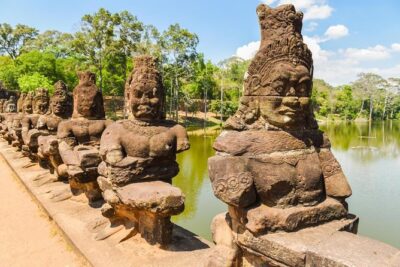
After the outer temples, you enter Angkor Thom through the South Gate. The approach crosses a moat about 100 meters wide, with a causeway flanked by naga balustrades and large stone figures.
This is an impressive arrival because the entrance is designed as a grand statement. The causeway leads you into the old Khmer capital, and the scale changes again from small Banteay Srei to a vast royal city.
You have about 20 minutes here. That gives you time to walk across the approach, inspect the gate, and take in the symbolism before continuing. It is worth resisting the urge to treat the South Gate as only a quick picture stop. The entrance explains how Angkor Thom was framed as a protected and ordered royal center.
Bayon and its famous stone faces
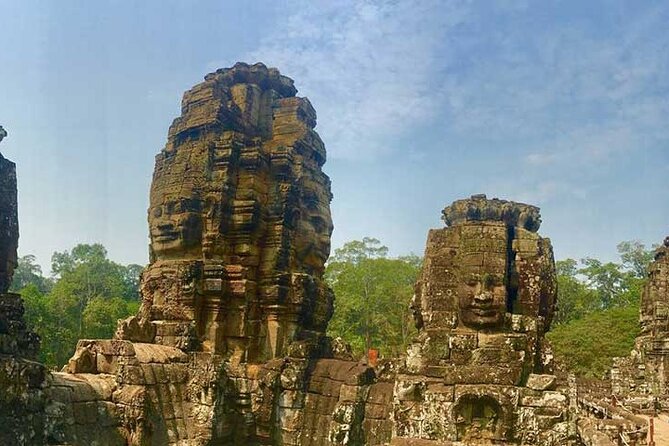
Bayon receives about 50 minutes, a good length for a first visit. Its towers carry gigantic carved faces, with 173 remaining according to the supplied information.
Who the faces represent remains debated. Local Khmer belief connects them with the Four Faces of Prohm, while other interpretations link them with King Jayavarman VII or a Buddhist image. Your guide can help you follow these competing ideas while you look closely at how the faces appear from different angles.
Bayon can feel hard to read at first. Towers overlap, galleries turn, and the faces seem to appear and disappear as you move. I like having a guide here because the temple rewards orientation. Without some explanation, you may notice the famous faces but miss how the design works as a whole.
The 50-minute visit is useful but not exhaustive. You will see the core of Bayon and get a sense of its unusual character, though a very devoted architecture fan may want more time.
Baphuon, Phimeanakas, and the royal center
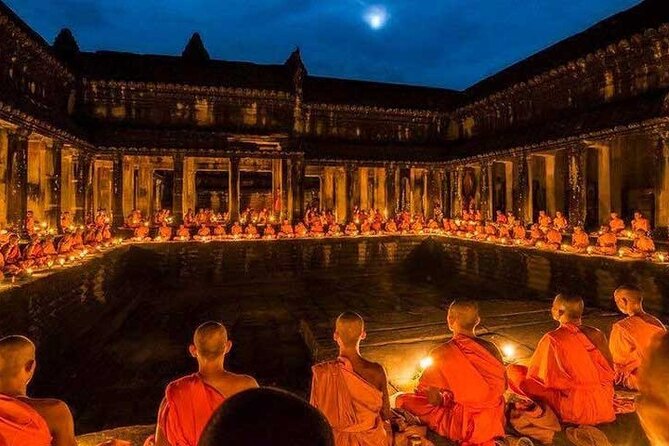
Baphuon is the next substantial stop, with about 40 minutes. King Udayadityavarman II built it as his state temple inside Angkor Thom, between the Royal Palace and Bayon. Its sandstone monument has a strong, elevated form and occupies an important place in the old capital.
The temple is close enough to other Angkor Thom sights that the route feels logical rather than scattered. You can compare Baphuon with Bayon: one is defined by a powerful stepped structure, the other by towers crowded with faces.
Phimeanakas gets about 30 minutes. It sits within the royal enclosure, an area you are likely to pass through as you move around the old capital. The temple comes with a story, and that makes it a good place for your guide to connect architecture with royal life and belief.
The surrounding royal enclosure is not as instantly recognizable as Angkor Wat or Ta Prohm. Still, it helps fill in the picture of Angkor Thom as a working capital rather than a collection of isolated monuments.
The Royal Terraces and the parade ground
The Terrace of the Elephants stretches more than 300 meters from Baphuon in the south to the Terrace of the Leper King in the north. King Jayavarman VII built it at the end of the 12th century.
You have about 30 minutes to see it. Its long frontage faces the parade grounds, and the elephant carvings give the terrace its name. This is a site where scale matters more than a single enclosed chamber. Walk along the edge and consider how it worked as a ceremonial viewing platform.
The Terrace of the Leper King receives about 15 minutes. Together, the two terraces form the eastern boundary of the Royal Palace grounds. The shorter stop is enough to see the carved walls and understand the relationship between the royal enclosure and the open grounds.
These visits are less intimate than Ta Prohm and less visually concentrated than Banteay Srei. Their value comes from setting. They show you how the royal city was organized and how public ceremonies may have related to the palace area.
Three hours at Angkor Wat
The final major stop is Angkor Wat, with about three hours. That length is welcome. The temple is too large and important to reduce to a brief stop at the front causeway.
Angkor Wat has five concentric rectangular walls and surrounding moats. The design symbolizes a cosmic chain of mountains and ocean, while the central tower represents Mount Meru, understood in Hindu and Buddhist belief as the center of the universe.
The symbolism becomes easier to grasp as you move inward. Start with the broad scale of the moat and outer walls, then notice how the galleries, towers, and central sanctuary create layers of space. Angkor Wat is not just a large building. It is a carefully ordered religious model in stone.
Three hours gives you room to see the main structure, study the carvings, and pause without making the last stop feel like a sprint. It also balances the earlier itinerary. You have already seen jungle ruins, a small carving-focused temple, a royal city, and several distinct architectural styles.
There is one practical issue: the tour information does not specify a sunrise departure or sunset finish. Do not assume either is included. The stated duration is about eight and a half hours, and the listed operating hours are 8:00 a.m. to 4:00 p.m. from Monday through Sunday during the published date range. Confirm the exact pickup time when booking, especially if you want a particular light or crowd condition.
Transport, comfort, and mobility
The air-conditioned vehicle is more than a minor perk in Cambodia. After several hours walking among stone temples, a cool ride between stops can help you keep going through the afternoon.
Cool water and towels are included. Parking fees and road tolls are also covered, so you are not repeatedly reaching for small payments during the route. Pickup and drop-off at the airport are included as well, which may be handy if your schedule lines up with the tour.
Most people can participate, but you should take the walking seriously. Ta Prohm, Baphuon, Phimeanakas, the terraces, and Angkor Wat all require time on your feet. If you have limited mobility, mention it in advance. The guide’s past arrangement of closer driving, a moped, and a tuk-tuk shows that some flexibility is possible, but you should not treat this as a fully step-free tour.
Who will get the most from this day
This tour suits a first visit to Siem Reap when you want the main monuments in one private day. It works especially well if you value explanations and want to adjust the balance between the headline temples and smaller sites.
It is also a good choice for couples, families, and small groups who do not want strangers in the vehicle. The private setup lets you ask questions, slow down, or make a reasonable change with the guide.
You may want a different plan if your priority is photography at one site, a relaxed pace, or extended time at every monument. Ten stops create breadth, not a leisurely study of each temple. Banteay Srei also adds driving time, so people with only a short Angkor visit should decide if its detailed carving is worth the trade-off.
The 100 percent recommendation rate and five-star average from 20 ratings point to a strong record, but the most useful lesson is more specific: the guide’s communication and willingness to help can make the day work better. Chanra is especially worth considering if you want to plan through WhatsApp or customize the route.
Booking, cancellation, and final call
Confirmation is provided at booking, and free cancellation is available if you cancel at least 24 hours before the start time. Changes or cancellations made inside that 24-hour window are not accepted for a refund.
I would book this tour if you want a private, well-covered introduction to Angkor and are comfortable with a full day of walking. The combination of Ta Prohm, Banteay Srei, Angkor Thom, and three hours at Angkor Wat gives you a strong range of experiences for $43, though you must add the $37 temple pass.
Before paying, confirm the pickup time, the airport transfer details, the guide assigned to your group, and how much flexibility you have with the ten-stop schedule. If you want personal attention, useful transport, and a broad first look at the Angkor area, this is a sound choice. If you want slow temple study, choose fewer sites and spend more time at each one.
FAQ
How much does the tour cost per person?
The tour costs $43 per person. The required one-day temple pass costs an additional $37 per person, making the basic combined cost $80 per person.
Is the temple pass included?
No. The one-day temple pass is not included in the tour price and must be purchased separately for $37 per person.
Is this a private tour?
Yes. Only your group participates in the activity, and transport is provided in an air-conditioned vehicle.
What is included in the tour?
The tour includes an air-conditioned vehicle, an English-speaking guide, parking fees, road tolls, cool water, towels, and pickup and drop-off at the airport.
How long does the tour last?
The tour lasts approximately 8 hours and 30 minutes. The itinerary includes ten stops, with about three hours scheduled at Angkor Wat.
Can I cancel for a full refund?
Yes, if you cancel at least 24 hours before the experience start time. Cancellations or changes made less than 24 hours before the start time are not refunded or accepted.
New around Siem Reap
- Kulen Mountain With Ticket included Plus Banteay Srei Temple Tour★ 5.0 · 7 reviews
- 2 Days Angkor temples with Sunrise & Sunset★ 5.0 · 7 reviews
- Private Siem Reap Airport Transfer to hotel in town★ 5.0 · 7 reviews
- 1-Day private Angkor Temple Tour with Sun Rise by Tuk Tuk from Siem Reap★ 4.5 · 7 reviews
- Siem Reap: Morning Cooking Class & Market Tour★ 5.0 · 7 reviews
- Kulen Mountain, Killing Fields and War Museum Tour★ 5.0 · 7 reviews
- War Museum, Killing Field, and APOPO Hero RATs Tour★ 5.0 · 7 reviews
- Half-Day: Silk Farm, Senteur Angkor, and Satcha Workshop★ 4.6 · 7 reviews
Angkor Wat Tours, compared.
Angkor Wat Sunrise or Sunset Tour with Guide from Siem Reap
Read our review →
Angkor Wat: Small-Group Sunrise or Sunset Tour
Read our review →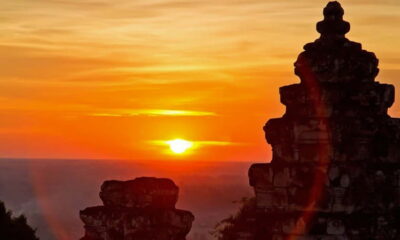
Angkor Wat Sunrise tour with Small – Group and Guide tours
Read our review →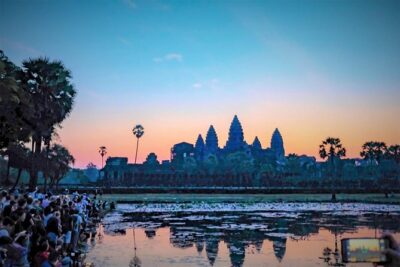
Angkor Wat Highlights and Sunrise Guided Tour from Siem Reap
Read our review →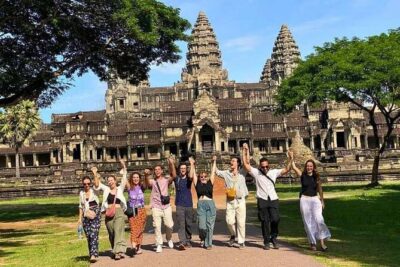
Angkor Wat Sunset Small Group Tour with Lunch Included
Read our review →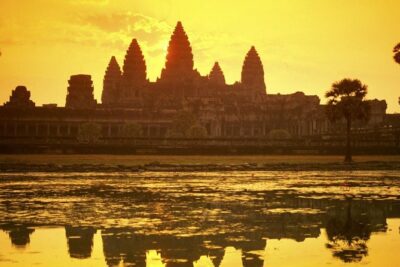
Full-Day Angkor Wat Sunrise Private Tour with Guide from Siem Reap
Read our review →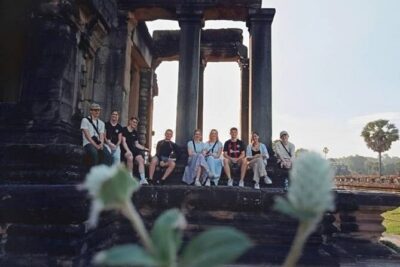
Angkor Wat Sunrise & 3 Main Temples with Breakfast – Small Group
Read our review →Browse the lists this tour appears in