
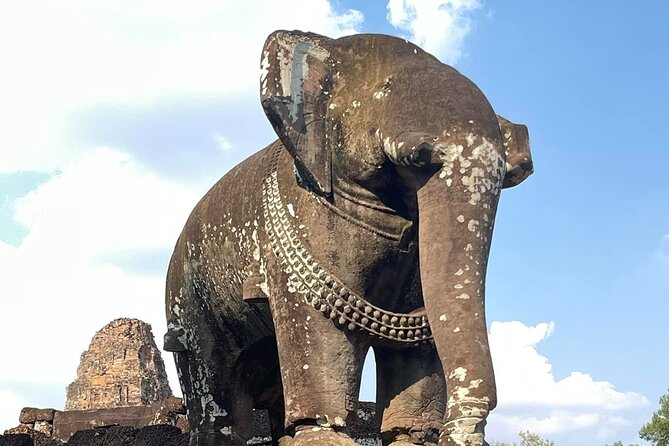
Reviewed · ANGKOR TEMPLE TOURS
Preah Khan, Neak Pean and Pre-Rup Private Tour
Preah Khan gives this half-day outing its real punch: a huge, partly overgrown temple where long galleries, carved doorways, and tree-lined ruins make Angkor feel less polished and more personal. I like the private vehicle, which keeps the day flexible, and I like the mix of major and smaller sites, including the unusual water temple of Neak Pean. The one catch is the admission cost: the $41 tour price does not include the $37 Preah Khan ticket.
If you have already seen Angkor Wat and Angkor Thom, this is a smart second-day plan. Guide Sim has earned especially warm praise for being helpful and well informed, and one family was able to adjust the route after realizing they had already visited one listed temple. Just remember that the tour covers a lot of ground in only four to five hours, so each stop receives a short, focused visit rather than a slow archaeological study.
Key points at a glance
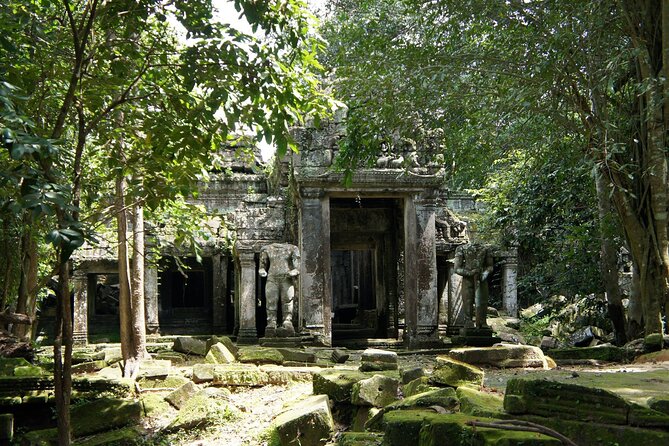
- Preah Khan is the main event: Allow about an hour for its long corridors, courtyards, and layered religious history.
- Neak Pean is unlike the other stops: The small temple sits on an artificial island in the middle of a former reservoir.
- Six sites fit into a half-day: You will see Preah Khan, Neak Pean, Ta Som, East Mebon, Srah Srang, and Pre Rup.
- A private tour gives you room to adjust: The route can be discussed with your guide if you have already seen one of the temples.
- Guide Sim receives special praise: His name comes up in several positive comments, with an emphasis on helpful explanations and a pleasant touring style.
- Budget for the entrance fee: The listed price is $41 per person, but the Preah Khan admission fee of $37 per person is extra.
Why this makes a good second Angkor day
Angkor is not one temple. It is a huge area of religious buildings, reservoirs, roads, and former royal centers spread across the forest. After the famous Angkor Wat and Angkor Thom, this route takes you farther out to places with a different mood and scale.
I like the way the stops build a story. Preah Khan is broad and maze-like. Neak Pean brings water and symbolism into the picture. Ta Som is smaller and quieter in feel, while East Mebon and Pre Rup show the brick-and-stone style of an earlier period. Srah Srang gives you a break beside a large reservoir.
This is also a useful choice if you want a private outing without arranging transport, route planning, and temple explanations yourself. An English-speaking guide travels with you, and an air-conditioned vehicle provides relief between the sites. Bottled water and hotel pickup and drop-off are included.
The schedule is tight, though. The planned visits total about four hours and ten minutes, before driving time. That fits the advertised four to five hours only because the stops are brisk. You will get a clear introduction to each place, but not unlimited time for photography, sketching, or quiet wandering.
More Angkor Temple Tours in Siem Reap:
- Siem Reap Tour: Angkor Wat Sunrise, Bayon, Ta Prohm, Banteay Srei
★ 5.0 · 931 reviews - Siem Reap: Bike the Angkor Temples – Full-Day 30km Tour
★ 5.0 · 463 reviews - Angkor Wat one Day Private Tour for All Highlight Angkor Temples
★ 5.0 · 199 reviews
Preah Khan, a royal temple with room to roam

Preah Khan means Royal Sword. King Jayavarman VII built it in the 12th century in honor of his father. Its flat design differs from the tall temple-mountain form seen at Pre Rup, and its plan unfolds through successive rectangular galleries.
Give this stop the full hour. The pleasure here comes from moving through one space after another, with walls, courtyards, carved details, and signs of age shaping the route. The scale helps you understand that Angkor was not simply a collection of isolated shrines. It was a large religious and civic world.
The temple is also described as a UNESCO-listed complex, so it carries particular weight within the Angkor area. Your guide can help you read the layout and explain both ancient and modern Cambodian context instead of leaving you to see the ruins as a series of attractive stones.
There is one important financial detail. The $41 tour price does not include the $37 admission fee for Preah Khan. That changes the real cost considerably, especially for two or more people. Check the booking details carefully so you understand how the admission is handled and what you need to pay separately.
Neak Pean and the meaning of water
Neak Pean, also called Neak Poan, means the entwined serpents. It was built on an artificial island in a large reservoir associated with Preah Khan. The former reservoir measured about 3.5 kilometers by 1 kilometer, a reminder of the water engineering that supported Angkor.
The temple itself is not large. Its appeal comes from the setting and design. Instead of entering a long complex, you approach a compact sacred structure surrounded by water and open space. That makes it a welcome change after Preah Khan.
You have about an hour here, which is generous compared with the smaller temples later in the day. Use the time to listen to the guide’s explanation of the site’s religious purpose and connection to the wider Angkor water system. The entrance is listed as free within this tour information, though your general Angkor admission arrangements still deserve attention before booking.
Neak Pean can be especially rewarding if you like temples that make sense only when you understand their setting. Without that explanation, it may seem like a small building at the end of a walk. With context, the reservoir and artificial island become the main part of the story.
Ta Som, a short stop with a forest feel
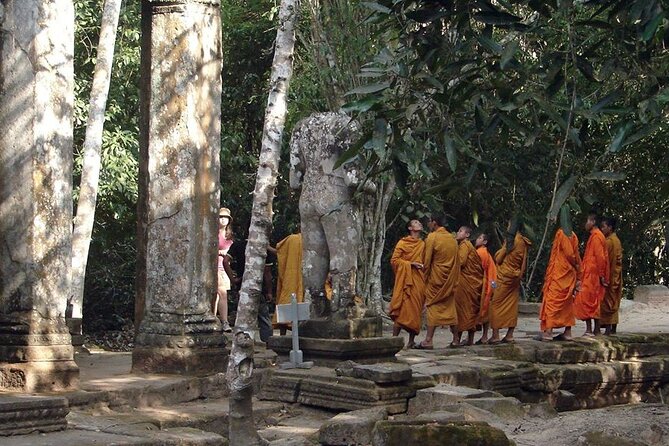
Ta Som was built at the end of the 12th century for King Jayavarman VII and dedicated to his father, Dharanindravarman II. It lies northeast of Angkor Thom and east of Neak Pean.
The planned visit lasts about 30 minutes. That is enough for a compact introduction, a look at the entrance and central areas, and a few photographs. It is not enough for a slow, detailed inspection of every carving.
The appeal here is the smaller scale. After Preah Khan’s long galleries and Neak Pean’s water setting, Ta Som lets you see a more modest temple without giving up the sense of age and forest surroundings. The route description specifically highlights its position among forests and jungles, so expect the setting to be part of the experience.
If you want every stop to be a major monument, Ta Som may feel brief. I see it instead as a useful change of pace, and the private format helps because you are not tied to a large group’s timetable.
A few more Siem Reap half-days to weigh up
- Angkor Wat Sunrise or Sunset Tour with Guide from Siem Reap
★ 5.0 · 12,109 reviews - Siem Reap: Angkor Wat: Small-Group Sunrise or Sunset Tour
★ 5.0 · 9,444 reviews - From Siem Reap: Kampong Phluk Floating Village Tour by Boat
★ 4.9 · 6,979 reviews - Sunset tour of Kampong Phluk stilts home village on the Tonle Sap
★ 5.0 · 4,865 reviews
East Mebon and an earlier Angkor style
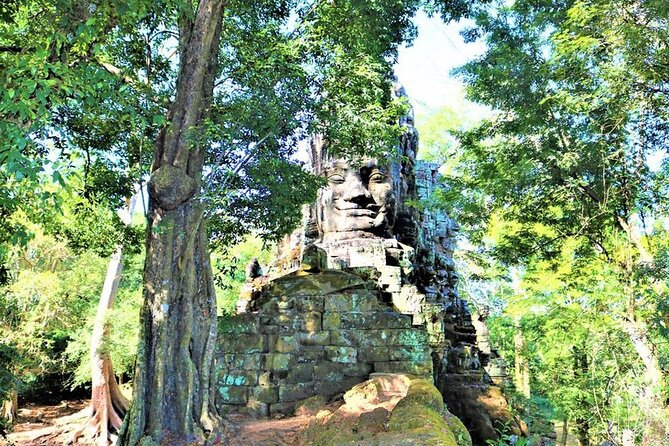
East Mebon was built in the 10th century by King Rajendravarman. It once stood on an artificial island in the center of the East Baray, a reservoir measuring about 7.5 kilometers by 1.8 kilometers. The reservoir is now dry, so the temple’s original island setting is easier to understand through explanation than through the present view.
The temple is associated with brick, laterite, and sandstone construction, and its earlier date gives you a useful contrast with the 12th-century buildings on the route. You have about 40 minutes here, enough to see the main structure and compare its design with Preah Khan, Ta Som, and Pre Rup.
I like this chronological spread. You are not looking at six nearly identical ruins. The tour moves between different building periods, royal patrons, materials, and religious settings. That makes the guide’s role important. A good explanation can turn the route into a connected lesson rather than a string of photo stops.
Srah Srang, a pause beside the reservoir
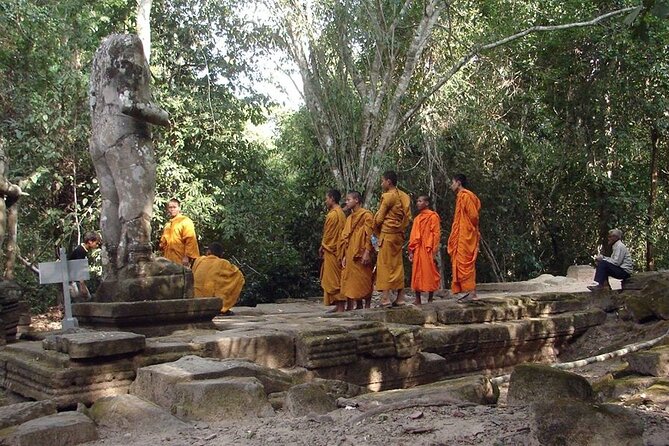
Srah Srang was dug in the mid-10th century under the direction of Kavindrarimathana, a Buddhist minister of Rajendravarman II. Jayavarman VII later modified it around the year 1200 and added the landing terrace.
You spend about 20 minutes here. That is short, but this stop is meant to give your day some breathing room. After several temple visits, the open water and broad view offer a visual reset.
The site also reinforces the importance of reservoirs in Angkor. Water was not a minor decorative feature. It shaped the location and function of major religious complexes. Your guide can connect Srah Srang with the much larger water systems you have already heard about at Neak Pean and East Mebon.
Do not expect a long walk or a full temple visit at Srah Srang. Think of it as a brief stop with historical value and a different view. If you prefer a nonstop sequence of major ruins, you may find the 20 minutes less essential. If you appreciate variety, it earns its place.
Pre Rup closes the route with a temple mountain
Pre Rup was built by King Rajendravarman in the 10th century. It uses brick, laterite, and sandstone, and follows the temple-mountain form. Its name is comparatively modern and means turning the body.
The planned visit lasts about 40 minutes. That gives you time to see the stepped structure, understand how it differs from the flat layout of Preah Khan, and take in its strong architectural shape.
Pre Rup works well as the final temple because it pulls together several ideas from the day: royal power, changing construction styles, religious symbolism, and the use of raised platforms to create a commanding sacred form. It is also a clear contrast with the low, gallery-based design of Preah Khan.
The route information does not promise a sunset visit, so do not book this tour solely for sunset photography. You are getting a daytime half-day temple circuit, not a dedicated golden-hour outing.
Guide Sim and the value of a private format
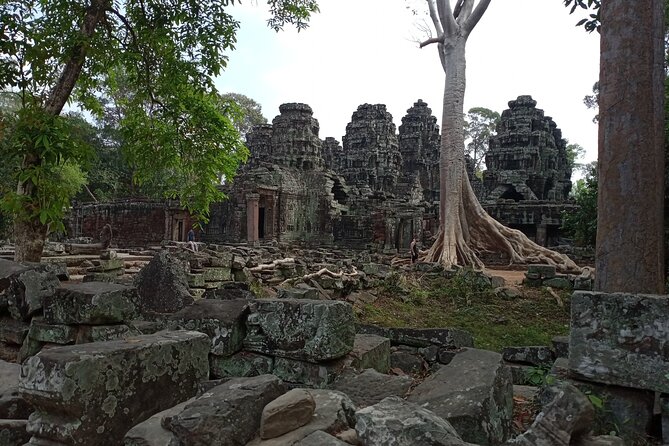
Guide Sim is the clearest individual strength attached to this experience. Several comments single him out for a pleasant, helpful approach and solid explanations. One family also found the guide willing to accommodate a change after they had already visited one of the scheduled temples.
That flexibility matters. A private tour means only your own group participates, so you can raise questions, ask for more background at a favorite site, or discuss adjusting the order. The information does not promise unlimited customization, but the private structure is more adaptable than a fixed group excursion.
The guide is also meant to explain ancient and modern history, Cambodian culture, and the way of life of Cambodian people. That wider focus is useful. Temples make more sense when you learn about the kings who commissioned them, the religious traditions behind them, and the society that built and maintained them.
The vehicle is air-conditioned, and hotel pickup and drop-off are included. Those are practical advantages in Siem Reap, where the heat can make the rides between sites as important as the visits themselves. Bottled water is included too.
Is $41 a good value?
At first glance, $41 per person looks reasonable for a private four to five-hour tour with a guide, vehicle, water, and hotel transport. The private format is the key value here. You are not only paying for admission or a ride. You are paying to have the route organized and explained without joining strangers.
But the advertised price does not include the $37 Preah Khan admission fee per person. That makes the total much higher than the headline figure. Since the other stops are listed with no additional ticket charge in the tour details, Preah Khan is the fee you need to plan around.
For a solo visitor, the combined cost may feel steep for a half-day. For a couple, family, or small private group, the vehicle and guide become easier to justify, especially if you value comfort and direct explanations. Group discounts are offered, but the exact reduction is not provided, so ask for the current terms before booking.
The average booking lead time is 23 days. That suggests planning ahead, particularly if you want a certain date or have a tight Siem Reap schedule. Confirmation is provided at booking, and cancellation is free up to 24 hours before the start time. Within 24 hours, no refund is available, and changes are not accepted.
Who should book this temple circuit?
I would choose this tour for a first or second full day in the Angkor area after seeing the headline sights, especially if you want to understand how the outlying temples fit together. It also suits families and small groups who prefer a private vehicle and the option to discuss the pace with one guide.
It is a good fit if you enjoy variety: a large royal complex, a water temple, a small forest temple, two 10th-century monuments, a reservoir, and a temple mountain. The route gives you more than one architectural style and more than one period of Angkor’s history.
I would be more cautious if your priority is lingering at each site. Six stops in four to five hours require discipline. Preah Khan receives the longest visit, while Ta Som and Srah Srang are quite short. You may also want to confirm the admission arrangements before paying, since the extra $37 charge is not hard to miss once you know to look for it.
Should you book it?
Book this tour if you want an efficient, private introduction to Angkor’s outer temples, with hotel transport and a guide who can connect architecture, royal history, water systems, and Cambodian culture. Guide Sim is a strong choice if he is assigned to your date, based on the especially positive comments about his help and explanations.
Skip it if you have already seen these six sites, want a full-day archaeological route, or dislike extra admission costs added to a low headline price. For most people building a second Angkor day, though, the mix of Preah Khan, Neak Pean, Ta Som, East Mebon, Srah Srang, and Pre Rup offers a useful change from the standard temple circuit.
FAQ
How long does the private tour last?
The tour lasts approximately four to five hours.
What temples and sites are included?
The route includes Preah Khan, Neak Pean, Ta Som, East Mebon, Srah Srang, and Pre Rup.
Is the Preah Khan admission fee included?
No. The listed information specifies an additional Preah Khan entrance fee of $37 per person.
Is transportation included?
Yes. Hotel pickup and drop-off are included in a private air-conditioned vehicle.
Is a tour guide included?
Yes. An English-speaking tour guide is included. Guide Sim is one guide associated with especially positive comments about this experience, though assignment should be confirmed for your booking.
Can I cancel for a full refund?
Yes, if you cancel at least 24 hours before the experience start time. Cancellations or changes made within 24 hours are not accepted for a refund.
New around Siem Reap
- Siem Reap Temple and Waterfall 3-Day Tour★ 4.5 · 3 reviews
- Siem Reap Private Tour: Angkor Wat Sunrise And Banteay Srei★ 5.0 · 3 reviews
- Siem Reap: Guided Day Trip to Local Village & Cooking Class★ 5.0 · 3 reviews
- Savor the Countryside: Tours with Authentic Cooking Classes”★ 5.0 · 3 reviews
- Angkor Wat Sunrise TukTuk Tour★ 5.0 · 3 reviews
- Angkor Wat Sunset In Private and Small-In-Group★ 4.3 · 3 reviews
- Full Day to Banteay Srei, Kulen National Park and Beng Mealea★ 5.0 · 3 reviews
- Exclusive Angkor temples and Small group temples tours★ 5.0 · 3 reviews
Angkor Temple Tours, compared.
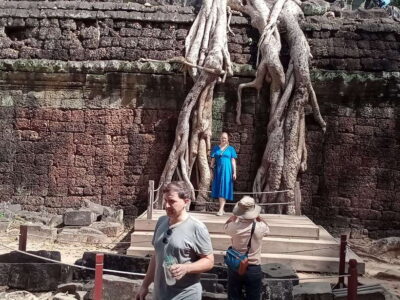
1-Day private Angkor Temple Tour from Siem Reap
Read our review →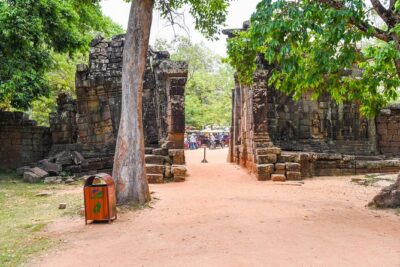
Private Full-Day Angkor Temple and Sunset Viewing with Lunch
Read our review →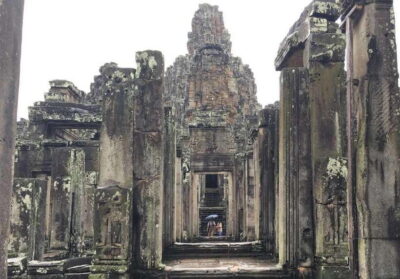

Private one-day tuktuk ‘small tour’ of the oldest Angkor temples
Read our review →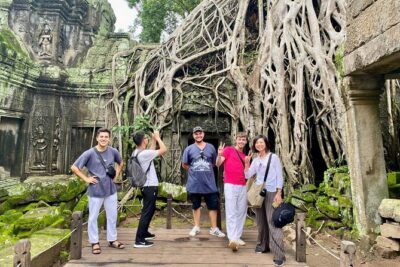
Explore Angkor Temple & Other – Private Vehicle with Tour Guided
Read our review →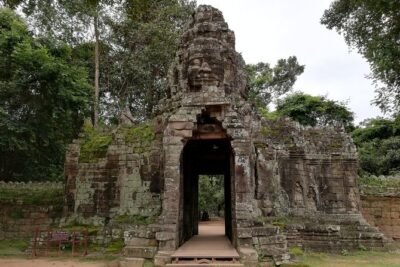
Angkor Wat Private Driver Tours to Angkor Wat Sunrise, Angkor Thom & Ta Prohm
Read our review →Browse the lists this tour appears in