Reviewed · SIEM REAP TOURS
Journey Through Time: Grand Tours with professional photographers
The best part of this private Angkor Grand Circuit tour is the freedom to see major temples without a large group setting the pace. Your guide leads you through Preah Khan, Neak Pean, Ta Som, Pre Rup, Eastern Mebon, and Banteay Srei, while a professional photographer records the day.
I like the private transport and the extra attention from the guide. I also like the mix of grand stone temples and quieter, tree-filled ruins, plus the practical touches: hotel transfer, bottled water, fruit, and phone-based ticket details. Guides named John, Diamond, Pich, and Davann have been associated with warm humor, history explanations, queue advice, and useful photos.
The main consideration is time. The advertised duration is about five to six hours, yet six stops are listed at roughly one hour each, and Banteay Srei lies about 25 kilometers northeast of Angkor Archaeological Park. You may need to keep moving, especially if you want proper time at every temple.
Key points at a glance
- Six very different temples: See the long galleries of Preah Khan, the island sanctuary of Neak Pean, tree-covered Ta Som, pyramid-shaped Pre Rup, Eastern Mebon, and ornate Banteay Srei.
- A genuinely private setup: Only your own group takes part, so you can ask questions and manage the pace more easily than on a large coach tour.
- Photography is part of the package: A professional photographer accompanies you, with past guests especially pleased with pictures and short videos.
- Hotel pickup and return: Private transport connects Siem Reap with Angkor and includes a complimentary round-trip hotel transfer.
- A useful companion to Angkor Wat: The Grand Circuit gives you a different side of the temple complex and works well after a main Angkor Wat visit.
- Budget for the temple pass: The one-day Angkor pass costs $37 per person and is not included in the $237 tour price.
What the Grand Circuit adds to your Angkor visit
Angkor is not one temple. It is a huge archaeological area with several routes, and the Grand Circuit takes you east and north of the most famous monuments. The route gives you a broad look at Khmer religious architecture, from the 10th century to the late 12th century.
You will not get the same iconic experience as an Angkor Wat sunrise tour. That is not a flaw. The Grand Circuit is about variety. You see buildings shaped by Buddhist devotion, Hindu belief, royal power, water engineering, and the slow return of trees and roots.
I think this tour makes the most sense as a second Angkor day, especially after you have already seen Angkor Wat and perhaps the Small Circuit. It fills in the picture rather than repeating the same style of monument.
The private format matters here. Temple visits can blur together when a guide has to manage a large group. With your own guide, you can stop for an explanation, ask about a carved figure, or spend less time at a site that does not capture your interest.
A few more Siem Reap half-days to weigh up
- Angkor Wat Sunrise or Sunset Tour with Guide from Siem Reap
★ 5.0 · 12,109 reviews - Siem Reap: Angkor Wat: Small-Group Sunrise or Sunset Tour
★ 5.0 · 9,444 reviews - From Siem Reap: Kampong Phluk Floating Village Tour by Boat
★ 4.9 · 6,979 reviews
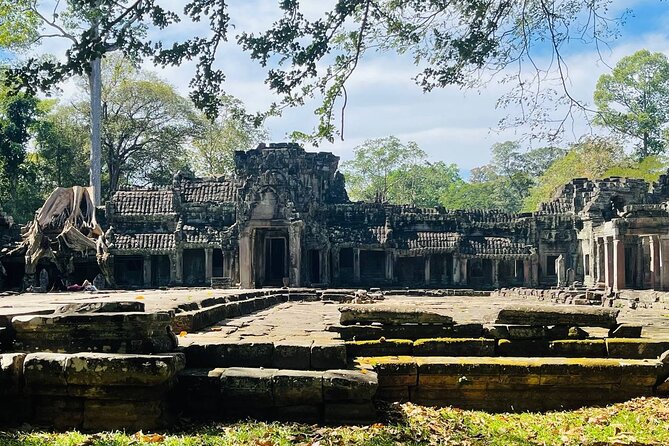
Preah Khan: long corridors and royal scale
Your first major stop is Preah Khan, also called the Royal Sword Temple. King Jayavarman VII built it in the early 12th century in honor of his father.
This is a large and layered temple. You move through galleries, doorways, courtyards, and long passageways rather than simply walking around one central tower. Its former importance is easy to understand when you hear that the complex once supported nearly 100,000 officials and servants.
Give this site your full attention. The scale can be hard to grasp from a single photograph, but a guide can help you read the plan of the temple and explain how its religious and administrative roles fit together.
Preah Khan also gives the photographer plenty to work with. Framed doorways, stone corridors, and weathered carvings create more interesting pictures than a simple standing pose in front of a tower. If you want photographs that show the temple rather than just your face, tell the photographer early.
The drawback is that one hour can feel tight. Preah Khan is expansive, and you may want longer here than at some of the smaller stops.
Neak Pean: a temple on an artificial island
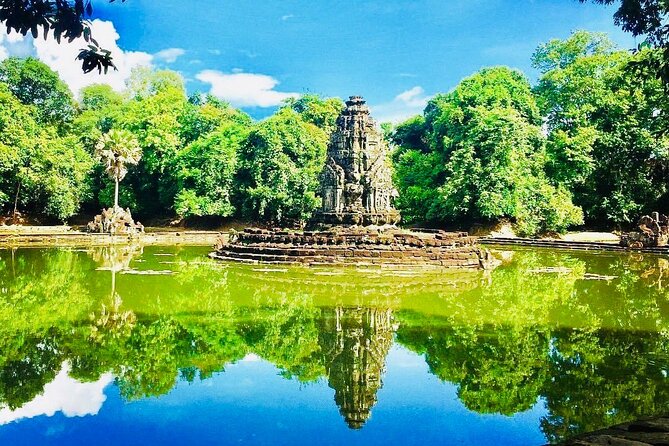
From Preah Khan, you continue to Neak Pean. This Buddhist temple was built by Jayavarman VII on an artificial island in the center of the Preah Khan Baray, also known as Jayatataka.
Its setting is unlike the other temples on this route. Instead of a broad complex of towers and galleries, Neak Pean centers on an island sanctuary surrounded by water and reached by a causeway.
The water setting is a key part of the visit. It helps you understand that Angkor’s temples were tied to large-scale water systems, not placed randomly across dry ground. Your guide can add the religious meaning behind the design and explain why an island sanctuary was important.
Neak Pean is also a shorter, more focused stop. You may find the one-hour allocation comfortable here, though the experience depends on water conditions and how far access allows you to walk.
Do not expect a vast temple complex. Neak Pean is about the central structure, the approach, and the relationship between sacred architecture and water.
Ta Som: nature reclaiming the stone
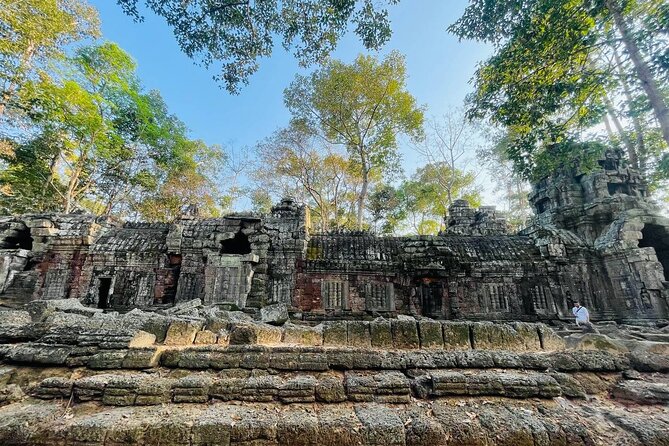
Ta Som comes next. Jayavarman VII built this late 12th-century temple in honor of his father, and it shares some of the atmospheric qualities that make Ta Prohm so popular.
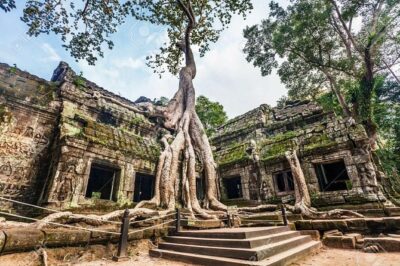
Ta Som remains largely unrestored, with trees and other plants growing around the stonework. The trees are not just decoration. They show how the site changed after its period of active use and why Angkor feels different from a neatly maintained museum complex.
I like Ta Som for its sense of scale. It is smaller and less demanding than Preah Khan, so you can focus on details: carved stone, narrow passages, broken sections, and roots pressing into the structure.
This is another good place for the photographer to take less formal pictures. A doorway partly wrapped by roots or a narrow passage with uneven stone can create a stronger memory than a standard temple portrait.
The tradeoff is that unrestored ruins can be uneven underfoot. The supplied information does not specify accessibility conditions, so wear sensible footwear and follow your guide’s advice around damaged areas.
A completely different sort of day from the same base:
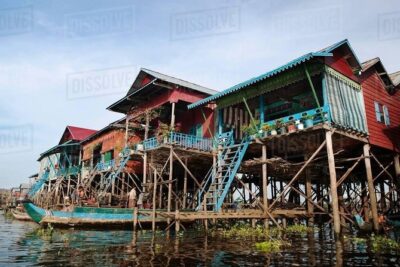
- Sunset tour of Kampong Phluk stilts home village on the Tonle Sap
★ 5.0 · 4,865 reviews - Siem Reap: Angkor Wat 2-Day Tour with Sunrise and Sunset
★ 4.9 · 4,429 reviews - Siem Reap: Kampong Phluk Floating Village Tour with Boat
★ 4.9 · 3,843 reviews - Siem Reap: Full-Day Angkor Wat Guided Tour with Sunset
★ 4.9 · 3,803 reviews
Pre Rup: a sandstone pyramid with a darker name
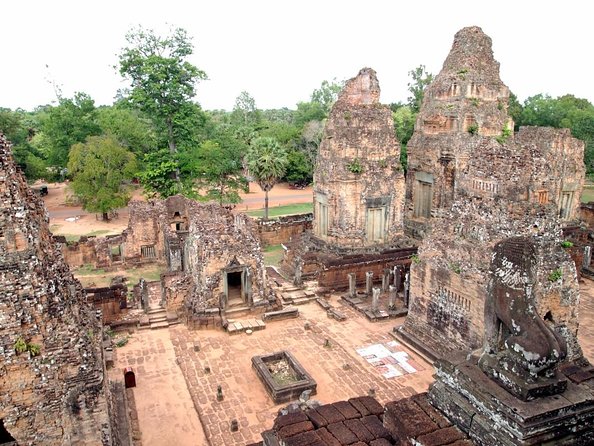
Pre Rup is a Hindu mountain temple built by King Rajendravarman in 961 or early 962. Its modern Khmer name means turn the body, a phrase connected with funerary beliefs.
The temple’s stepped, pyramid-like form gives you a different architectural view from the long corridors of Preah Khan and the island layout of Neak Pean. Its sandstone structure reads as a strong geometric mass, with levels that draw your eye upward.
This is the stop where the guide’s storytelling is especially useful. The name may sound simple, but it opens a door into Cambodian ideas about death and royal ritual. You get more from the visit when you know why the temple was built, not just when it was built.
Pre Rup can also be a good place for photographs that show the shape of a temple. Ask for a few pictures that include the full structure, rather than only close-up portraits.
The tour lists about one hour here. That gives you time to look around, hear the main explanation, and take photos, but it may not allow a slow architectural study.
Eastern Mebon: elephants above a dry baray
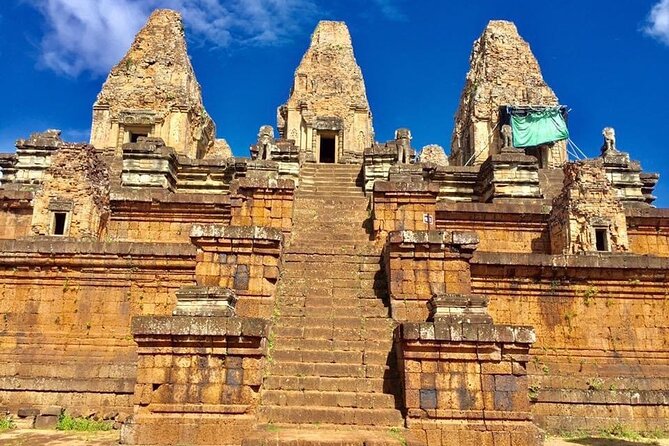
The next temple is Eastern Mebon, a 10th-century Hindu temple built by King Rajendravarman. It was dedicated to Vishnu and honored the king’s parents.
Eastern Mebon once sat on an artificial island in the center of the East Baray, a huge reservoir that is now dry. The temple therefore gives you another clear example of the connection between Angkor’s sacred buildings and its waterworks.
The site is known for its strong, sculptural details, including stone elephants. Those figures make the temple feel different from the more enclosed corridors of Preah Khan or the tree-covered Ta Som.
I find Eastern Mebon valuable because it connects several subjects at once: Hindu worship, royal family memorials, engineering, and changing water systems. A good guide can turn those separate facts into one clear explanation.
Like Pre Rup, Eastern Mebon is best approached as a temple with a distinct plan and purpose, not merely another photo stop. If you are tiring by this point, let your guide know. Private touring makes it easier to adjust your attention, even if the overall schedule remains fixed.
Banteay Srei: the small temple with fine carving
Banteay Srei is about 25 kilometers northeast of the Angkor Archaeological Park. It is smaller than Angkor Wat, but its detailed stone carving gives it a special place on this route.
The temple dates from the 10th century and is often associated with finely worked Khmer art. Its smaller scale lets you look closely at ornament and carved surfaces instead of trying to take in a huge complex all at once.
This stop also changes the rhythm of the day. After several large or open temple sites, Banteay Srei offers a more intimate visit. The countryside setting adds to the sense that you have moved beyond the busiest core of Angkor.
Banteay Srei is listed with free admission in the supplied tour information, while the other temple stops list admission as not included. You should still confirm the exact ticket arrangements before setting out, since the Angkor pass is separately required for the tour as a whole.
The distance is the practical issue. If all six temples are included in five to six hours, Banteay Srei may compress the time available elsewhere. Ask at pickup how the guide plans to handle the route and whether the day is expected to run closer to six hours.
A guide, a photographer, and a private vehicle
The tour includes an English-speaking professional guide, a professional photographer, and a luxury private car or van. That combination is the heart of the experience.
The guide is not simply there to point out buildings. John has been described as friendly and funny, with explanations of Cambodian history and small details around the temples. Diamond, also referred to as Pich, has been associated with history, kings, culture, photographs, and videos. Davann has been praised for humor and for helping avoid queues.
You should not assume a particular guide is guaranteed unless the operator confirms it. Still, those names give you a useful sense of the guiding style connected with the tour: informal, personable, and focused on stories as well as logistics.
The photographer is a real advantage if you want to be in the pictures instead of always holding the camera. Ask how and when the photos or videos will be delivered, since the supplied details do not explain the format or turnaround.
Private transport also removes a common source of hassle. You get pickup and return to your hotel in Siem Reap, rather than arranging separate transport to Angkor. Water, tissues, and natural fruit are included, but food and other drinks are not.
Is $237 a fair price?
The listed price is $237. The key question is whether that amount is for your full private group or priced per person, so confirm the booking basis before paying.
The value is strongest for a group that wants its own car or van, a guide, and a photographer. Splitting a private tour among several people can make the arrangement more attractive than booking separate transport, guiding, and photography.
You must add the one-day Angkor temple pass at $37 per person. Food, drinks, personal expenses, tips, and a listed $15 sun-light charge are also excluded. The wording around the sun-light charge is unclear, so ask the operator exactly what it covers.
This is not the cheapest way to see Angkor. It can be good value if you care about private pacing, detailed explanations, and usable photographs. It is less compelling if you only want basic transport and plan to take your own pictures.
Timing, clothing, and small practical points
The tour lasts about five to six hours and starts and ends in Krong Siem Reap, with hotel pickup offered. A mobile ticket is provided, so downloading your e-ticket to your phone can make meeting your driver easier.
Wear clothing that covers your shoulders and knees. Shorts and sleeveless tops are not allowed at places of worship and selected museums, and you may be refused entry if you do not follow the dress rules. This applies to both men and women.
Bring sun protection, since the tour includes open temple grounds and the information lists a sun-light charge. Food is not included, so plan accordingly. Mineral water and natural fruit are supplied.
The tour is marked as suitable for most people and near public transportation. It is a private activity, so only your own group participates. An 82-year-old family member has been taken on the tour, suggesting that mixed-age groups can manage it, but the uneven surfaces and walking between monuments still deserve consideration.
Free cancellation is available if you cancel at least 24 hours before the start time. Cancellations or changes made later are not accepted for a refund.
Should you book this Grand Circuit tour?
Book it if you want a private day with a real guide, hotel transport, and professional photographs. It is especially useful after Angkor Wat, since the route adds different periods, temple designs, and quieter settings rather than repeating the most famous monument.
I would be cautious if your priority is a relaxed, slow visit to every temple. Six stops, a five to six-hour schedule, and the drive to Banteay Srei create a full program. Confirm the timing, the $237 pricing basis, the possible $15 charge, and how the photographer supplies your images.
For families, couples, and small groups who value personal attention, this is a strong option. The humor associated with guides such as John, Diamond, Pich, and Davann may also help make a long temple day feel easier. Just keep your expectations clear: this is an efficient Grand Circuit overview with photography, not an unhurried archaeological study.
FAQ
Where does the tour start and finish?
It starts in Krong Siem Reap, Cambodia, and ends back at the meeting point. Complimentary round-trip hotel pickup and return transport are offered.
How long does the tour last?
The estimated duration is five to six hours.
Which temples are included?
The route includes Preah Khan, Neak Pean, Ta Som, Pre Rup, Eastern Mebon, and Banteay Srei.
Is the Angkor temple pass included?
No. The one-day Angkor temple pass costs $37 per person and is not included.
Is this a private tour?
Yes. Only your own group participates in the activity.
What transport is provided?
A luxury private car or van is included, along with round-trip transport between Siem Reap and Angkor.
Is a guide included?
Yes. An English-speaking professional tour guide is included.
Is photography included?
Yes. A professional photographer is included. The available information does not specify how or when the finished photos and videos are delivered, so confirm that before booking.
What clothing is required?
You must cover your knees and shoulders. Shorts and sleeveless tops are not allowed at places of worship and selected museums, and entry may be refused if you do not follow the dress code.
New around Siem Reap
- Siem Reap Temple and Waterfall 3-Day Tour★ 4.5 · 3 reviews
- Siem Reap: Guided Day Trip to Local Village & Cooking Class★ 5.0 · 3 reviews
- Savor the Countryside: Tours with Authentic Cooking Classes”★ 5.0 · 3 reviews
- Siem Reap Private Tour: Angkor Wat Sunrise And Banteay Srei★ 5.0 · 3 reviews
- Angkor Wat Sunset In Private and Small-In-Group★ 4.3 · 3 reviews
- Angkor Wat Sunrise TukTuk Tour★ 5.0 · 3 reviews
- Angkor Wat: Highlights and Sunrise with Spanish Guide★ 4.8 · 3 reviews
- Full Day to Banteay Srei, Kulen National Park and Beng Mealea★ 5.0 · 3 reviews
Siem Reap Tours, compared.
Angkor Wat Sunrise or Sunset Tour with Guide from Siem Reap
Read our review →
Angkor Wat: Small-Group Sunrise or Sunset Tour
Read our review →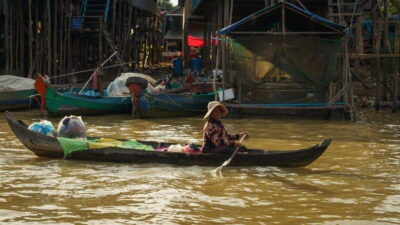
Sunset tour of Kampong Phluk stilts home village on the Tonle Sap
Read our review →
Kampong Phluk Floating Village Tour with Boat
Read our review →
Angkor Wat Sunrise tour with Small – Group and Guide tours
Read our review →