
Reviewed · ANGKOR WAT TOURS
Angkor Wat: Sunrise 2.5 Days Temples & Tonle Sap-Small Group
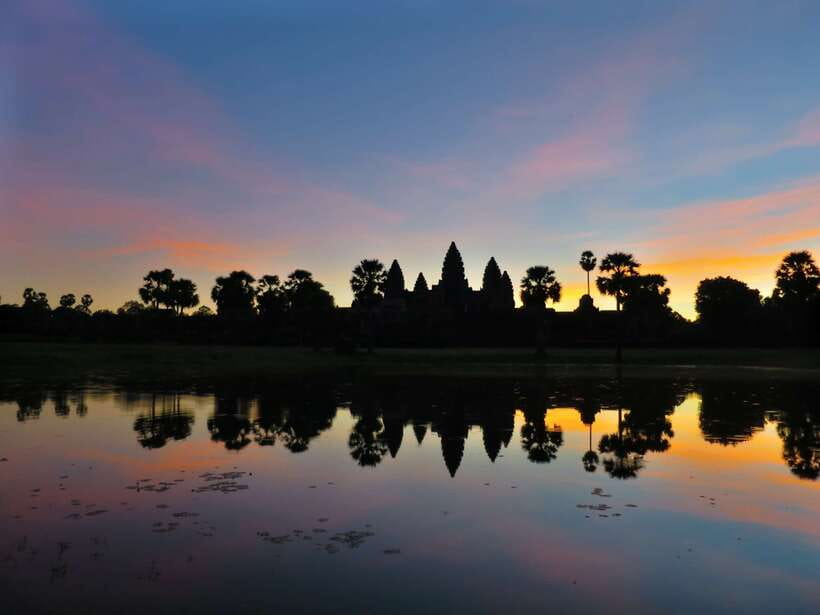
Angkor Wat at sunrise is the star here, but the real strength of this tour is the way it spreads the great temple complex over 2.5 days. You see the famous monuments, then reach quieter sites such as Neak Pean and Preah Khan before temple fatigue sets in.
I like the small-group limit of 15, and I like the practical care built into the day. Drivers such as Keal, Mao, and Ro have been praised for handing out cold water and wet towels after long walks in the heat. Guides including Pal Saruon, Pireak, Sam, AJ, and Pi bring different strengths, from temple history to local life.
The main drawback is cost clarity: the advertised $69 does not include the required $62 three-day temple pass, or breakfast. You should budget about $131 before meals, and remember that the pre-dawn start and long temple walks are not a good fit for anyone with limited mobility.
Key points at a glance
- Sunrise at Angkor Wat: Enter before dawn, walk through the eastern side, and watch the temple change as daylight arrives.
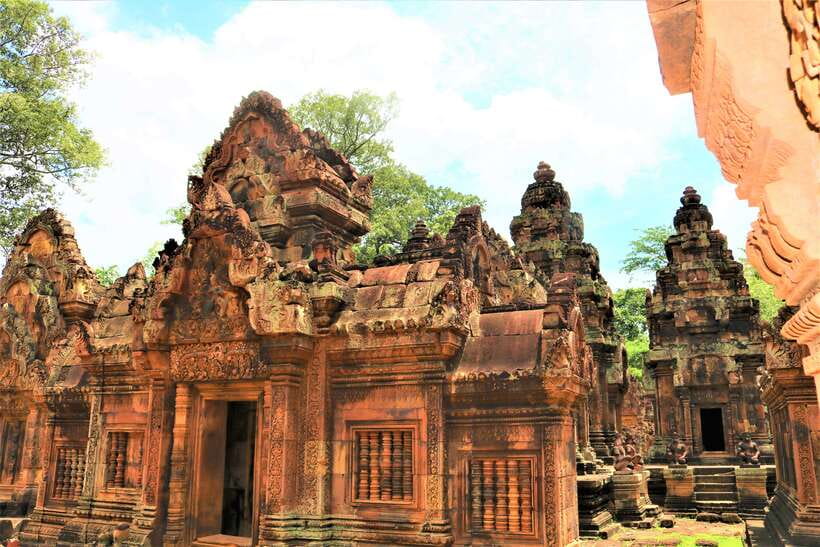
- Banteay Srei’s fine carving: This smaller sandstone temple has some of the most detailed relief work in Cambodia.
- Three days without rushing every stop: The schedule gives you time for the major temples and several sites outside the usual central circuit.
- Tonle Sap or Phare Circus: Visit Kampong Phluk and its flooded forest when conditions suit, or see Cambodia’s acclaimed circus during the dry season.
- Small group transport: A maximum of 15 people, hotel pickup, air conditioning, water, and cool towels make the heat easier to handle.
- Strong guide-and-driver pairing: Pal Saruon, Pireak, Sam, AJ, Pi, Keal, Mao, and Ro are among the named staff praised for clear explanations and attentive service.
Why the 2.5-day format works
Angkor is not one temple. It is a huge archaeological zone spread across several roads, with grand ceremonial sites, small shrines, reservoirs, gates, galleries, and forest-covered ruins. Trying to see everything in one hot day usually leaves you with a stack of photographs and little sense of what you saw.
This tour breaks the visit into two full temple days, followed by a shorter morning outing. That rhythm matters. Day one reaches the more distant temples. Day two handles the famous central monuments and begins before sunrise. Day three takes you beyond the temple zone to Tonle Sap, or to Phare Circus during the dry-season alternative.
You travel in an air-conditioned vehicle with hotel pickup and drop-off. The group can contain up to 15 people, so this is not a private tour, but it is still more manageable than a large coach outing. The guide can explain details as you walk, and you have a better chance of hearing instructions at busy stops.
The included mineral water is useful, but I would still bring more water if you drink often. Comfortable shoes are essential. You will walk over stone, through galleries, and across uneven ground. Short skirts are not allowed, so pack clothing that covers your knees and shoulders for temple visits.
More Angkor Wat Tours in Siem Reap:
- Angkor Wat Sunrise or Sunset Tour with Guide from Siem Reap
★ 5.0 · 12,109 reviews - Siem Reap: Angkor Wat: Small-Group Sunrise or Sunset Tour
★ 5.0 · 9,444 reviews - Siem Reap: Angkor Wat 2-Day Tour with Sunrise and Sunset
★ 4.9 · 4,429 reviews
Day one: Banteay Srei and the quieter northern temples
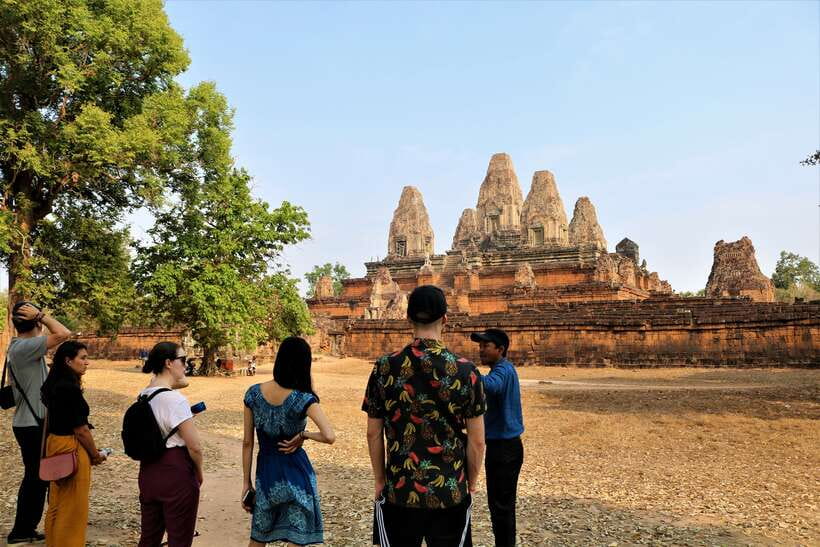
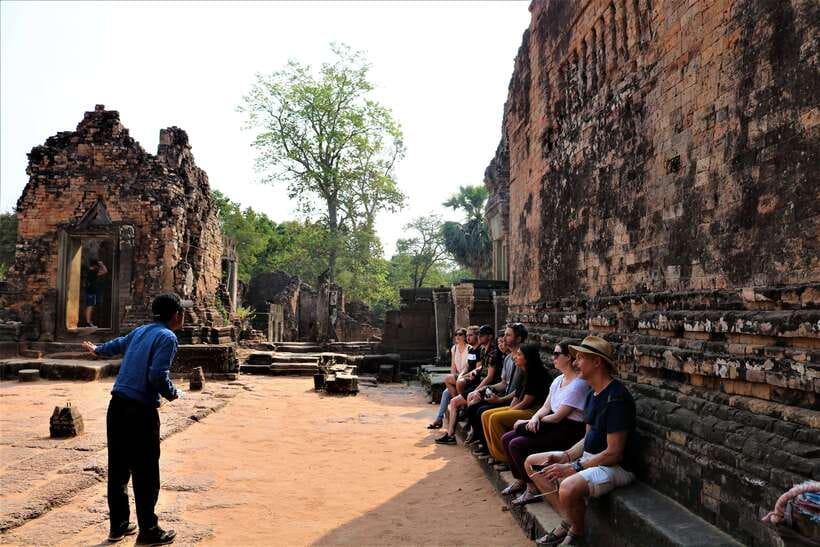
The first day starts outside Angkor Thom, with Pre Rup. This Hindu temple was built as a state temple and follows the classic mountain-temple design, rising in levels from a broad base. Its materials, brick, laterite, and sandstone, give it a different look from the more polished monuments in the central complex.
Pre Rup is a good opening stop because it introduces the basic ideas of Khmer temple design without the crowds and scale of Angkor Wat. You can see how the temple rises toward a central sanctuary, and your guide can explain the religious meaning behind that layout.
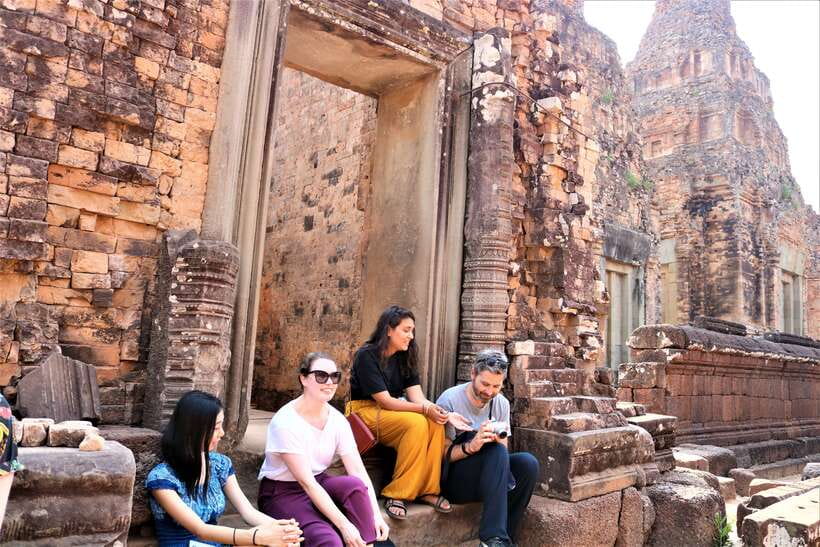
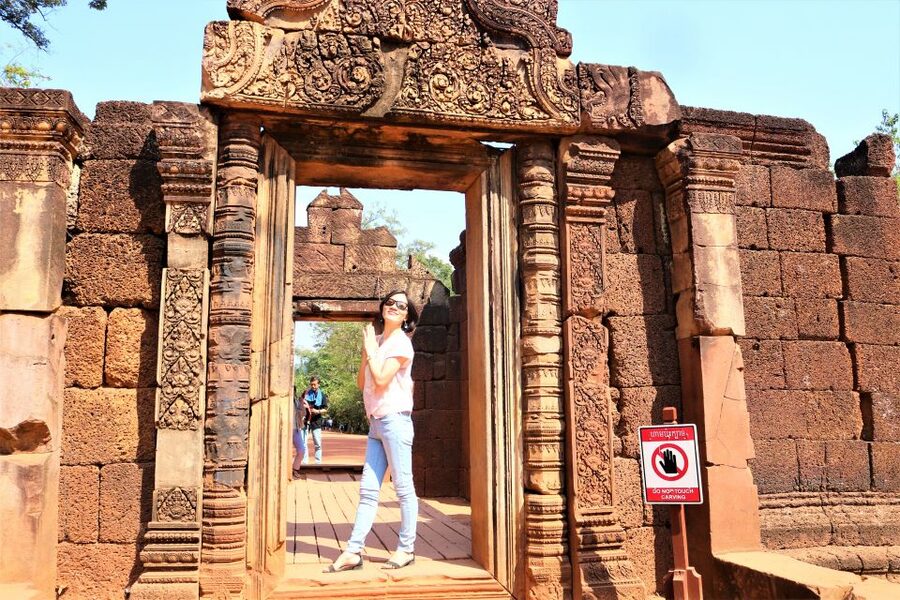
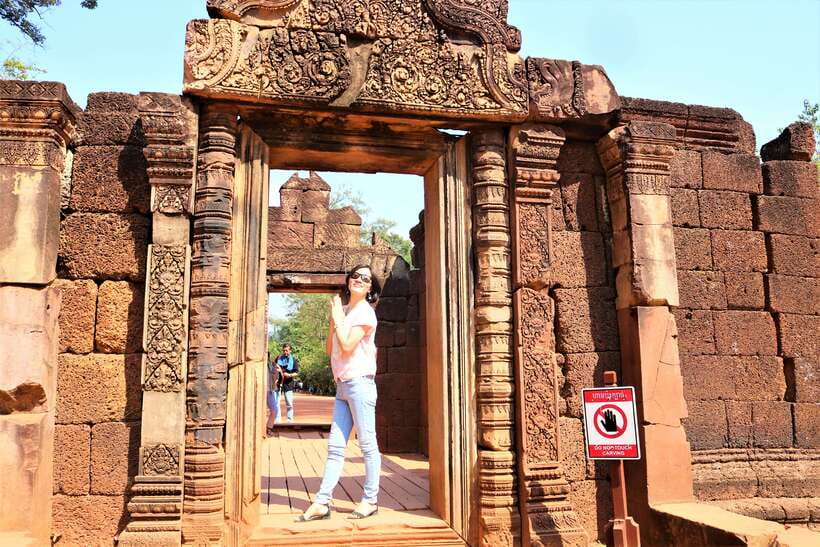
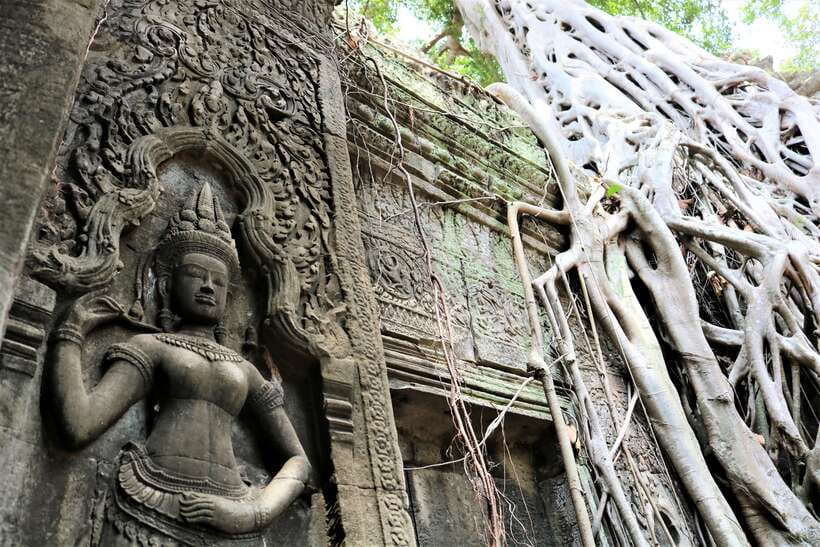
The tour then drives to Banteay Srei, often called the ladies’ temple. The nickname should not distract from the real reason to visit: its exceptionally fine sandstone carving. The temple is smaller than Angkor Wat, but its lintels, pediments, and figures are packed with careful detail.
This is the place where a good guide earns the fee. From a distance, the carvings can look like decoration. Up close, you start to notice figures, plants, stories, and tiny patterns cut into the warm-colored stone. Guides such as Pal Saruon have been praised for explaining the temples in detail and taking strong photographs, a useful combination when you are trying to frame these smaller structures.
Banteay Srei lies farther from the main Angkor group, so the drive takes time. That is the tradeoff. You spend more time in the vehicle, but you reach a temple with a distinct character and a calmer sense of scale. It was only accessible to visitors from the late 1990s, after the Khmer Rouge left the area, which adds important context to its place in modern Cambodian tourism.
On the return journey, Neak Pean offers another change of pace. The temple sits on an artificial island in a pool, reached by a walkway across the water. Its design is linked to a Buddhist healing complex, and the water setting makes it unlike the mountain temples you have just seen.
The stop is not as massive as Angkor Wat or Angkor Thom. That is precisely the point. Neak Pean gives you a pause from towering stone and lets you consider how water shaped both Khmer engineering and religious life.
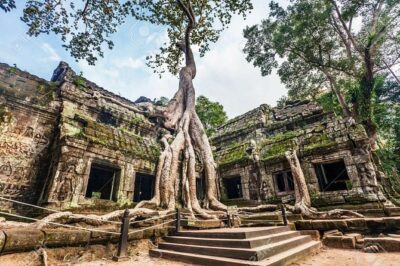
The day ends at Preah Khan, one of the most atmospheric ruins in the area. It is partly collapsed, partly overgrown, and full of long corridors, broken stone, and tree roots. Preah Khan once served as a major religious and educational center, but today its appeal is more immediate: you walk through a place where nature and masonry have been left in uneasy partnership.
Your guide can help separate fact from movie-style jungle fantasy. Roots are not simply swallowing every wall, and not every ruin is untouched. Still, Preah Khan offers a strong sense of age, especially late in the day when the broken galleries feel less formal than the grand temples.
Day two: entering Angkor Wat before sunrise
The second day begins before dawn at your hotel. This is an early start, not a gentle holiday morning. You enter Angkor Wat in darkness with a torch and walk through the eastern side, which sees fewer visitors than the main western approach.
The early entry is valuable for more than the famous photograph. In the dim corridors, the temple feels quieter and more mysterious. As the sky brightens, you can study the layout before the heat becomes intense. The classic sunrise view is usually the visual prize, but the eastern passage also gives the morning a sense of discovery.
Your guide leads you through the galleries and explains the long bas-relief carvings. Angkor Wat’s reliefs show scenes from Hindu epics, battles, royal processions, and the daily world of the Khmer Empire. Without explanation, a long carved wall can become a blur of figures. A strong English-speaking guide points out the key scenes and explains how religion, kingship, warfare, and ordinary life meet in the stone.
The tour description calls this the longest stretch of bas-relief carvings in the world. The exact way such claims are measured can vary, but the practical truth is clear: there is a great deal to see. Do not expect to understand every panel in one morning. I would focus on the sections your guide identifies, then allow yourself time to look without trying to memorize everything.
After the morning temple visit, you stop for breakfast outside Angkor Wat. Breakfast is not included, so bring money and do not expect it to be part of the $69 tour price. You also get a short rest before continuing, which is important after the pre-dawn wake-up and long walk.
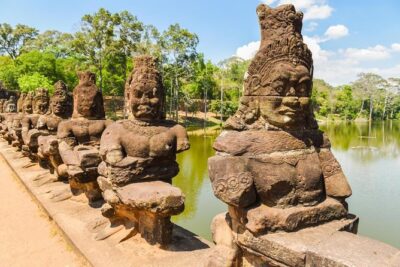
Next comes the southern gate of Angkor Thom. The approach is one of the most memorable entrances in the complex. A row of 54 gods and 54 demons lines the causeway, each side pulling on the body of a giant serpent. The figures represent the churning of the ocean of milk, a major Hindu creation story.
The gate leads into Angkor Thom, a fortified royal city rather than a single temple. Walls, gates, roads, and reservoirs help you understand the scale of the Khmer capital. This is where the tour’s guide service becomes especially useful. The stones are impressive, but the city plan explains how power operated here.
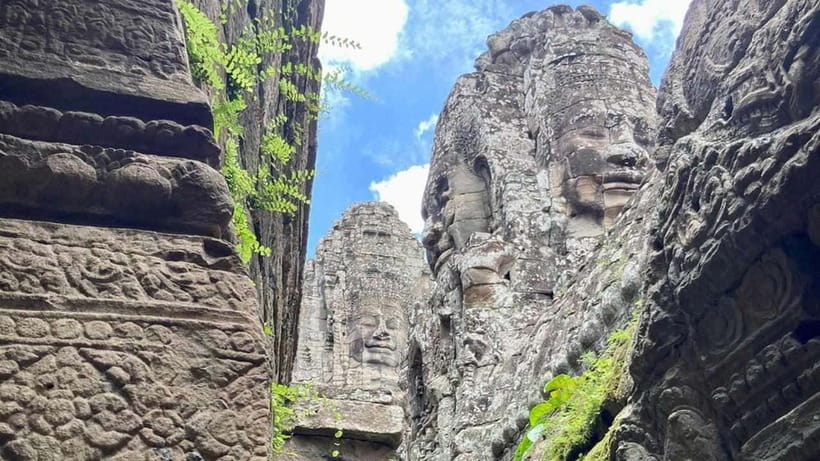
At the center of Angkor Thom sits Bayon. Its towers carry more than 200 enormous carved faces, often identified with the bodhisattva Avalokiteshvara or with the ruler Jayavarman VII. The faces appear from different angles as you move around the temple, creating an unusual feeling that the monument is watching you.
Bayon is visually confusing at first. Towers overlap, corridors turn sharply, and carvings crowd the walls. Give yourself time to look up and around. The guide can direct you toward the faces and explain the bas-reliefs showing markets, warfare, boats, animals, and daily scenes.
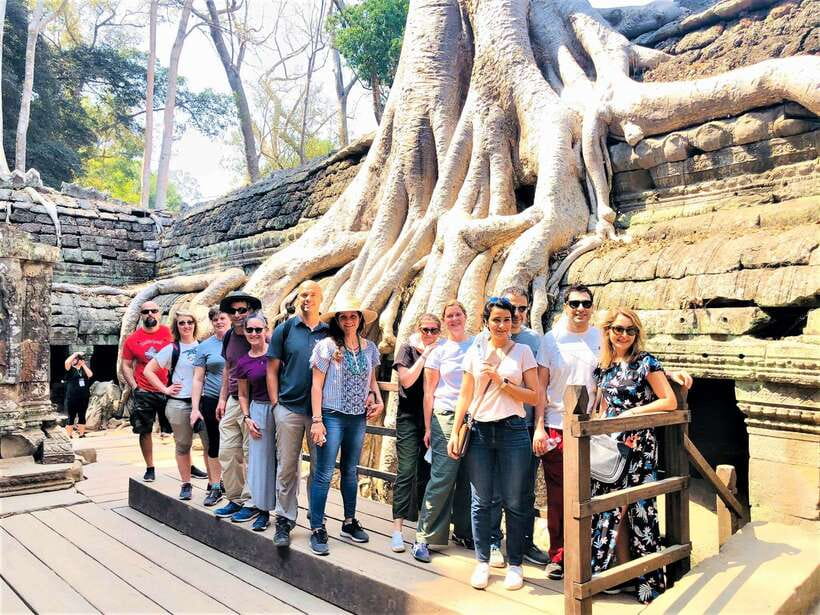
After lunch and a rest break, the afternoon continues at Ta Prohm. This is the temple most associated with trees and jungle roots. Its ruined galleries and huge trunks make it instantly recognizable, but the site is more than a dramatic photo stop.
Ta Prohm was part of a large monastic and religious complex. The remaining corridors show how grand the original plan was, even though sections have collapsed. Tree roots are part of the attraction, but they also create conservation problems. You will see a monument shaped by both nature and careful preservation.
Ta Prohm can be crowded, especially around the most photographed doorways. The small group helps, but it cannot remove the wider crowds at a major site. Your guide may help you find better angles and explain what you are seeing beyond the famous roots.
By the end of this day, you will have covered a lot of ground. The rest break is not a minor detail. Without it, the combination of sun, stone surfaces, early rising, and repeated walking can make the afternoon feel like work. The drivers’ habit of offering cold water and fresh towels at the vehicle is another small service that becomes very welcome in Cambodia’s heat.
Day three: Kampong Phluk on Tonle Sap
The final morning heads into the countryside toward Tonle Sap, one of the world’s largest freshwater lakes. The planned stop is Kampong Phluk, a group of three fishing villages set among flooded forest.
You take a boat through the village and see houses built on stilts. The design reflects the lake’s changing water levels, with homes and daily routines adapted to seasonal flooding. This is not a decorative add-on to the temple visit. It gives you a look at how people live beyond Siem Reap’s hotel district and ancient monuments.
The flooded forest is the visual highlight. Depending on water conditions, the boat moves through trees rising from the water, with stilt houses and fishing activity nearby. You may see local people at work and get a closer sense of how fishing supports the community.
AJ has been praised for explaining village life, traditional fishing, local produce, and the people working in the nearby market. That kind of commentary adds value because the boat ride alone can leave you seeing only scenery. Ask questions about the houses, the fishing methods, and the seasonal changes if your guide invites them.
Tonle Sap is also the part of the tour most affected by the season. From March through June, the alternative is Cambodia Phare Circus rather than the lake. The supplied information describes this as the dry-season option and gives a seat in section C.
That change may affect your choice. If you mainly want to see the floating villages, check the current program before booking. If you visit during the dry season, you may instead attend a Cambodian circus performance, which offers a cultural evening rather than a boat trip. The two experiences are not interchangeable, so this is worth confirming before you pay.
More Tonle Sap Lake Tours in Siem Reap:
- Sunset tour of Kampong Phluk stilts home village on the Tonle Sap
★ 5.0 · 4,865 reviews - Siem Reap: Kulen Mountain, Beng Mealea and Tonle Sap Tour
★ 5.0 · 1,483 reviews - Tonle Sap Lake & Kampong Phluk Village Half-Day Tour
★ 5.0 · 1,045 reviews - Kulen Mountain with Beng Mealea and Tonle Sap Small Group Tour
★ 5.0 · 780 reviews
What the $69 price really covers
At first glance, $69 for 2.5 days looks unusually low for a guided Angkor visit. The reason is that the main temple admission is separate. You must buy a three-day temple pass for $62 per person, bringing the basic total to about $131.
That combined price is easier to judge. It includes the licensed English-speaking guide, air-conditioned transport, hotel pickup and drop-off, mineral water, and the Tonle Sap boat cruise with entrance fee. During the dry-season alternative, it includes a section C ticket for Phare Circus instead.
Breakfast is not included. Lunch is also not listed as included, so plan to pay for meals along the way. The tour has plenty of value if you want transport, explanations, and a carefully arranged route without organizing each temple yourself. It is less attractive if you already have a driver and prefer to explore alone.
The temple pass is a major part of the budget, but it also covers the multi-day structure. Since this tour uses the pass over three calendar days, the cost makes more sense than paying for a rushed single-day visit.
Guides, drivers, and the small-group setup
The strongest human element is the guide-and-driver team. Pal Saruon is noted for patient explanations, Angkor culture, and photography. Pireak is described as friendly and thorough. Sam has been praised for explaining both temple history and present-day Cambodian traditions.
AJ brings a different focus at Tonle Sap, where the useful questions concern fishing, markets, houses, and seasonal life. Pi is known for detailed explanations of the temples, culture, and spiritual traditions. You may not receive one specific guide, since assignments can vary, but these names show the level of local interpretation the operator provides.
Drivers also matter here. Keal, Mao, and Ro are specifically praised for smooth support, cold water, and wet towels after temple walks. The towels are not a luxury detail. After several hours among hot stone courtyards, a cool cloth can make the next stop much more comfortable.
A maximum of 15 people keeps the tour social but not fully private. In a full group, you will still need to stay close to the guide and wait for others at entrances. In the low season, the group may be much smaller, with one past June visit described as almost private. That can make the experience more flexible, but you should not count on it.
Who should book this experience
I would choose this tour if you have limited time in Siem Reap and want the major temples explained rather than simply photographed. It suits first-time visitors who want Angkor Wat, Angkor Thom, Bayon, Ta Prohm, Banteay Srei, and several less central ruins in one organized plan.
It also suits you if you value local context. The guides discuss Khmer history, religion, culture, and current life, while the Tonle Sap outing shows a side of Cambodia that stone temples cannot provide.
I would think twice if you dislike pre-dawn starts, long walks, heat, or fixed schedules. People with mobility impairments should not book this activity, since the temple grounds include uneven surfaces and substantial walking.
Before booking, check three things: the exact starting times, the seasonal Tonle Sap or Phare Circus plan, and the total cost after adding the $62 temple pass and meals. You should also bring comfortable shoes and clothing that meets temple rules.
Should you book it?
Book this tour if you want a well-paced first visit to Angkor with a local English-speaking guide, dependable transport, and a useful mix of famous and less-visited temples. The cold water and towels, repeated praise for the guides, and small-group limit add real practical value.
Skip it if you want a private itinerary, dislike group timing, or are choosing the tour mainly for Tonle Sap and visiting during the dry-season circus period. For most active first-time visitors, though, the $69 base price is a good starting point once you account for the required temple pass.
FAQ
Is the temple pass included in the $69 price?
No. The three-day Angkor temple pass costs $62 per person and must be purchased separately.
Is breakfast included?
No. Breakfast is not included, so you should budget separately for it.
How many people can join the tour?
The small group is limited to 15 participants.
Is hotel pickup included?
Yes. Pickup and drop-off are provided at your hotel in an air-conditioned vehicle. Wait in the hotel lobby for collection.
Will I visit Tonle Sap Lake?
The itinerary includes Tonle Sap and a boat cruise to Kampong Phluk, but Cambodia Phare Circus is used as the alternative during the dry season from March through June. Check the current schedule before booking.
What language does the guide speak?
The tour includes a live English-speaking guide.
Is the tour suitable for people with mobility impairments?
No. The activity is not considered suitable for people with mobility impairments because of the walking and temple conditions.
More early starts in Siem Reap
- Angkor Wat Sunrise tour with Small – Group and Guide tours
★ 5.0 · 3,655 reviews - Angkor Wat Highlights and Sunrise Guided Tour from Siem Reap
★ 5.0 · 3,213 reviews - Full-Day Angkor Wat Sunrise Private Tour with Guide from Siem Reap
★ 5.0 · 2,920 reviews - Siem Reap: Angkor Wat Sunrise and Full-Day Sightseeing Tour
★ 4.9 · 2,828 reviews
More Small Group Tours in Siem Reap
- Angkor Wat Sunset Small Group Tour with Lunch Included
★ 5.0 · 3,059 reviews - Angkor Wat Sunrise & 3 Main Temples with Breakfast – Small Group
★ 5.0 · 2,857 reviews - Angkor 2-Day Sunset & Sunrise Small-Group Tour
★ 5.0 · 2,567 reviews - Kulen Mountain: Small-Group Tour and Picnic lunch
★ 4.9 · 1,802 reviews
New around Siem Reap
- Kulen Mountain With Ticket included Plus Banteay Srei Temple Tour★ 5.0 · 7 reviews
- 2 Days Angkor temples with Sunrise & Sunset★ 5.0 · 7 reviews
- Private Siem Reap Airport Transfer to hotel in town★ 5.0 · 7 reviews
- 1-Day private Angkor Temple Tour with Sun Rise by Tuk Tuk from Siem Reap★ 4.5 · 7 reviews
- Siem Reap: Morning Cooking Class & Market Tour★ 5.0 · 7 reviews
- Kulen Mountain, Killing Fields and War Museum Tour★ 5.0 · 7 reviews
- War Museum, Killing Field, and APOPO Hero RATs Tour★ 5.0 · 7 reviews
- Angkor Explorer by Cambodiajeep★ 5.0 · 7 reviews
Angkor Wat Tours, compared.
Angkor Wat Sunrise or Sunset Tour with Guide from Siem Reap
Read our review →
Angkor Wat: Small-Group Sunrise or Sunset Tour
Read our review →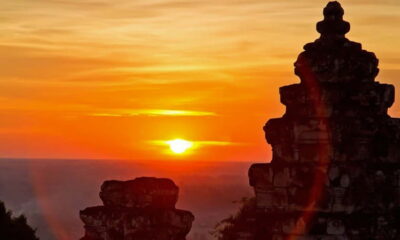
Angkor Wat Sunrise tour with Small – Group and Guide tours
Read our review →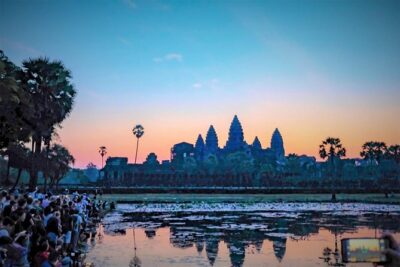
Angkor Wat Highlights and Sunrise Guided Tour from Siem Reap
Read our review →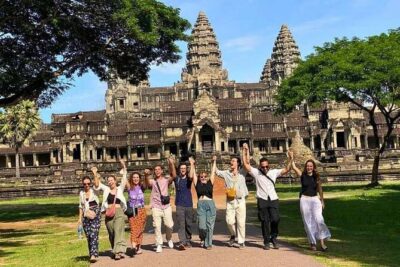
Angkor Wat Sunset Small Group Tour with Lunch Included
Read our review →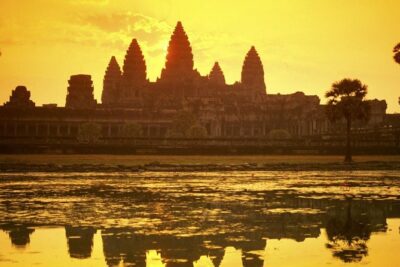
Full-Day Angkor Wat Sunrise Private Tour with Guide from Siem Reap
Read our review →
Angkor Wat Sunrise & 3 Main Temples with Breakfast – Small Group
Read our review →Browse the lists this tour appears in