
Reviewed · ANGKOR WAT TOURS
Private Angkor Wat and Lost Temple Jungle Tour
Angkor Wat is only the opening act here. In about six and a half hours, you move from the vast galleries of Angkor Wat to Bayon’s stone faces, then into the tree-covered ruins of Ta Prohm. I especially like the private format and the way the route mixes famous monuments with smaller temples such as Thommanon and Banteay Kdei.
I also like having a guide who can turn carved kings and old religious symbols into a story you can follow. Guides Bon Sith and Mr. Somra have earned particular praise for clear English and thoughtful explanations. The main catch is cost: the $40 tour does not include the $37 Angkor Pass, and lunch is extra.
Key points at a glance
- Six major stops in one outing: Angkor Wat, Angkor Thom’s South Gate, Bayon, Thommanon, Ta Prohm, and Banteay Kdei.
- Private tuk-tuk transport: Your group receives hotel pickup and drop-off rather than joining a large coach.
- Strong guide focus: Bon Sith and Mr. Somra are noted for clear English, useful historical detail, and a friendly manner.
- A good mix of famous and quieter ruins: You get the icons, but also time at Thommanon and Banteay Kdei.
- Budget carefully: The advertised $40 price excludes the one-day temple pass, listed at $37 per person, plus lunch.
- Flexible cancellation: Cancel at least 24 hours before the start time for a full refund.
Why this route works so well in six and a half hours
Angkor is too large to treat as one temple. The sites are spread across a broad archaeological park, and each one gives you a different view of Khmer architecture and religion. This route makes sensible use of your time by linking the best-known monuments with several smaller stops.
You begin with Angkor Wat, the grandest and most demanding visit. From there, the route turns toward Angkor Thom, where the South Gate provides a quick but memorable entrance. Bayon follows, giving you time to study its famous faces and Buddhist carvings.
The later stops change the mood. Thommanon is small and easier to grasp after the scale of Angkor Wat. Ta Prohm brings the jungle setting and movie fame, while Banteay Kdei offers another Buddhist temple with a quieter feel. The sequence gives you variety instead of six similar stone compounds.
A private trip also helps with pacing. You can ask your guide to clarify a carving, explain a king, or slow down at a place that catches your eye. You are not locked into a large group moving at one fixed speed, though the listed stop times still create a fairly full day.
More Angkor Wat Tours in Siem Reap:
- Angkor Wat Sunrise or Sunset Tour with Guide from Siem Reap
★ 5.0 · 12,109 reviews - Siem Reap: Angkor Wat: Small-Group Sunrise or Sunset Tour
★ 5.0 · 9,444 reviews - Siem Reap: Angkor Wat 2-Day Tour with Sunrise and Sunset
★ 4.9 · 4,429 reviews
Angkor Wat, two hours with Cambodia’s great monument
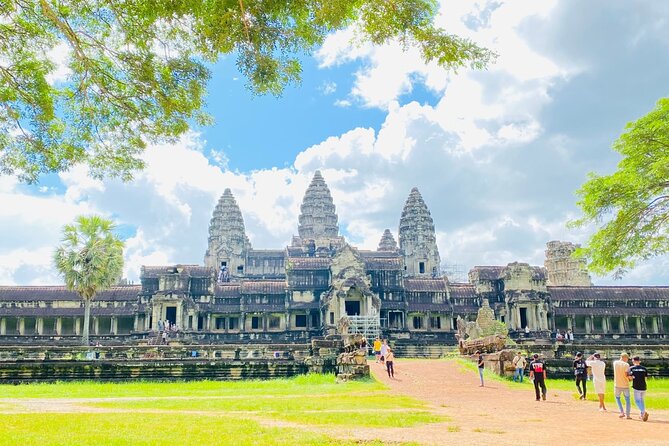
Allow two hours for Angkor Wat, and use them well. Built in the 12th century under King Suryavarman II, it began as a Hindu temple dedicated to Vishnu and later became a Buddhist place of worship. It is also the largest religious monument in the world.
The scale can be hard to take in at first. Towers, galleries, courtyards, ponds, and long stone corridors create a grand sequence rather than a single building. Your guide is especially useful here, since the carvings and layout make more sense when you understand the religious ideas behind them.
Look closely at the carved scenes and the balance of the temple design. Angkor Wat is not simply a photogenic ruin. Its plan reflects a sacred view of the universe, with the central towers representing a holy mountain. You do not need a lecture on every detail, but a good explanation makes the architecture feel less like a pile of impressive stones.
Two hours is enough for a solid first visit, but not enough to inspect every gallery. Wear practical shoes and expect a lot of walking. This is the busiest and most visually commanding part of the route, so you may want to keep your camera away for a few minutes and let the scale register.
Angkor Thom’s South Gate and the road to Bayon
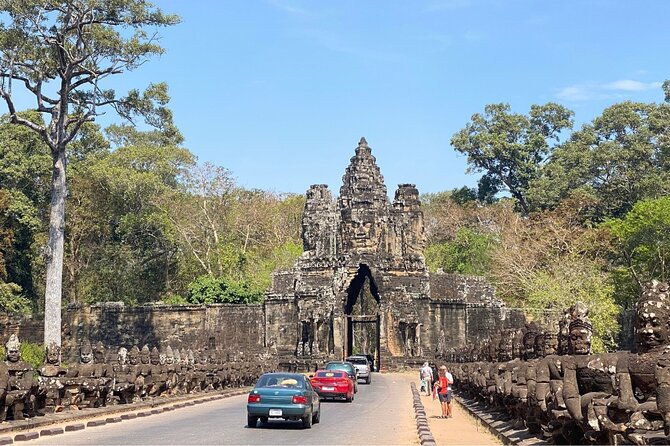
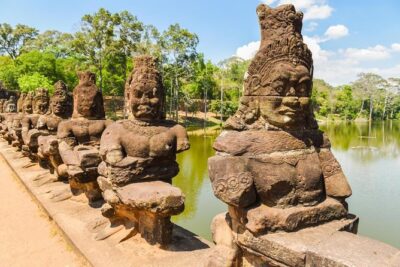
The South Gate receives about 30 minutes, which is a sensible amount of time. You can walk through or pause for photographs, and the approach gives you a clear sense of the fortified city of Angkor Thom.
This gate is more than a brief roadside stop. It introduces the imagery and power of the city built under King Jayavarman VII. Take a moment to study the figures lining the approach and the gate itself before moving on.
The short visit also protects your energy. Angkor days involve heat, dust, and plenty of walking, so not every stop needs to last an hour. Your guide can explain what you are seeing without turning the gate into a long formal lecture.
Bayon’s many faces, one and a half hours
Bayon is the emotional center of this route for many people. Located in the middle of Angkor Thom, it was built in the late 12th or early 13th century as the state temple of King Jayavarman VII. Unlike the broad, ordered feel of Angkor Wat, Bayon can feel compressed and puzzling, with towers and corridors packed close together.
The stone faces are the reason most people come, but do not stop there. Spend time with the bas-reliefs, which show scenes of daily life, conflict, and royal power. These carvings help connect the temple to the wider Khmer world rather than leaving it as a collection of mysterious faces.
An hour and a half gives you time to move through the main areas without rushing. This is where a guide’s skill matters most. The architecture is not always easy to read, and you will get more from the visit if someone points out the religious symbols, the king’s role, and the meaning behind the design.
Guides such as Bon Sith and Mr. Somra have been praised for speaking English well and explaining history and culture clearly. That matters at Bayon, where a short explanation can make an otherwise confusing corner suddenly click.
A few more Siem Reap half-days to weigh up
- From Siem Reap: Kampong Phluk Floating Village Tour by Boat
★ 4.9 · 6,979 reviews - Sunset tour of Kampong Phluk stilts home village on the Tonle Sap
★ 5.0 · 4,865 reviews - Siem Reap: Kampong Phluk Floating Village Tour with Boat
★ 4.9 · 3,843 reviews - Siem Reap: Full-Day Angkor Wat Guided Tour with Sunset
★ 4.9 · 3,803 reviews
Thommanon, a smaller temple with breathing room
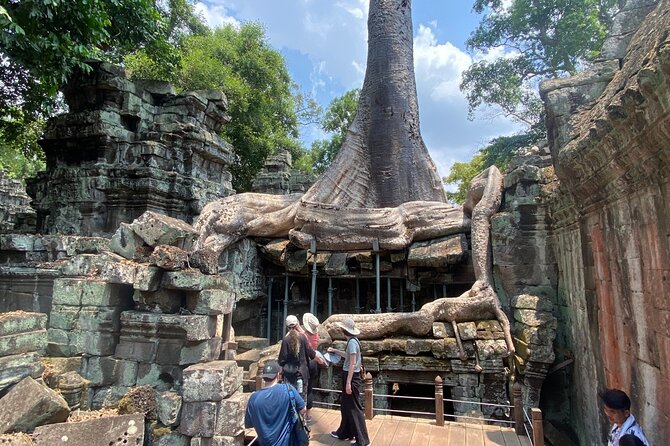
Thommanon receives 30 minutes. It is one of the smaller Hindu temples associated with the reign of Suryavarman II, located east of Angkor Thom and near Chau Say Tevoda.
Do not expect another Angkor Wat. Thommanon’s appeal comes from its compact scale and cleaner sense of proportion. After Bayon’s crowded towers, you can take in the structure more quickly and focus on its carvings and Hindu design.
This stop is also a useful reminder that Angkor is not only about its headline monuments. Smaller temples help you see repeated architectural ideas without the sheer volume of a major complex. If your guide is good at comparisons, this is a chance to connect Thommanon with the larger temples you have already visited.
The 30-minute limit is appropriate. You will get a taste rather than a full study, but that is part of the route’s value. It gives you another architectural style without taking time from Ta Prohm.
Ta Prohm, the jungle temple and the busiest stop
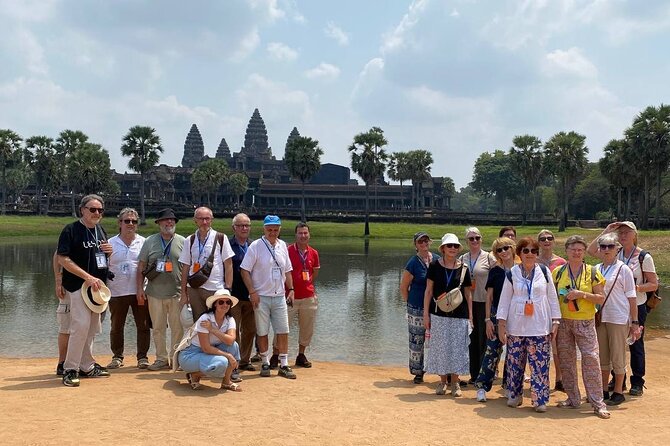
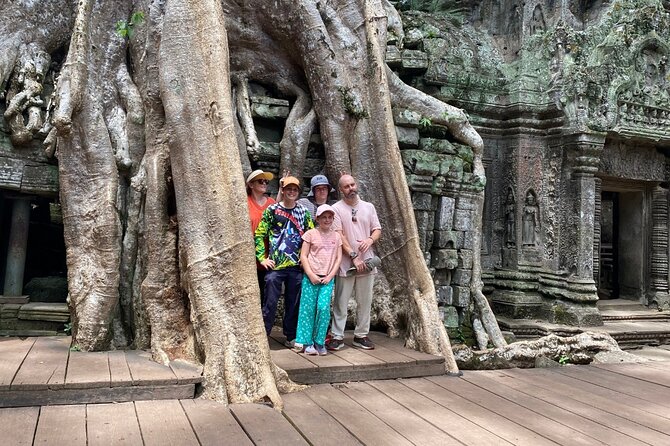
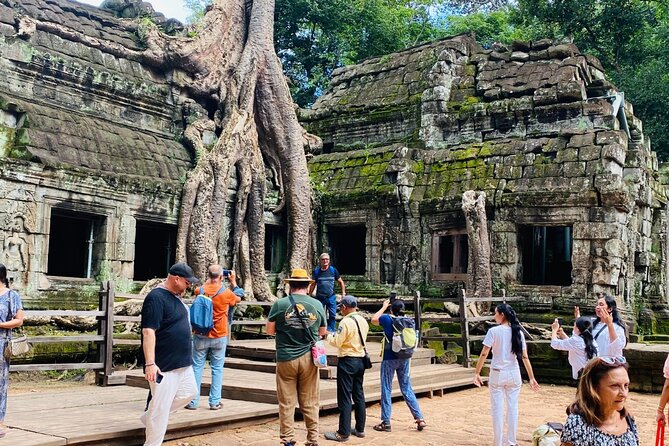
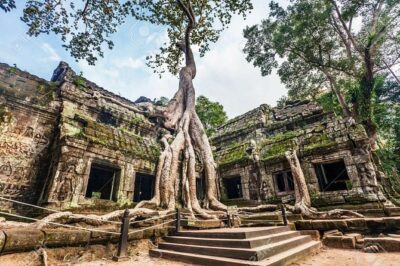
Ta Prohm is the temple most closely linked with the modern image of Angkor. It became famous as the Tomb Raider temple, and large tree roots growing across the stone have made it one of the park’s most recognizable sights.
The movie connection may bring you here, but the temple works even without it. The roots, collapsed galleries, narrow passages, and shifting light create a strong sense of age. Nature has not simply decorated the building. It has become part of how you see the ruins.
The scheduled hour is enough to visit the principal areas, though you should expect this to be a popular stop. Your guide can help you focus on the important features rather than spending the whole visit waiting for the perfect photograph.
This is also a place where you need to watch your footing. The ground and stone surfaces can be uneven, and the temple layout is not always obvious. Stay close enough to keep track of your guide, especially if you are interested in the history rather than only the famous tree roots.
Ta Prohm is likely to be the most dramatic change from Angkor Wat. If Angkor Wat feels planned and monumental, Ta Prohm feels intimate, broken, and partly reclaimed by the forest. That contrast is one of the best reasons to choose a route that includes both.
Banteay Kdei, a quieter Buddhist finish
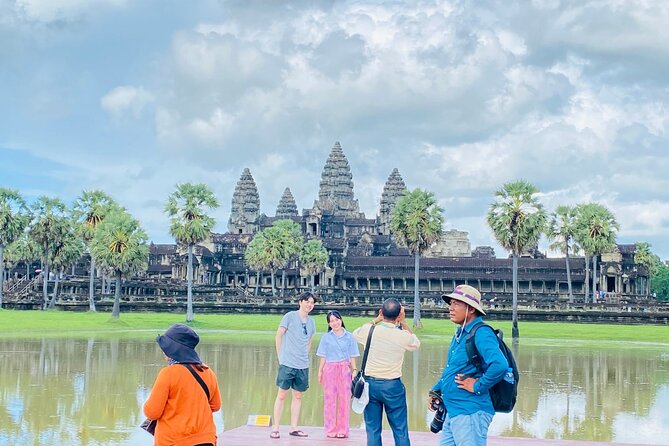
Banteay Kdei receives one hour and sits southeast of Ta Prohm and east of Angkor Thom. It is a Buddhist temple with architectural links to Bayon, Ta Prohm, and Preah Khan.
After Ta Prohm, Banteay Kdei may feel less famous, but do not treat it as filler. Its quieter setting gives you a chance to look at the structure without thinking only about the best-known photograph. The temple helps round out the story of Buddhist architecture under Jayavarman VII.
An hour is generous compared with the smaller stops. You can walk through at a calmer pace and compare its design with Bayon and Ta Prohm. Ask your guide to point out similarities and differences. That kind of conversation is where a private outing earns its keep.
The route ending here also makes sense. You have already seen the great symbol of Angkor, the royal city gate, the many faces of Bayon, a smaller Hindu temple, and the jungle-covered Ta Prohm. Banteay Kdei gives you time to absorb the pattern rather than ending with another huge monument.
What the private tuk-tuk adds
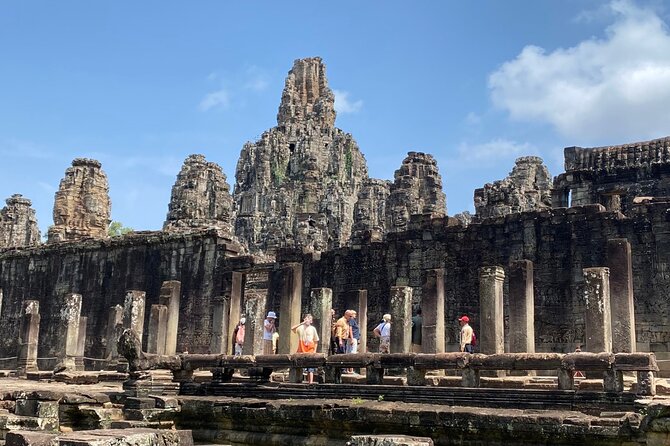
Transportation is by tuk-tuk, with hotel pickup and drop-off in Siem Reap and bottled water included. For this kind of day, that is practical. You are outside for much of the experience, and the open-sided ride gives you a closer sense of the roads between the temples.
The private format means only your group participates. That is a real advantage if you want to ask questions or adjust the amount of time spent looking at carvings. It also avoids the awkwardness of waiting for a large party at every gate.
The tour information also describes private car and small-group minivan options, so confirm the vehicle choice when booking if that matters to you. The included details specifically list tuk-tuk transportation, while the activity is identified as private.
The driver is not the main interpreter, but the driver’s part still matters. Direct feedback highlights friendly service and punctuality, which makes a difference when the day involves several temple transfers. You want the vehicle ready when you finish a hot walk, not another delay added to an already full schedule.
The guide can make or break the temple visit
Angkor is far more rewarding with an English-speaking guide. Without context, you can admire the carvings and towers but miss the difference between a Hindu temple built for Vishnu and a Buddhist state temple linked with Jayavarman VII.
The strongest guide comments focus on clear English, historical detail, and genuine interest. Bon Sith and Mr. Somra are names associated with particularly strong explanations. One guide was praised for being both well informed and sincere, while another was noted for explaining culture as well as architecture.
I would use the private setting actively. Ask why a temple was built, what changed when religious use shifted, and how Bayon relates to Ta Prohm and Banteay Kdei. You are paying for interpretation as well as transport, so do not be shy about asking for more than a list of dates.
The guide’s pace also matters. Six stops in six and a half hours can become a blur if every explanation is long. The best approach is short background at each temple, then time for you to look around and ask focused questions.
Is $40 a good deal?
The advertised tour price is $40 per person, but your real minimum cost is higher. The one-day Angkor Pass is listed separately at $37 per person, and lunch is not included. That brings the basic tour and admission total to $77 per person before food.
For a private six-and-a-half-hour outing with hotel transfers, a guide, tuk-tuk transport, and water, that can be reasonable value, especially if you are splitting the experience with a companion or small group. The price is less attractive if you expected the temple admission to be bundled in.
The key is to compare like with like. A cheaper transport-only option will not provide the same historical explanation. A larger group might cost less per person but give you less control over questions and pacing. Here, the value rests mainly in the private guide and efficient route.
Bring money for the pass and lunch, and treat the $40 figure as the tour service price rather than the full day’s cost. That simple adjustment prevents an unpleasant surprise.
Who should book this Angkor route?
I would recommend it to a first-time visitor who wants the main Angkor sights without planning transport and temple order alone. It suits couples, friends, and families who value a private setting and want to ask questions along the way.
It is also a good fit if you have only one full day for the archaeological park. You will not see every important temple in the region, but you will cover the essential set: Angkor Wat, Bayon, Ta Prohm, and several useful supporting stops.
You may want a different plan if your priority is a slow photographic study of one or two temples. The schedule is full, and the stop times are planned around coverage rather than complete solitude or detailed architectural research.
The activity is described as suitable for most people, but the route includes walking around large temple compounds and uneven stone areas. Anyone concerned about mobility should ask the operator for more detail before booking.
Free cancellation is available if you cancel at least 24 hours before the local start time. Changes or cancellations inside that window are not refunded, so make your plans firm before the cutoff.
Should you book the Private Angkor Wat and Lost Temple Jungle Tour?
Book it if you want the big three, Angkor Wat, Bayon, and Ta Prohm, plus a few less famous temples in one well-organized private outing. The English-speaking guide is the main reason to choose it, with Bon Sith and Mr. Somra noted for the clear, friendly explanations you want at a site this complex.
Skip it if the $40 headline price feels misleading once you add the $37 pass and lunch, or if you prefer to spend a full day at just one or two monuments. For most first visits, though, the route offers a practical balance of famous sights, smaller ruins, private transport, and useful local interpretation.
FAQ
Is the Angkor Pass included in the tour price?
No. The one-day temple ticket costs $37 per person and must be paid separately.
How long does the tour last?
The experience lasts approximately six hours and 30 minutes.
Is hotel pickup and drop-off included?
Yes. Two-way hotel transfers within Siem Reap are included.
What transportation is provided?
The included transportation is by tuk-tuk. The tour information also refers to private car and small-group minivan options, so confirm your preferred vehicle when booking.
Is lunch included?
No. Lunch is not included in the tour price.
Can I cancel for a full refund?
Yes, if you cancel at least 24 hours before the experience start time. Cancellations or changes made within 24 hours are not refunded.
New around Siem Reap
- Kulen Mountain With Ticket included Plus Banteay Srei Temple Tour★ 5.0 · 7 reviews
- 2 Days Angkor temples with Sunrise & Sunset★ 5.0 · 7 reviews
- Private Siem Reap Airport Transfer to hotel in town★ 5.0 · 7 reviews
- 1-Day private Angkor Temple Tour with Sun Rise by Tuk Tuk from Siem Reap★ 4.5 · 7 reviews
- War Museum, Killing Field, and APOPO Hero RATs Tour★ 5.0 · 7 reviews
- Siem Reap: Morning Cooking Class & Market Tour★ 5.0 · 7 reviews
- Kulen Mountain, Killing Fields and War Museum Tour★ 5.0 · 7 reviews
- Half-Day: Silk Farm, Senteur Angkor, and Satcha Workshop★ 4.6 · 7 reviews
Angkor Wat Tours, compared.
Angkor Wat Sunrise or Sunset Tour with Guide from Siem Reap
Read our review →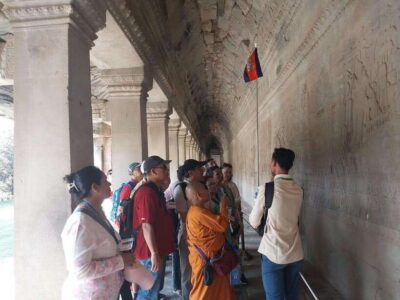
Angkor Wat: Small-Group Sunrise or Sunset Tour
Read our review →
Angkor Wat Sunrise tour with Small – Group and Guide tours
Read our review →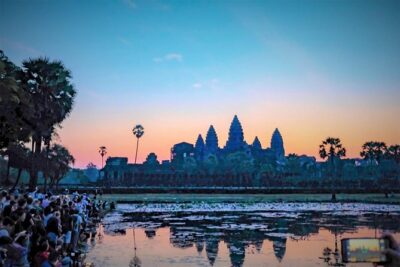
Angkor Wat Highlights and Sunrise Guided Tour from Siem Reap
Read our review →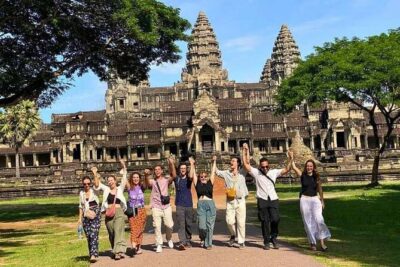
Angkor Wat Sunset Small Group Tour with Lunch Included
Read our review →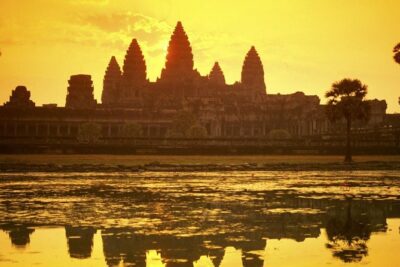
Full-Day Angkor Wat Sunrise Private Tour with Guide from Siem Reap
Read our review →
Angkor Wat Sunrise & 3 Main Temples with Breakfast – Small Group
Read our review →Browse the lists this tour appears in