
Reviewed · SIEM REAP TOURS
One day normal Angkor tour
Angkor Wat is best seen before the heat settles in, and this 7:30 AM private tour gets you moving at the right time. You cover the essential temples in one long day, with guide Bunleat often leading the way and explaining the Hindu and Buddhist ideas carved into the stone.
I like the private vehicle and hotel pickup, since you can leave your hotel without sorting out a tuk-tuk or sharing the day with strangers. I also like the guide’s practical help with photography, including suggestions for good angles at Angkor Wat. The main drawback is cost: the $45 tour price does not include the $37 one-day temple ticket or lunch.
Key points to know before booking
- A 7:30 AM start: The early departure gives you a better chance of seeing Angkor Wat before the worst heat and crowds.
- Bunleat as guide: He is praised for clear explanations of architecture, religion, restoration, and temple legends.
- Private transport: Your group travels by air-conditioned car or minivan, with bottled water provided.
- The essential circuit: Angkor Wat, Bayon, Ta Prohm, Angkor Thom, Baphuon, Phimeanakas, the Royal Palace area, and the Royal Terraces are included.
- Extra costs matter: Add $37 per person for the one-day Angkor pass, plus lunch and any tip.
- Temple clothing is strict: Cover your knees and shoulders, or you may be refused entry.
Why this one-day Angkor tour works
The Angkor Archaeological Park is too large to handle casually. The famous temples are spread across a broad area, and the heat can turn a loose plan into a tiring one. This tour gives you a clear route, hotel transport, and a guide who can explain what you are looking at instead of leaving you to decode every carved wall alone.
You get about seven to eight hours in the park. That is enough for the headline sites, but not enough for every temple in the area. I see that as a sensible trade for a first visit. You get the places most people hope to see, while avoiding an exhausting attempt to cover the entire park.
The tour is listed at $45 per person, with private transport, hotel pickup and drop-off, bottled water, the guide, local taxes, and the vehicle included. The important catch is the separate $37 temple ticket. Lunch is also extra, so your real daily cost is higher than the advertised tour rate.
A few more Siem Reap half-days to weigh up
- 1-Day Amazing Angkor Wat Tour with Sunset & All Interesting Major Temples
★ 5.0 · 308 reviews - Angkor Wat one Day Private Tour for All Highlight Angkor Temples
★ 5.0 · 199 reviews - 1-Day private Angkor Temple Tour from Siem Reap
★ 4.9 · 178 reviews
Starting at 7:30 AM from Siem Reap
Pickup is provided from your hotel, and the listed meeting point is Royal Angkor Resort on National Road 6. The tour ends back at the meeting point, though the service also states that hotel drop-off is included. Confirm your exact pickup details when booking, especially if your hotel is outside the usual Siem Reap area.
The early start is one of the strongest parts of the plan. Angkor Wat is cooler and calmer in the morning than later in the day, and arriving early gives you a better chance to view the temple without the full midday crush. This is not a sunrise tour, so you are not being asked to leave in the middle of the night.
Expect transport by private car or minivan with air conditioning. That matters in Cambodia. After walking over hot stone and open courtyards, a cool vehicle gives you a useful break between temples. Bottled water is included, and several accounts of the service also describe cold water and chilled towels as thoughtful touches, though the formal inclusions specifically promise bottled water.
Angkor Wat: begin with Cambodia’s great temple
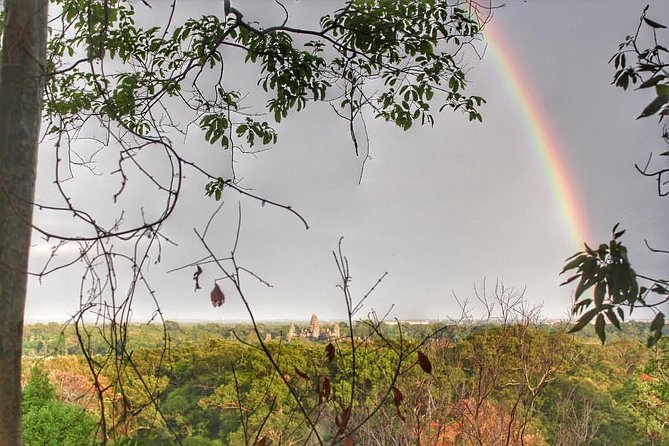
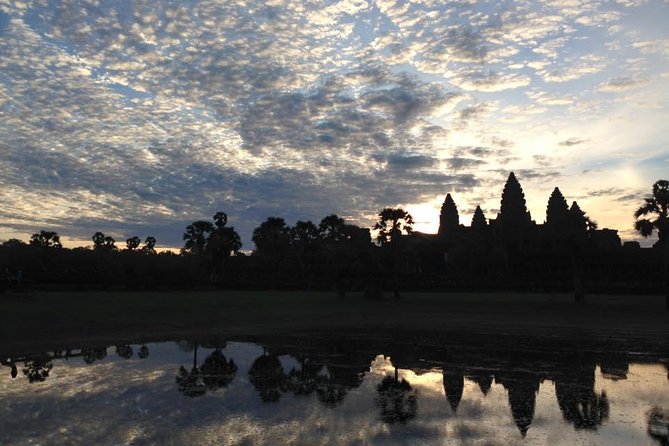
The first major stop is Angkor Wat, the site most closely tied to Siem Reap. Built as a Hindu temple dedicated to Vishnu, it is famous for its vast scale, towers, galleries, and long carved reliefs. The morning timing helps you take in the structure before the day becomes punishingly hot.
This is where a good guide earns the fee. Angkor Wat can look like a grand wall of stone if you do not know what to watch for. Bunleat is praised for explaining the temple’s background before walking through its details, including religious meaning, construction, and restoration. He also helps with photo positions, which is useful when you want more than the standard straight-on picture.
You should still pace yourself. Angkor Wat has long corridors, stairs, courtyards, and uneven stone surfaces. A moderate level of physical fitness is required, and you will spend much of the day walking outside. Wear shoes that handle stone well, and bring only what you need.
Basei ChamKrong and the temple’s early Khmer setting
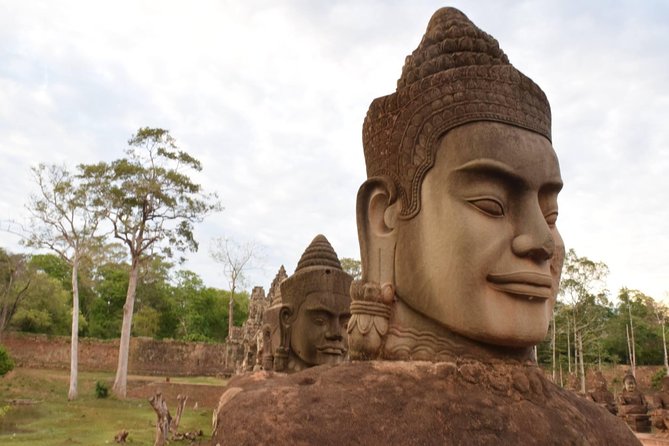
The route then heads north to Basei ChamKrong, a pyramid temple built in the tenth century. The site is dedicated to Shiva and offers a smaller-scale contrast with Angkor Wat’s huge galleries and towers.
The temple is described as having a pyramid plan comparable to the ancient Maya site of Tikal. That comparison is useful as a visual aid, though you should treat it as a similarity in form rather than a connection between the two cultures. Here, the point is to see how a raised temple structure creates a strong vertical focus.
A stop like this can be valuable because it breaks up the famous-temple routine. You are not only ticking off the three best-known names. You are also seeing how Khmer temple design developed through different periods and purposes.
A completely different sort of day from the same base:
- Angkor Wat Sunrise or Sunset Tour with Guide from Siem Reap
★ 5.0 · 12,109 reviews - Siem Reap: Angkor Wat: Small-Group Sunrise or Sunset Tour
★ 5.0 · 9,444 reviews - From Siem Reap: Kampong Phluk Floating Village Tour by Boat
★ 4.9 · 6,979 reviews - Sunset tour of Kampong Phluk stilts home village on the Tonle Sap
★ 5.0 · 4,865 reviews
Bayon and the stone faces of Angkor Thom
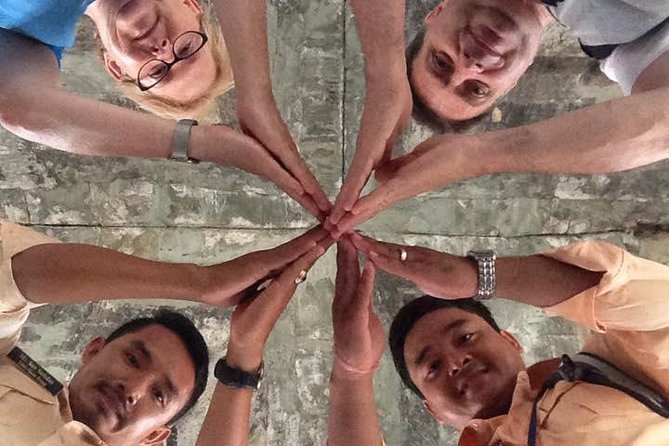
Next comes Bayon, located in the middle of Angkor Thom, the ancient city. Its towers carry the famous serene faces that look out over the temple from several directions. This is one of the most memorable stops on the circuit, but it can also be confusing without guidance because the galleries, passages, and towers create a tight maze.
Your guide’s role here is to connect the carvings with Khmer religious and royal ideas. The temples were not built as isolated monuments. They formed part of a planned city, and Bayon’s central position helps explain its importance within Angkor Thom.
The stone faces are the obvious draw, but look down at the bas-reliefs as well. They show scenes of daily life and warfare, giving you a more human view of the people who built and used the city. Ask your guide to point out the difference between religious imagery and scenes drawn from ordinary life.
Baphuon, Phimeanakas, and the Royal Palace area

The circuit continues to nearby sites including Baphuon, Phimeanakas, and the former Royal Palace area. These temples do not have the same instant recognition as Angkor Wat or Ta Prohm, but they help you understand Angkor Thom as a royal center rather than just a collection of ruins.
Baphuon is a large temple mountain with broad stone approaches. Its scale becomes clear as you move through the approach and look back across the structure. It is another place where sturdy footwear and a steady pace help.
Phimeanakas is associated with the Royal Palace area. The palace itself was largely built from perishable materials, so what remains is mainly the stone religious and ceremonial architecture. That contrast is worth noting: a city can lose its wooden homes, halls, and daily spaces while its stone temples survive.
The schedule is full, so you may not have unlimited time at each minor stop. If you care more about close study than checking off every name, tell your guide early. A private tour gives you more room to express that preference than a large group outing.
The Royal Terraces and a look at Angkor as a city
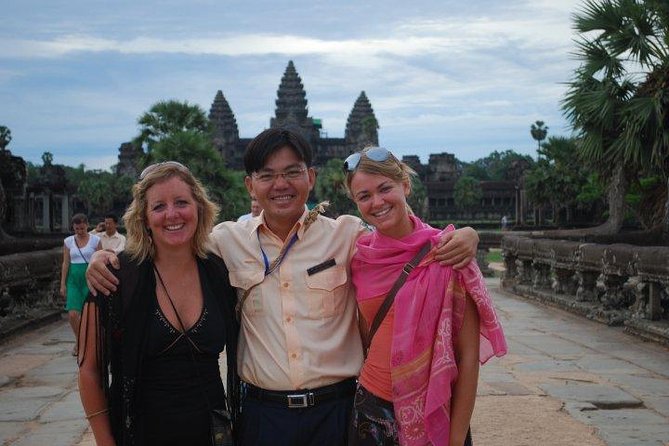
The Royal Terraces add another piece to the Angkor Thom story. They were ceremonial platforms connected with the city’s central area, and their carved surfaces show the importance of public display and royal power.
This stop is less about entering a grand enclosed temple and more about reading the remains as part of an urban plan. After Bayon and Baphuon, the terraces help you see how roads, ceremonial spaces, and temples fit together.
That wider view is one of the tour’s strengths. You are not simply moving from one photogenic ruin to the next. The route shows Angkor as a functioning capital with religious buildings, royal spaces, public platforms, and carefully planned approaches.
Ta Prohm and the power of nature over stone
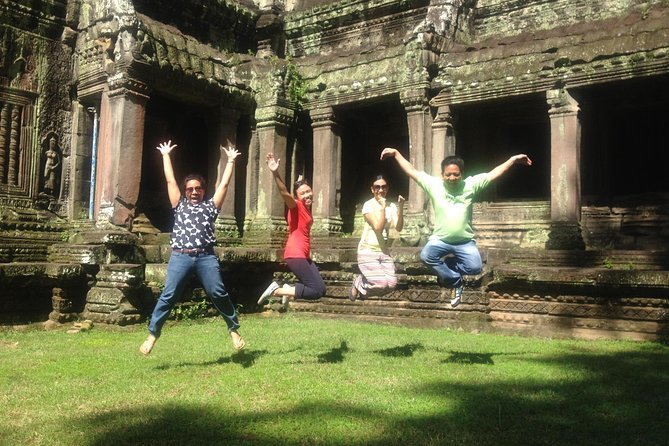
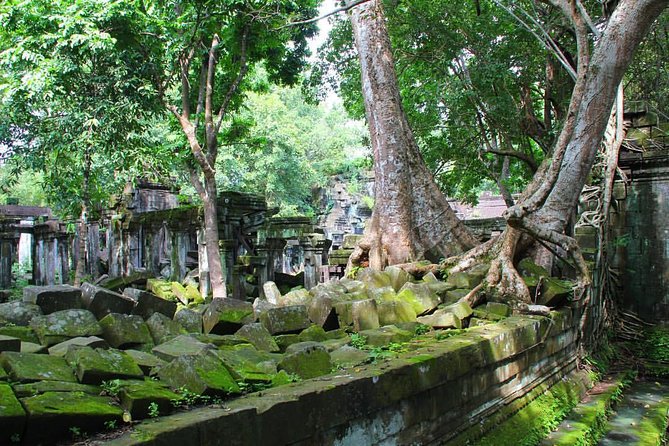
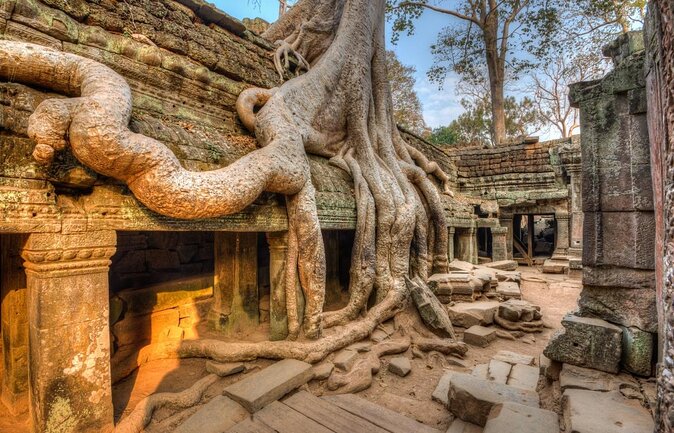
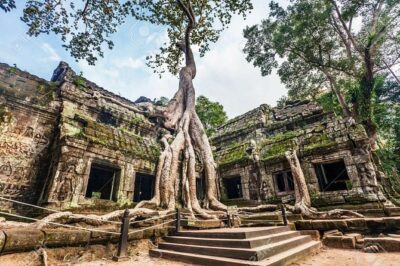
Ta Prohm is the other essential stop. It is famous for the trees that grow over and through sections of the temple, creating the image many people carry with them before arriving in Cambodia.
The appeal is immediate, but Ta Prohm deserves more than a quick photo stop. Its galleries, doorways, and carved stonework show how much of the temple remains beneath the dramatic roots and collapsed sections. You can appreciate the atmosphere while still looking closely at the architecture.
This is also a good place to ask about conservation. The temple has been stabilized so people can enter, but it has not been rebuilt into a neat, complete monument. That balance between access and preservation is part of what makes the visit interesting.
The site can be crowded, and narrow passages may slow your progress. Your guide can help you find useful photo angles and explain the layout, but you should expect less solitude here than at smaller temples.
Lunch, heat, and the practical rhythm of the day
Lunch is not included. The itinerary allows a stop at a restaurant where you can purchase your meal, so bring enough local cash or confirm accepted payment methods before setting out. A restaurant stop also gives you a chance to sit down during a demanding day, but it adds to the total cost.
Plan for heat even with an early start. The air-conditioned car helps between sites, but much of your time is spent outside on exposed paths and stone courtyards. Drink the provided water regularly rather than waiting until you feel thirsty.
Dress is not a minor suggestion here. Knees and shoulders must be covered for both men and women at places of worship and selected museums. Shorts and sleeveless tops can lead to refused entry, so wear light clothing that still covers you properly.
The tour requires moderate physical fitness. You will encounter uneven surfaces, stairs, long walking stretches, and temple approaches. If you have mobility concerns, ask the provider for more detail before booking, since the supplied information does not describe specific accessibility arrangements.
What the guide adds to the day
The guide is the main reason to choose this over simply hiring transport. Bunleat is repeatedly praised for explaining Angkor’s history, Hinduism, Buddhism, architecture, and restoration in a patient way. His experience at Angkor Wat is described as extending over more than ten years.
That background matters because the park contains layers of meaning. A carved figure may belong to a Hindu story, a later Buddhist change, or a royal program tied to a specific ruler. A guide who can place those pieces in context turns stonework into something easier to understand.
You also get practical help. Bunleat is noted for suggesting photo angles and taking pictures for visitors. That will not replace a careful photographer, but it is useful when you want a picture of your whole group without handing your phone to a stranger.
The praise is strongest for his patience and clear explanations. That makes this tour a good match if you want to ask questions or need history explained without rushing. If you prefer silent wandering and long stretches alone, a private guide may feel more involved than you want.
Private transport and group size
This is a private activity, so only your group participates. That gives you more control over the pace than a shared coach, and it makes the air-conditioned car more useful because you can return to it when you need a break.
The transport is described as a car or minivan. Specific vehicle type may vary, but air conditioning and bottled water are included. Several detailed accounts describe a clean private car and very cold air conditioning, which is exactly what you will appreciate after walking through the temples.
Private does not mean leisurely. The route covers many major sites in one day, and the seven to eight-hour schedule remains busy. You should expect a focused highlights tour, not a slow archaeological study.
Is the $45 price good value?
The value depends on how you count the day. At $45 per person, you receive a private vehicle, hotel pickup and drop-off, a professional art historian guide, bottled water, and local taxes. For a private service, that is a fair base price.
But add the required one-day temple ticket of $37 per person. Lunch is separate, and a tip is optional. The final spend is therefore notably higher than $45, and you should budget for that before booking.
I think the price makes the most sense for first-time visitors who want the main Angkor sights without arranging several separate services. The guide, transport, and route planning remove a lot of friction. For solo visitors, the per-person cost may feel less attractive than for a couple or small group, though group discounts are offered.
Who should choose this tour?
Choose it if you want to see Angkor Wat, Bayon, Ta Prohm, and Angkor Thom in one day with a guide who can explain the religious and cultural setting. It suits couples, families, and small private groups that value hotel pickup and a cool vehicle between long walks.
It also suits photographers who want help finding sensible angles, provided you accept that the main sites can be busy. The early start improves your chances of better conditions, but it does not guarantee an empty temple.
You may want a different plan if you want a sunrise departure, a very slow visit, or a large number of outlying temples. This itinerary is built around the major central highlights, not a remote-temple expedition.
Book at least 24 hours ahead if you need the free cancellation option. Cancellation less than 24 hours before the start time is not refundable, and changes inside that period are not accepted.
Should you book the One Day Normal Angkor Tour?
I would choose this tour if your time in Siem Reap is limited and you want the major temples handled in a sensible order. The strongest reasons are Bunleat’s temple knowledge and patience, the private air-conditioned transport, and the early start.
Just budget honestly. The $45 price is only the tour service, not the $37 temple pass or lunch. If you are comfortable with a full walking day and want guided context rather than a simple driver, this is a practical, focused way to see Angkor’s essential sites.
FAQ
How long does the Angkor tour last?
The tour lasts approximately seven to eight hours.
What time does the tour start?
The itinerary begins at 7:30 AM.
Is hotel pickup included?
Yes. Hotel pickup and hotel drop-off are included in the tour service.
Is the Angkor temple ticket included?
No. The one-day ticket costs $37 per person and is not included in the $45 tour price.
Is lunch included?
No. Lunch is not included. The itinerary allows time to stop at a restaurant where you can buy lunch.
Is transportation private?
Yes. This is a private activity for your group, using an air-conditioned car or minivan.
Which temples are included?
The itinerary includes Angkor Wat, Basei ChamKrong, Bayon, Angkor Thom, Baphuon, Phimeanakas, the Royal Palace area, the Royal Terraces, and Ta Prohm.
Is bottled water provided?
Yes. Bottled water is included.
What should I wear to the temples?
Your knees and shoulders must be covered. Shorts and sleeveless tops are not allowed at places of worship and selected museums.
Can I cancel for a full refund?
Yes, if you cancel at least 24 hours before the experience start time. Cancellations made less than 24 hours ahead are not refunded.
New around Siem Reap
- Kulen Mountain With Ticket included Plus Banteay Srei Temple Tour★ 5.0 · 7 reviews
- Private Siem Reap Airport Transfer to hotel in town★ 5.0 · 7 reviews
- 2 Days Angkor temples with Sunrise & Sunset★ 5.0 · 7 reviews
- 1-Day private Angkor Temple Tour with Sun Rise by Tuk Tuk from Siem Reap★ 4.5 · 7 reviews
- Siem Reap: Morning Cooking Class & Market Tour★ 5.0 · 7 reviews
- Kulen Mountain, Killing Fields and War Museum Tour★ 5.0 · 7 reviews
- War Museum, Killing Field, and APOPO Hero RATs Tour★ 5.0 · 7 reviews
- Half-Day: Silk Farm, Senteur Angkor, and Satcha Workshop★ 4.6 · 7 reviews
Siem Reap Tours, compared.
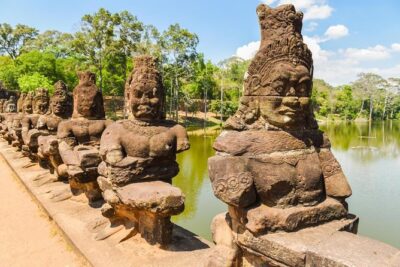
Angkor Wat Sunrise or Sunset Tour with Guide from Siem Reap
Read our review →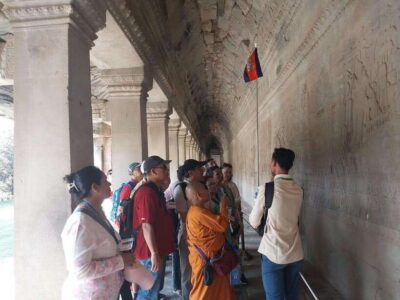
Angkor Wat: Small-Group Sunrise or Sunset Tour
Read our review →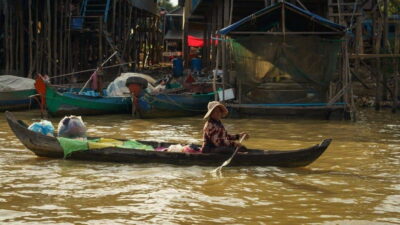
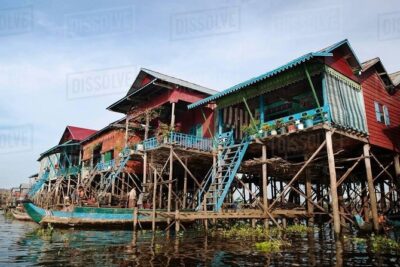
Sunset tour of Kampong Phluk stilts home village on the Tonle Sap
Read our review →
Kampong Phluk Floating Village Tour with Boat
Read our review →
Angkor Wat Sunrise tour with Small – Group and Guide tours
Read our review →
Angkor Wat Highlights and Sunrise Guided Tour from Siem Reap
Read our review →Browse the lists this tour appears in